






中国农业科学 ›› 2026, Vol. 59 ›› Issue (16): 3577-3590.doi: 10.3864/j.issn.0578-1752.2026.16.008
袁伟( ), 张图, 董广恩, 石金卓, 李海笑, 曹志艳(), 刘宁(), 董金皋
收稿日期:2026-03-16
接受日期:2026-04-16
出版日期:2026-08-16
发布日期:2026-08-17
通信作者:
联系方式:
袁伟,E-mail:19503278706@163.com。
基金资助:
YUAN Wei(), ZHANG Tu, DONG GuangEn, SHI JinZhuo, LI HaiXiao, CAO ZhiYan(), LIU Ning(), DONG JinGao
Received:2026-03-16
Accepted:2026-04-16
Published:2026-08-16
Online:2026-08-17
摘要:
【目的】 棕榈酰化修饰是一种动态可逆的蛋白质翻译后修饰,在信号转导、代谢稳态、蛋白定位与运输等生物过程中发挥着关键的调控作用,但在玉米大斑病菌(Setosphaeria turcica)中的功能及其对病菌致病力的影响尚不清楚。研究棕榈酰转移酶StPFA5在玉米大斑病菌生长发育及致病力调控中的作用,为阐明棕榈酰化修饰介导的玉米大斑病菌生长发育与致病过程的分子机制打下基础。【方法】 利用同源比对鉴定StPFA5并构建进化树,通过RT-qPCR测定StPFA5在病菌侵染过程中的表达水平。通过同源重组技术创制StPFA5的敲除突变体及回补菌株,针对菌株WT、∆StPFA5、C.∆StPFA5,测定生长速率及致病力,观察菌丝形态和菌丝萌发过程,并通过酸沉碱溶提取菌丝黑色素,RT-qPCR测定黑色素合成相关基因表达水平。此外,将各菌株接种在含刚果红和CFW的PDA平板上,测定StPFA5对病菌细胞壁稳定性的影响。通过蛋白组学和棕榈酰化修饰蛋白组学研究,结合数据库检索,鉴定WT和∆StPFA5中的差异棕榈酰化修饰位点及所属蛋白,进行功能分析。【结果】 StPFA5与异旋孢腔菌(Cochliobolus heterostrophus)PFA5同源性最高,达80.35%。与野生型相比,∆StPFA5的菌落生长速率降低、菌丝形态畸形、致病力显著下降,基因回补后恢复到野生型水平。同时,∆StPFA5的菌丝黑色素含量降低,黑色素合成相关基因表达显著下调,细胞壁胁迫敏感性降低。棕榈酰化修饰组学分析发现,敲除StPFA5导致448个棕榈酰化位点的修饰水平下调,下调位点所属蛋白富集在氨基酸合成代谢、碳代谢、糖酵解、细胞周期、染色体浓缩等通路。综合∆StPFA5表型结果发现,StPFA5可能通过调控这些途径相关蛋白的棕榈酰化水平影响玉米大斑病菌生长发育及致病力。【结论】 棕榈酰转移酶StPFA5通过调控蛋白质的棕榈酰化修饰水平,促进玉米大斑病菌的生长发育和黑色素合成,并对该病菌的致病力发挥正向调控作用。
袁伟, 张图, 董广恩, 石金卓, 李海笑, 曹志艳, 刘宁, 董金皋. 棕榈酰转移酶StPFA5参与调控玉米大斑病菌生长发育及致病力[J]. 中国农业科学, 2026, 59(16): 3577-3590.
YUAN Wei, ZHANG Tu, DONG GuangEn, SHI JinZhuo, LI HaiXiao, CAO ZhiYan, LIU Ning, DONG JinGao. Palmitoyl Transferase StPFA5 Regulates the Growth, Development and Pathogenicity of Setosphaeria turcica[J]. Scientia Agricultura Sinica, 2026, 59(16): 3577-3590.
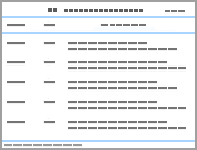
表1
引物信息"
| 引物名称Primer name | 引物序列Sequence of primers (5′-3′) | 用途Usage |
|---|---|---|
| β-tubulin-F β-tubulin-R | GTGCGCAAGGAGGCTGAGGG CATGAAGAAATGGAGACGGGGGAA | 检测β-tubulin表达量 Detect the expression level of β-tubulin |
| StPFA5-F StPFA5-R | GCATCATAGCCGAGTCGACA TCCTTCGACCGAGGTGTAGT | 检测StPFA5表达量 Detect the expression level of StPFA5 |
| StPFA5-Up-F StPFA5-Up-R | CTGCGCATTTGCTCTACT RATGCTCCTTCAATATCATCTTCTGGGGGTCATTTGGACGGATGT | 扩增StPFA5上游片段 Amplify the upstream fragment of StPFA5 |
| StPFA5-HPH-F StPFA5-HPH-R | ACATCCGTCCAAATGACCCCCAGAAGATGATATTGAAGGAGCAT ACGCCGAACACAGAGCAATAAAAGAAGGATTACCTCTAAACAAG | 扩增HPH片段 Amplify the fragment of HPH |
| StPFA5-Down-F StPFA5-Down-R | CTTGTTTAGAGGTAATCCTTCTTTTATTGCTCTGTGTTCGGCGT AACCGACAACCAACCGACC | 扩增StPFA5下游片段 Amplify the downstream fragment of StPFA5 |
| G418-F G418-R | TAAAATCGACAAGCCCGGCG CAGCCCGATTTCCATTCCTC | 回复转化子抗性验证 Resistance verification of complementation transformants |
| StMR1-F StMR1-R | ACAGCCCCCAGTTCATGAT TCTACTCGGGGTGTGTGTGTGC | 检测StMR1表达量 Detect the expression level of StMR1 |
| StPKS18-F StPKS18-R | GCGTGAGATCAATGCTGCTG TCGTTGTCGTACGTCTTGCA | 检测StPKS18表达量 Detect the expression level of StPKS18 |
| StMVP1-F StMVP1-R | GGCCTTACCGAATCACCCA CGGGCTTGTGTGTGGGATTATTG | 检测StMVP1表达量 Detect the expression level of StMVP1 |
| StSCD3-F StSCD3-R | TGTCACAGAGAATGGCTCGGTC TCCATCGTCTCTCCTCTCCAA | 检测StSCD3表达量 Detect the expression level of StSCD3 |
| St3HNR-F St3HNR-R | AAGCTCATGGACGACGTTGT ATGGCCATGCACCTGGTAAA | 检测St3HNR表达量 Detect the expression level of St3HNR |
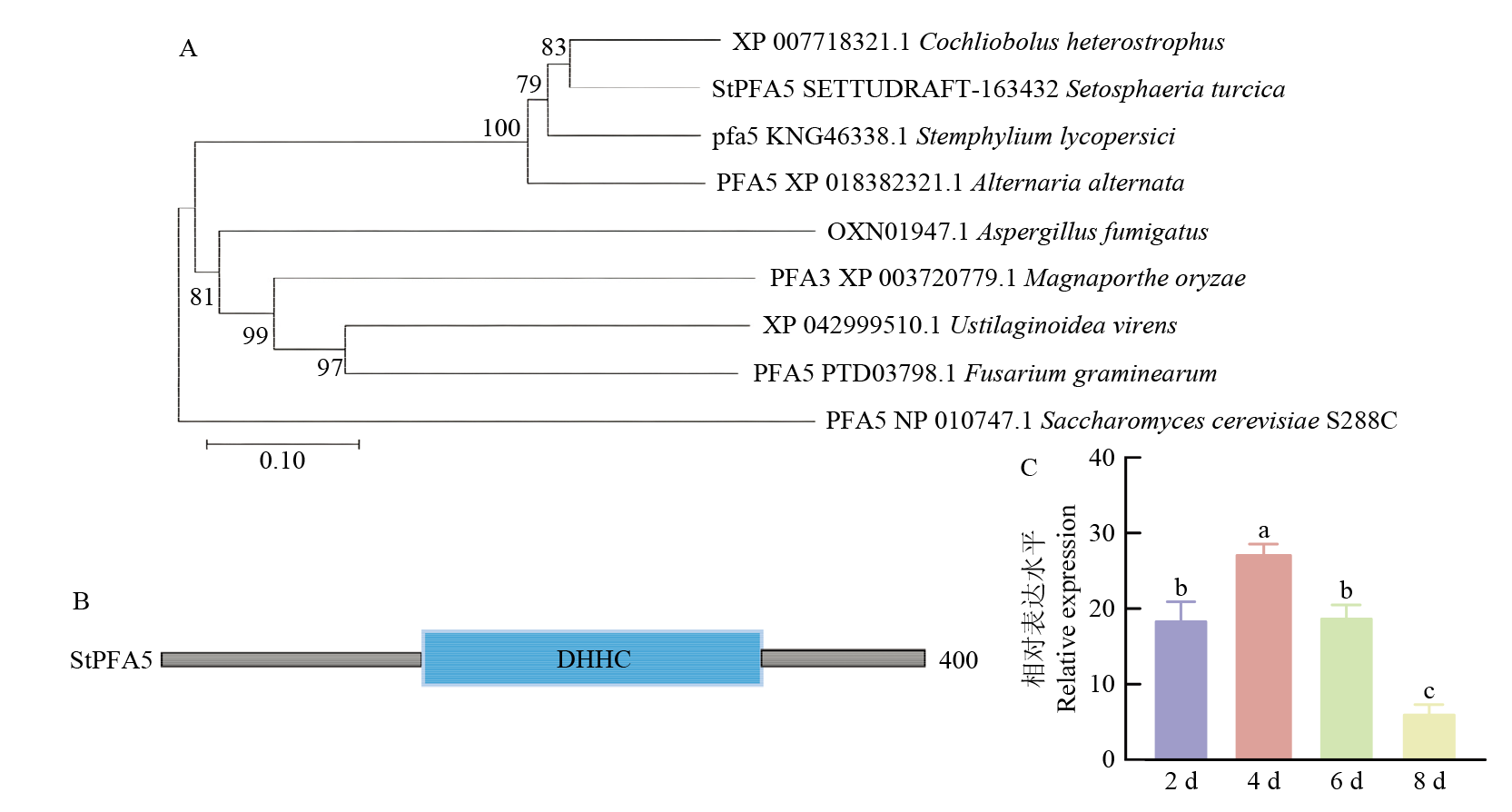
图1
StPFA5系统发育分析及其在侵染过程中的表达水平 A:PFA5同源蛋白系统发育树The phylogenetic tree of PFA5 homologous proteins;B:StPFA5结构示意图Schematic representation of the StPFA5 domain structure;C:玉米大斑病菌侵染过程中StPFA5的表达量,柱上不同字母表示均值差异显著(P<0.05)The gene relative expression of StPFA5 during the infection process of S. turcica, different letters on the bars indicate significant differences in the mean values (P<0.05)"

图2
StPFA5敲除及回补突变体创制 A:StPFA5同源重组策略Homologous recombination strategy for StPFA5;B:转化子StPFA5 PCR验证PCR verification of StPFA5 in transformants,3—5:转化子Transformant;C:转化子潮霉素抗性PCR验证PCR verification of hygromycin resistance in transformants,3—6:转化子Transformant;D:StPFA5回补策略Complementation strategy for StPFA5;E:C.∆StPFA5 PCR验证PCR verification of C.∆StPFA5,3—6:转化子Transformant;F:转化子G418抗性PCR验证PCR verification of G418 resistance in transformants,3、4:转化子Transformant;G:转化子StPFA5的RT-qPCR验证RT-qPCR verification of StPFA5 in transformants。M:DL 5000 marker;1:阳性对照Positive control;2:阴性对照Negative control"

图3
StPFA5对玉米大斑病菌生长发育(A)及致病力(B)的影响 * P<0.05;** P<0.01;*** P<0.001。下同"

图4
StPFA5对玉米大斑病菌菌丝萌发和附着胞形成的影响"

图5
StPFA5对玉米大斑病菌黑色素合成与细胞壁完整性的影响 A:StPFA5对玉米大斑病菌黑色素合成的影响Effect of StPFA5 on melanin synthesis of S. turcica;B:RT-qPCR测定StPFA5敲除对玉米大斑病菌黑色素合成相关基因表达的影响Determination of the effect of StPFA5 knockout on the expression of melanin biosynthesis-related genes of S. turcica by RT-qPCR;C:StPFA5对玉米大斑病菌细胞壁完整性的影响Effect of StPFA5 on cell wall integrity of S. turcica"
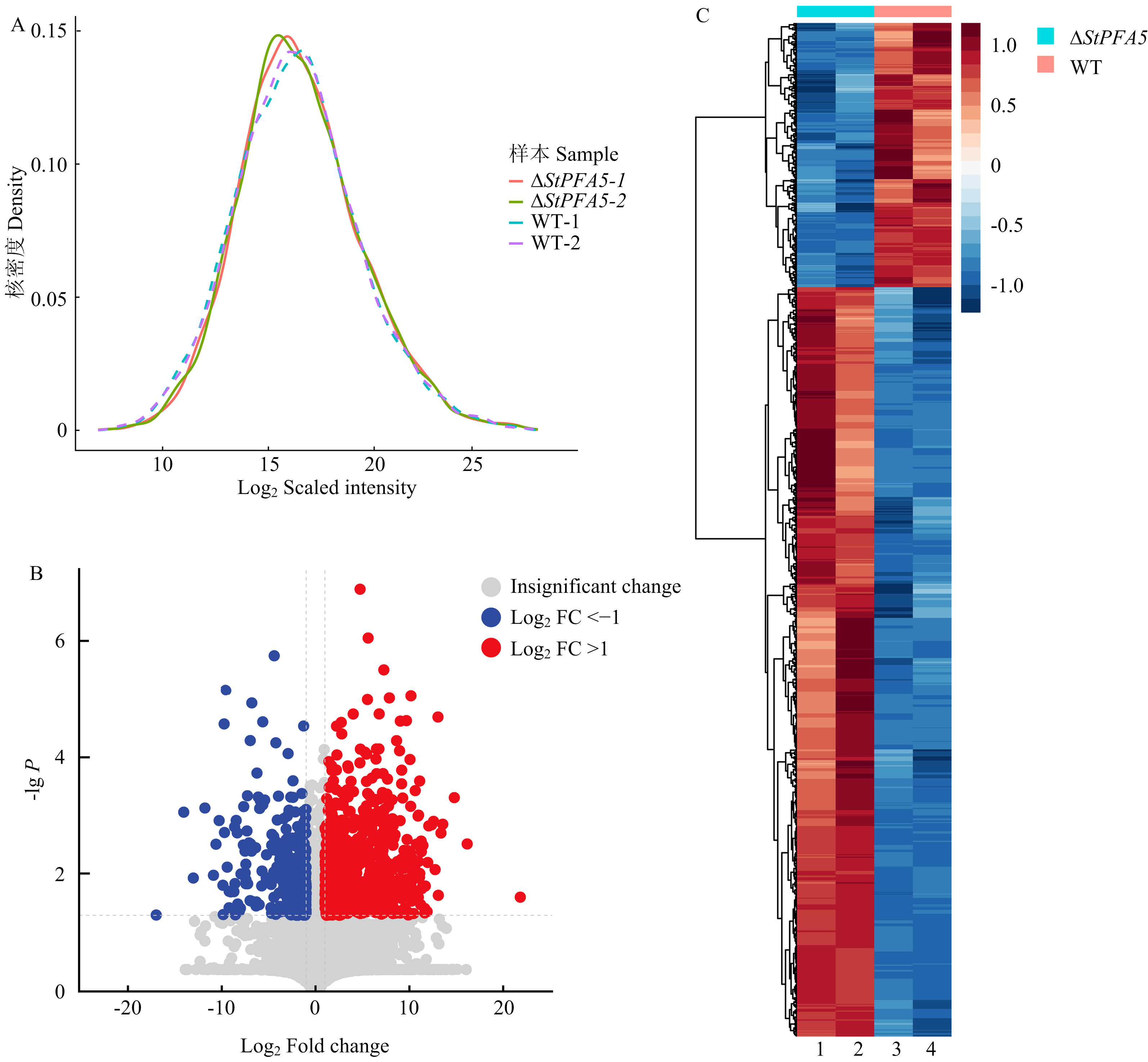
图6
StPFA5棕榈酰化修饰位点分析 A:样本表达分布的核密度图Nuclear density plot of sample expression distribution;B:∆StPFA5 vs WT组的火山图Volcano plot of the ∆StPFA5 vs WT group;C:∆StPFA5 vs WT组下调蛋白表达量热图Heatmap of down-regulated protein expression levels in the ∆StPFA5 vs WT group, 1: ΔStPFA5-1; 2: ΔStPFA5-2; 3: WT-1; 4: WT-2"
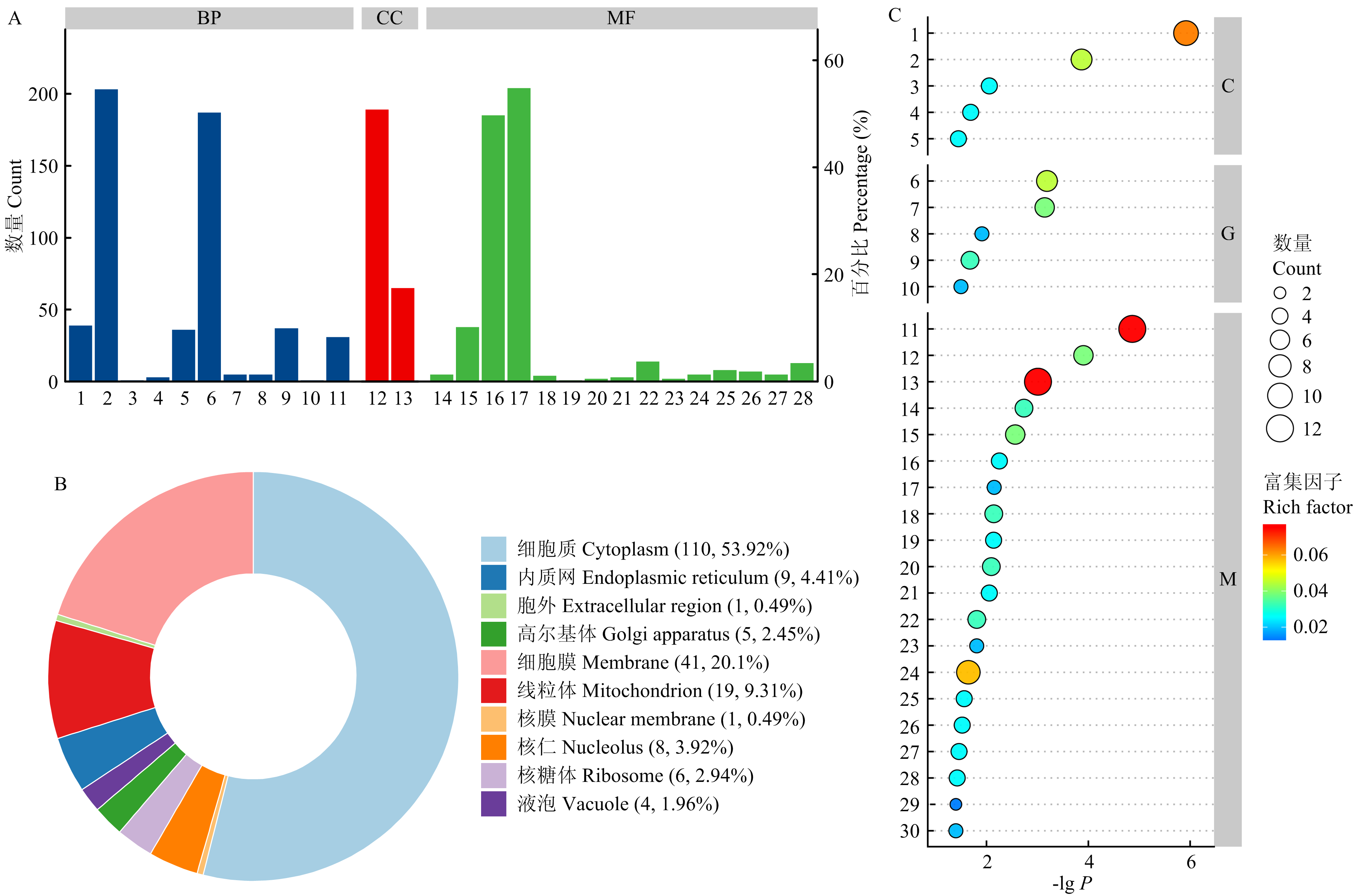
图7
StPFA5棕榈酰化修饰蛋白功能分析 A:∆StPFA5 vs WT组下调位点所属蛋白的GO功能蛋白统计GO functional annotation statistics of proteins containing down-regulated sites in the ∆StPFA5 vs WT group,1:生物调控Biological regulation;2:细胞过程Cellular process;3:脱毒作用Detoxification;4:稳态过程Homeostatic process;5:定位Localization;6:代谢过程Metabolic process;7:生物过程负调控Negative regulation of biological process;8:生物过程正调控Positive regulation of biological process;9:生物过程调控Regulation of biological process;10:生殖过程Reproductive process;11:刺激响应Response to stimulus;12:细胞解剖实体Cellular anatomical entity;13:含蛋白复合物Protein-containing complex;14:抗氧化活性Antioxidant activity;15:ATP依赖活性ATP-dependent activity;16:结合Binding;17:催化活性Catalytic activity;18:细胞骨架活性Cytoskeletal motor activity;19:电子转移活性Electron transfer activity;20:通用转录起始活性General transcription initiation activity;21:分子衔接蛋白活性Molecular adaptor activity;22:分子功能调节活性Molecular function regulator activity;23:分子转导活性Molecular transducer activity;24:蛋白折叠分子伴侣活性Protein folding chaperone activity;25:结构分子活性Structural molecule activity;26:转录调节活性Transcription regulator activity;27:翻译调节活性Translation regulator activity;28:转运蛋白活性Transporter activity;B:∆StPFA5 vs WT组下调蛋白的细胞组分亚细胞定位Subcellular localization of cellular component for down-regulated proteins in the ∆StPFA5 vs WT group;C:∆StPFA5 vs WT组下调位点所属蛋白的KEGG pathway富集气泡图,展示差异位点所属蛋白富集显著性top 30的pathway Bubble plot of KEGG pathway enrichment for proteins containing down-regulated sites in the ∆StPFA5 vs WT group, presenting top 30 significantly enriched pathways of proteins with differential sites,1:酵母细胞周期Cell cycle-yeast;2:酵母减数分裂Meiosis-yeast;3:过氧化物酶体Peroxisome;4:吞噬体Phagosome;5:马达蛋白Motor protein;6:泛素介导的蛋白水解Ubiquitin mediated proteolysis;7:核质转运Nucleocytoplasmic transport;8:错配修复Mismatch repair;9:内质网蛋白加工Protein processing in endoplasmic reticulum;10:mRNA监控通路mRNA surveillance pathway;11:氨基酸生物合成Biosynthesis of amino acids;12:缬氨酸、亮氨酸和异亮氨酸降解Valine, leucine and isoleucine degradation;13:辅因子生物合成Biosynthesis of cofactors;14:色氨酸代谢Tryptophan metabolism;15:半胱氨酸和甲硫氨酸代谢Cysteine and methionine metabolism;16:叶酸介导的一碳代谢One carbon pool by folate;17:氰基氨基酸代谢Cyanoamino acid metabolism;18:乙醛酸和二羧酸代谢Glyoxylate and dicarboxylate metabolism;19:丙氨酸、天冬氨酸和谷氨酸代谢Alanine, aspartate and glutamate metabolism;20:2-氧羧酸代谢2-Oxocarboxylic acid metabolism;21:苯丙氨酸代谢Phenylalanine metabolism;22:丙酮酸代谢Pyruvate metabolism;23:赖氨酸生物合成Lysine biosynthesis;24:碳代谢Carbon metabolism;25:丙酸代谢Propanoate metabolism;26:糖酵解/糖异生Glycolysis/Gluconeogenesis;27:氨基糖和核苷酸糖代谢Amino sugar and nucleotide sugar metabolism;28:果糖和甘露糖代谢Fructose and mannose metabolism;29:牛磺酸和亚牛磺酸代谢Taurine and hypotaurine metabolism;30:氮代谢Nitrogen metabolism"
| [1] |
邹金鹏, 岳浩峰, 李海笑, 刘峥, 刘宁, 曹志艳, 董金皋. 基于非靶向代谢组学分析StLAC2和StLAC6差异影响玉米大斑病菌的机制[J]. 中国农业科学, 2023, 56(16): 3110-3123. DOI: 10.3864/j.issn.0578-1752.2023.16.006.
|
|
|
|
| [2] |
张世梅. 稻瘟菌DHHC家族棕榈酰化修饰酶功能及其抑制剂处理效果分析[D]. 武汉: 华中农业大学, 2022.
|
|
|
|
| [3] |
doi: 10.3390/ijms24032141 |
| [4] |
doi: 10.1016/j.micres.2014.04.001 |
| [5] |
doi: 10.1111/mmi.v117.2 |
| [6] |
郝玉彬, 李海笑, 张赛, 刘宁, 刘英姿, 曹志艳, 董金皋. 玉米大斑病菌小柱孢酮脱水酶StSCD家族鉴定及其功能分析[J]. 中国农业科学, 2022, 55(16): 3134-3143. DOI: 10.3864/j.issn.0578-1752.2022.16.006.
|
|
|
|
| [7] |
doi: 10.1016/S2095-3119(21)63679-1 |
| [8] |
|
| [9] |
doi: 10.1042/BCJ20220251 pmid: 37610048 |
| [10] |
doi: 10.1016/j.plipres.2016.05.002 pmid: 27233110 |
| [11] |
李程, 黄宇兴, 赵雅楠, 鞠振宇, 胡乾. 蛋白质棕榈酰化对小鼠棕色脂肪组织产热功能的影响及其调控机制[J]. 中国病理生理杂志, 2026, 42(6): 1081-1091.
|
|
|
|
| [12] |
doi: 10.1038/s41580-024-00700-8 pmid: 38355760 |
| [13] |
pmid: 12360323 |
| [14] |
doi: 10.1371/journal.pcbi.1004405 |
| [15] |
doi: 10.1038/s41477-022-01164-4 |
| [16] |
doi: 10.1111/nph.12077 pmid: 23252521 |
| [17] |
doi: 10.1038/sj.emboj.7600724 |
| [18] |
pmid: 16751107 |
| [19] |
doi: 10.1128/spectrum.03861-22 |
| [20] |
阳晶晶, 马艳, 王悦, 孙阳, 李盼, 郭峰. ACE2蛋白Cys141、Cys344和Cys498位点的棕榈酰化修饰促进其在细胞外囊泡的定位[J]. 基础医学与临床, 2025, 45(9): 1151-1157.
|
|
|
|
| [21] |
doi: 10.1002/mol2.v17.1 |
| [22] |
doi: 10.1098/rsob.210026 |
| [23] |
doi: 10.1080/10409238.2017.1409191 pmid: 29239216 |
| [24] |
doi: 10.1038/s41467-024-49105-3 pmid: 38821916 |
| [25] |
暨凯忠, 孔一豪, 支忆清, 金莹莹, 陈建权. 锌指DHHC型棕榈酰转移酶5在组织稳态和疾病中的作用及机制[J]. 中国组织工程研究, 2026, 30(17): 4430-4445.
|
|
|
|
| [26] |
doi: 10.1091/mbc.E08-03-0252 pmid: 18701706 |
| [27] |
doi: 10.1093/genetics/163.1.47 pmid: 12586695 |
| [28] |
doi: 10.1128/mbio.02704-24 |
| [29] |
doi: 10.1093/molbev/msab120 pmid: 33892491 |
| [30] |
doi: 10.1371/journal.pone.0092610 |
| [31] |
doi: 10.1038/s41586-020-2799-2 |
| [32] |
吴诗亲, 杨简, 黄萃园, 刘丽, 李文强, 王伟, 张静. 棕榈酰化促进血管衰老相关心血管疾病的研究进展[J]. 实用医学杂志, 2026, 42(9): 1586-1591.
|
|
|
|
| [33] |
doi: 10.3390/ijms25021224 |
| [34] |
张博文, 赵丽雯, 徐璐, 李盼, 曾凡力, 孟亚南, 董金皋. 玉米大斑病菌细胞周期蛋白依赖性激酶结构亚基StCks1鉴定及其基因功能分析[J]. 中国农业科学, 2024, 57(5): 900-908. DOI: 10.3864/j.issn.0578-1752.2024.05.006.
|
|
|
|
| [35] |
doi: 10.1105/tpc.15.00179 pmid: 26320225 |
| [36] |
doi: 10.1128/CMR.13.4.708 pmid: 11023965 |
| [37] |
doi: 10.1007/s00253-020-10532-z pmid: 32206837 |
| [38] |
|
| [39] |
曹志艳, 杨胜勇, 董金皋. 植物病原真菌黑色素与致病性关系的研究进展[J]. 微生物学通报, 2006, 33(1): 154-158.
|
|
|
|
| [40] |
doi: 10.3390/plants14142121 |
| [41] |
doi: 10.3389/fmicb.2022.843838 |
| [42] |
doi: 10.1128/JB.180.12.3031-3038.1998 pmid: 9620950 |
| [43] |
|
| [44] |
doi: 10.1016/j.funbio.2018.10.005 |
| [1] | 董钰, 吴千, 冯萱, 郑银英, 崔百明. 解淀粉欧文氏菌新质粒pEA60通过调节毒力因子的合成增强菌株的致病力[J]. 中国农业科学, 2026, 59(5): 996-1007. |
| [2] | 刘羽凡, 陈峥, 陈德局, 刘欣, 肖荣凤, 王阶平, 王璕, 刘波, 何进, 陈梅春. 芽孢杆菌脂肽靶向减弱青枯雷尔氏菌致病力的生防作用[J]. 中国农业科学, 2026, 59(13): 2853-2866. |
| [3] | 范晓涵, 张维军, 袁锦锋, 赵栋霖, 张成省, 张之矾, 徐康文. 青枯菌GMI 1000菌株c-di-GMP合成酶Rsp1208的功能[J]. 中国农业科学, 2026, 59(11): 2374-2386. |
| [4] | 从琪琪, 张静怡, 孟祥龙, 戴蓬博, 李波, 胡同乐, 王树桐, 曹克强, 王亚南. 我国苹果轮纹病弱毒菌株中病毒的鉴定及其携带情况的检测[J]. 中国农业科学, 2025, 58(3): 478-492. |
| [5] | 童朝阳, 刘文华, 张国欣, 董春燕, 张燕霞, 徐晓伟, 何东, 刘何春, 李杨, 王凤涛, 冯晶, 姚小波, 刘梅金, 蔺瑞明. 青稞穗腐病发生与穗螨群体迁移的关系[J]. 中国农业科学, 2025, 58(3): 493-506. |
| [6] | 张淑红, 高凤菊, 武秋颖, 纪景欣, 张运峰, 许可, 谷守芹, 范永山. 玉米大斑病菌热激蛋白HSP 9/12基因的克隆与表达分析[J]. 中国农业科学, 2025, 58(18): 3648-3663. |
| [7] | 杨文娟, 高嘉诚, 王艳婷, 李妍, 郭铭, 汪军成, 孟亚雄, 王化俊, 司二静. 条纹病菌效应蛋白Pg00778调控对大麦致病力的作用[J]. 中国农业科学, 2025, 58(15): 3020-3035. |
| [8] | 王程泽, 张燕, 付伟, 贾京哲, 董金皋, 申珅, 郝志敏. 玉米ACO基因家族生物信息学及表达模式分析[J]. 中国农业科学, 2024, 57(7): 1308-1318. |
| [9] | 董在芳, 丁腾腾, 单艺轩, 李洪连, 陈琳琳, 邢小萍. 自噬相关基因FpAtg3参与假禾谷镰孢的生长和致病[J]. 中国农业科学, 2024, 57(6): 1080-1090. |
| [10] | 张博文, 赵丽雯, 徐璐, 李盼, 曾凡力, 孟亚南, 董金皋. 玉米大斑病菌细胞周期蛋白依赖性激酶结构亚基StCks1鉴定及其基因功能分析[J]. 中国农业科学, 2024, 57(5): 900-908. |
| [11] | 张淑红, 张运峰, 高凤菊, 武秋颖, 许可, 李亚子, 李艳梅, 谷守芹, 范永山, 巩校东. 玉米大斑病菌小分子热激蛋白基因克隆与表达分析[J]. 中国农业科学, 2024, 57(17): 3384-3397. |
| [12] | 张健, 赵彬森, 冯浩, 黄丽丽. Vm-milRN7调控苹果树腐烂病菌致病的功能及机理[J]. 中国农业科学, 2024, 57(10): 1930-1942. |
| [13] | 宫安东, 雷银玉, 吴楠楠, 刘景榕, 宋梦鸽, 张艺美, 杨光, 杨鹏. 氧酰基载体蛋白还原酶基因FgOAR1对禾谷镰孢生长、发育和致病的影响[J]. 中国农业科学, 2023, 56(24): 4854-4865. |
| [14] | 邹金鹏, 岳浩峰, 李海笑, 刘峥, 刘宁, 曹志艳, 董金皋. 基于非靶向代谢组学分析StLAC2和StLAC6差异影响玉米大斑病菌的机制[J]. 中国农业科学, 2023, 56(16): 3110-3223. |
| [15] | 黄家权,李莉,吴丰年,郑正,邓晓玲. 携带不同原噬菌体的黄龙病菌在柑橘木虱体内的增殖及致病力[J]. 中国农业科学, 2022, 55(4): 719-728. |
|
||
