






中国农业科学 ›› 2026, Vol. 59 ›› Issue (19): 4250-4262.doi: 10.3864/j.issn.0578-1752.2026.19.005
王璐莹( ), 杨杰, 卢海涛, 王欣, 赵英龙, 杨杰, 王贵彦()
收稿日期:2026-03-12
接受日期:2026-06-09
出版日期:2026-10-01
发布日期:2026-10-10
通信作者:
联系方式:
王璐莹,E-mail:1343971834@qq.com。
基金资助:
WANG LuYing(), YANG Jie, LU HaiTao, WANG Xin, ZHAO YingLong, YANG Jie, WANG GuiYan()
Received:2026-03-12
Accepted:2026-06-09
Published:2026-10-01
Online:2026-10-10
摘要:
【目的】探究不同轮作模式对土壤微生物群落特征和共现网络的影响,为改善土壤微环境,提升土壤生态系统稳定性与抗逆能力提供了理论依据。【方法】以华北平原冬小麦-夏玉米复种连作(WMWM)为对照,设置春甘薯与冬小麦-夏玉米轮作(SPWM)、春花生与冬小麦-夏玉米轮作(PWM)和春谷子与冬小麦-夏玉米轮作(MWM)3种轮作模式。基于6年田间定位试验,利用扩增子测序和随机森林等方法,系统分析不同轮作系统对土壤微生物多样性、群落组成、共现网络及其与土壤性质和产量的影响。【结果】与冬小麦-夏玉米复种连作(WMWM)相比,轮作显著提升了土壤微生物α多样性。其中,春甘薯与冬小麦-夏玉米轮作(SPWM)的细菌ACE指数较对照显著增加22.8%,春谷子与冬小麦-夏玉米轮作(MWM)的真菌ACE指数较对照显著增加52.2%,春花生与冬小麦-夏玉米轮作(PWM)和春谷子与冬小麦-夏玉米轮作(MWM)的细菌和真菌的Simpson指数和Shannon指数较冬小麦-夏玉米复种连作(WMWM)均显著增加。主成分分析(PCA)分析表明,多样化作物轮作改变了土壤微生物群落结构,形成了相对独特的微生物群落。轮作提高了变形菌门(Proteobacteria)、酸杆菌门(Acidobacteria)、放线菌门(Actinobacteria)等优势细菌及子囊菌门(Ascomycota)、球囊菌门(Glomeromycota)等优势真菌的相对丰度。春花生与冬小麦-夏玉米轮作(PWM)和春谷子与冬小麦-夏玉米轮作(MWM)的变形菌门(Proteobacteria)相对丰度分别较对照提高12.8%和14.0%;春甘薯、春花生和春谷子与冬小麦-夏玉米轮作的子囊菌门(Ascomycota)和球囊菌门(Glomeromycota)相对丰度比对照显著提高34.9%、42.7%和46.2%;同时,轮作增加了微生物共现网络的节点数,提高了平均聚类系数和模块化程度,正向互作比例提升。相关分析结果表明,细菌多样性、群落结构和共现网络与土壤全氮、铵态氮、硝态氮、有机碳显著相关,而真菌多样性、群落结构和共现网络与土壤全氮、速效钾、速效磷、铵态氮、微生物生物量氮显著相关。随机森林预测模型表明,铵态氮、硝态氮、真菌群落丰度、真菌多样性和真菌共现网络是影响产量的关键因素。【结论】多样化作物与冬小麦-夏玉米轮作通过优化土壤微生物群落结构,改善微生物共现网络结构,有效增强土壤生态系统的稳定性与复杂性,可为提升粮田土壤生态系统稳定性与抗逆能力提供理论依据。
王璐莹, 杨杰, 卢海涛, 王欣, 赵英龙, 杨杰, 王贵彦. 多样化轮作对土壤微生物群落特征和共现网络的影响[J]. 中国农业科学, 2026, 59(19): 4250-4262.
WANG LuYing, YANG Jie, LU HaiTao, WANG Xin, ZHAO YingLong, YANG Jie, WANG GuiYan. Effects of Diversified Crop Rotation on Soil Microbial Community Characteristics and Co-Occurrence Network[J]. Scientia Agricultura Sinica, 2026, 59(19): 4250-4262.

表1
不同处理土壤微生物群落α多样性指数"
| 处理 Treatment | 丰富度指数Richness index | 多样性指数Diversity index | |||
|---|---|---|---|---|---|
| ACE | Chao1 | Simpson | Shannon | ||
| 细菌 Bacteria | WMWM | 5221.6±46.12c | 5199.8±158.68b | 0.997±0.0002b | 10.2±0.13b |
| SPWM | 6411.7±70.69a | 6010.2±167.58a | 0.998±0.00006a | 10.5±0.01a | |
| PWM | 5970.6±57.62b | 5577.0±327.35ab | 0.998±0.00009a | 10.5±0.01a | |
| MWM | 6036.4±63.34b | 6018.5±45.08a | 0.998±0.00003a | 10.5±0.03a | |
| 真菌 Fungi | WMWM | 176.3±2.53d | 173.1±3.62d | 0.982±0.0008b | 6.4±0.05c |
| SPWM | 330.9±4.65b | 324.3±3.69b | 0.983±0.003ab | 7.0±0.04b | |
| PWM | 309.0±3.80c | 279.5±6.58c | 0.988±0.0005a | 7.1±0.05b | |
| MWM | 369.1±9.44a | 365.9±3.96a | 0.988±0.001a | 7.3±0.04a | |
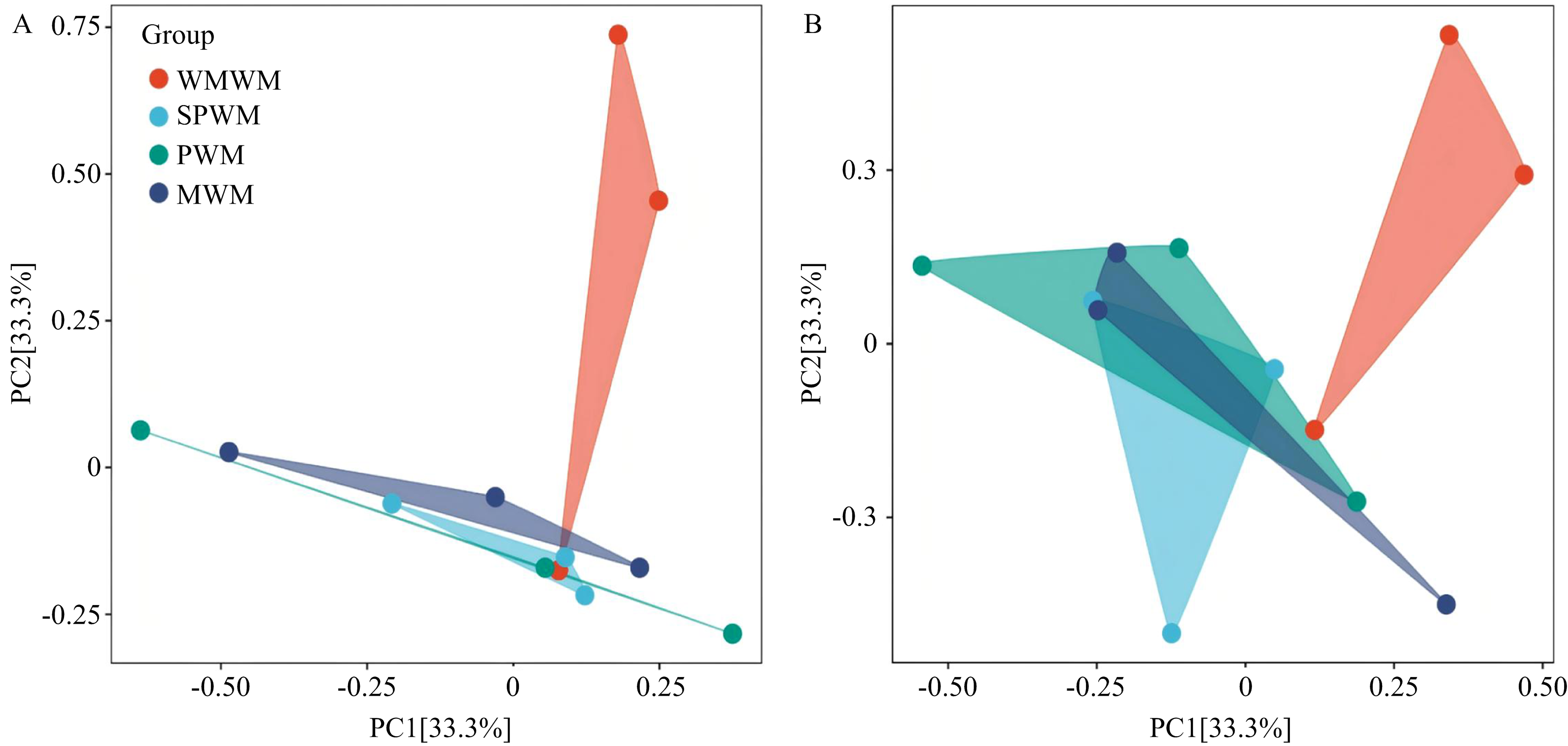
图1
不同处理土壤微生物细菌(A)和真菌(B)群落PCA分析"
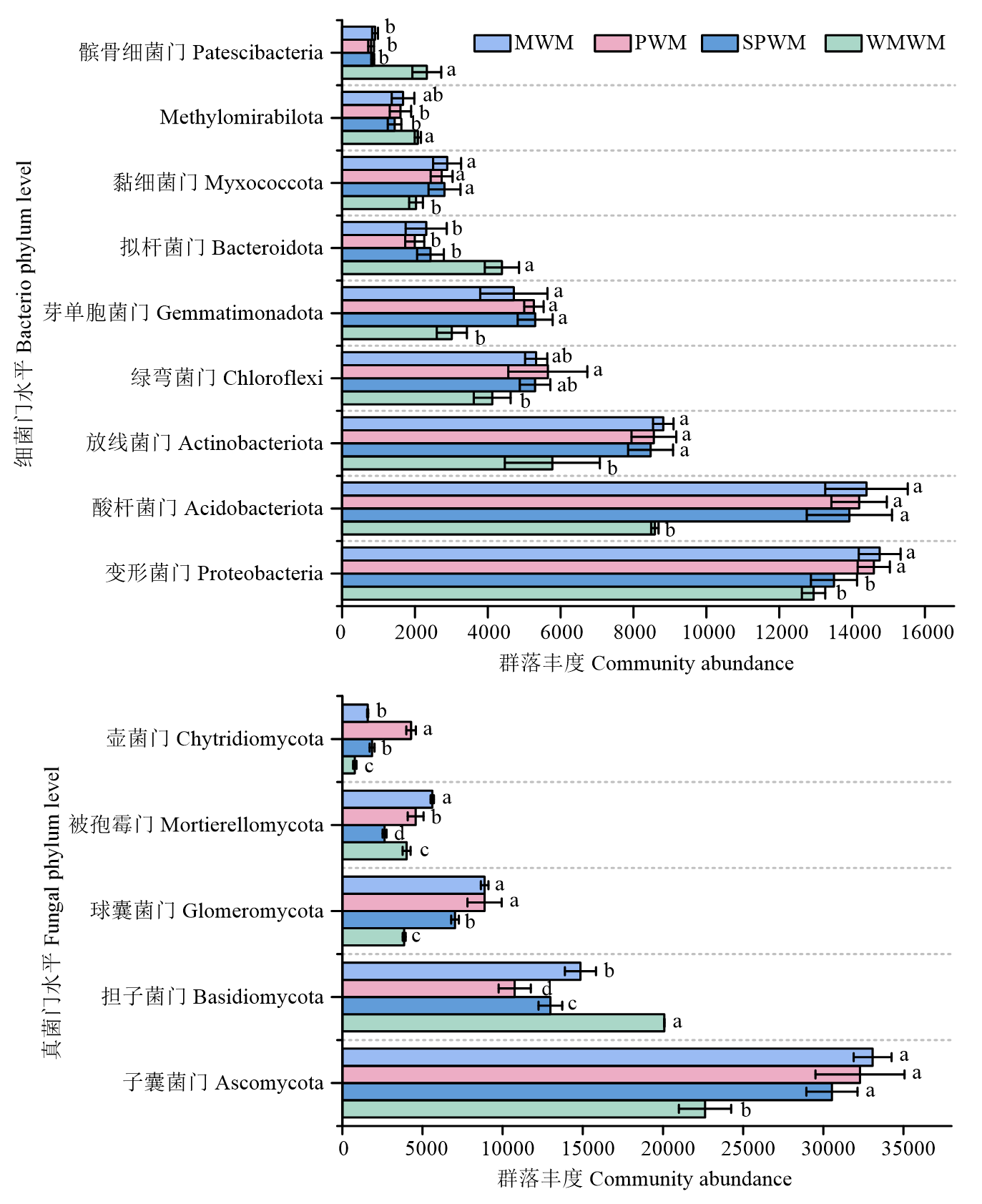
图2
土壤微生物门水平细菌(A)和真菌(B)群落相对丰度"
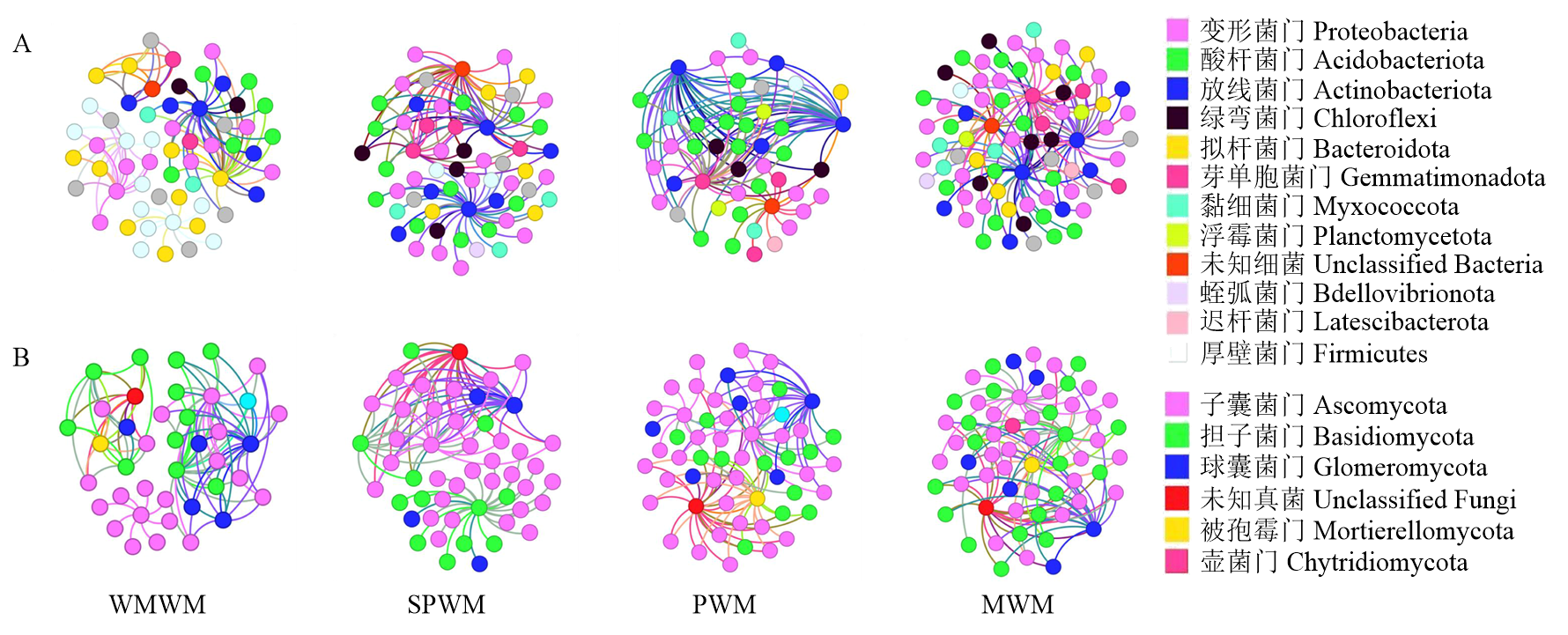
图3
不同轮作模式土壤细菌(A)和真菌(B)群落共现网络分析 A:细菌共现网络;B:真菌共现网络"
表2
作物轮作对微生物网络拓扑特性的影响"
| 处理 Treatment | 细菌Bacteria | 真菌Fungi | ||||||
|---|---|---|---|---|---|---|---|---|
| WMWM | SPWM | PWM | MWM | WMWM | SPWM | PWM | MWM | |
| 节点Node | 48 | 62 | 69 | 80 | 41 | 51 | 59 | 62 |
| 模组化Modularization | 0.27 | 0.45 | 0.66 | 0.62 | 0.52 | 0.40 | 0.59 | 0.63 |
| 平均聚类系数Average clustering coefficient | 0.24 | 0.20 | 0.35 | 0.15 | 0.33 | 0.20 | 0.36 | 0.31 |
| 平均度数Average degree | 1.50 | 1.61 | 2.08 | 1.25 | 2.50 | 1.96 | 1.72 | 1.61 |
| 密度Density | 0.02 | 0.03 | 0.04 | 0.16 | 0.06 | 0.04 | 0.03 | 0.03 |
| 平均加权度Average weighted degree | 8.70 | 9.65 | 12.50 | 7.50 | 15.00 | 11.77 | 10.35 | 9.68 |
| 正向链接Positive link (%) | 66 | 50 | 45 | 46 | 49 | 47 | 50 | 54 |
| 负向链接Negative link (%) | 34 | 50 | 55 | 54 | 51 | 53 | 50 | 46 |
表3
不同轮作模式土壤理化性质、夏玉米生物量和产量"
| 处理 Treatment | 全氮 Total nitrogen (g·kg-1) | 铵态氮 Ammonium nitrogen (mg·kg-1) | 硝态氮 Nitrate nitrogen (mg·kg-1) | pH | 有机碳 Organic carbon (g·kg-1) | 速效磷 Available phosphorus (mg·kg-1) | 速效钾 Available potassium (mg·kg-1) | 微生物 生物量碳 Microbial biomass carbon (mg·kg-1) | 微生物 生物量氮 Microbial biomass nitrogen (mg·kg-1) | 生物量 Biomass (kg·hm-2) | 产量 Yield (kg·hm-2) |
|---|---|---|---|---|---|---|---|---|---|---|---|
| WMWM | 1.25± 0.01c | 2.23± 0.06c | 28.79± 0.45c | 7.55± 0.03b | 11.9± 0.36c | 39.62± 0.05c | 122.74± 0.74c | 130.64± 1.84d | 31.79± 0.62c | 18666.86± 151.74d | 8773.43± 71.32d |
| SPWM | 1.38± 0.04b | 3.77± 0.35b | 34.82± 0.20b | 7.43± 0.01c | 14.76± 0.19a | 43.17± 0.50b | 132.69± 1.07b | 166.34± 1.52b | 34.82± 0.20b | 20936.11± 69.96b | 9839.97± 32.88b |
| PWM | 1.49± 0.03ab | 3.83± 0.15b | 35.64± 0.27b | 7.07± 0.01d | 12.87± 0.53bc | 45.74± 0.22a | 132.63± 1.00b | 149.06± 1.39c | 38.23± 0.40a | 21400.86± 138.93a | 10058.41± 65.30a |
| MWM | 1.41± 0.02a | 4.85± 0.09a | 38.14± 0.39a | 7.69± 0.03a | 13.46± 0.29b | 43.47± 0.25b | 146.39± 1.19a | 181.84± 2.74a | 34.3± 0.34b | 19657.68± 102.56c | 9239.11± 48.21c |
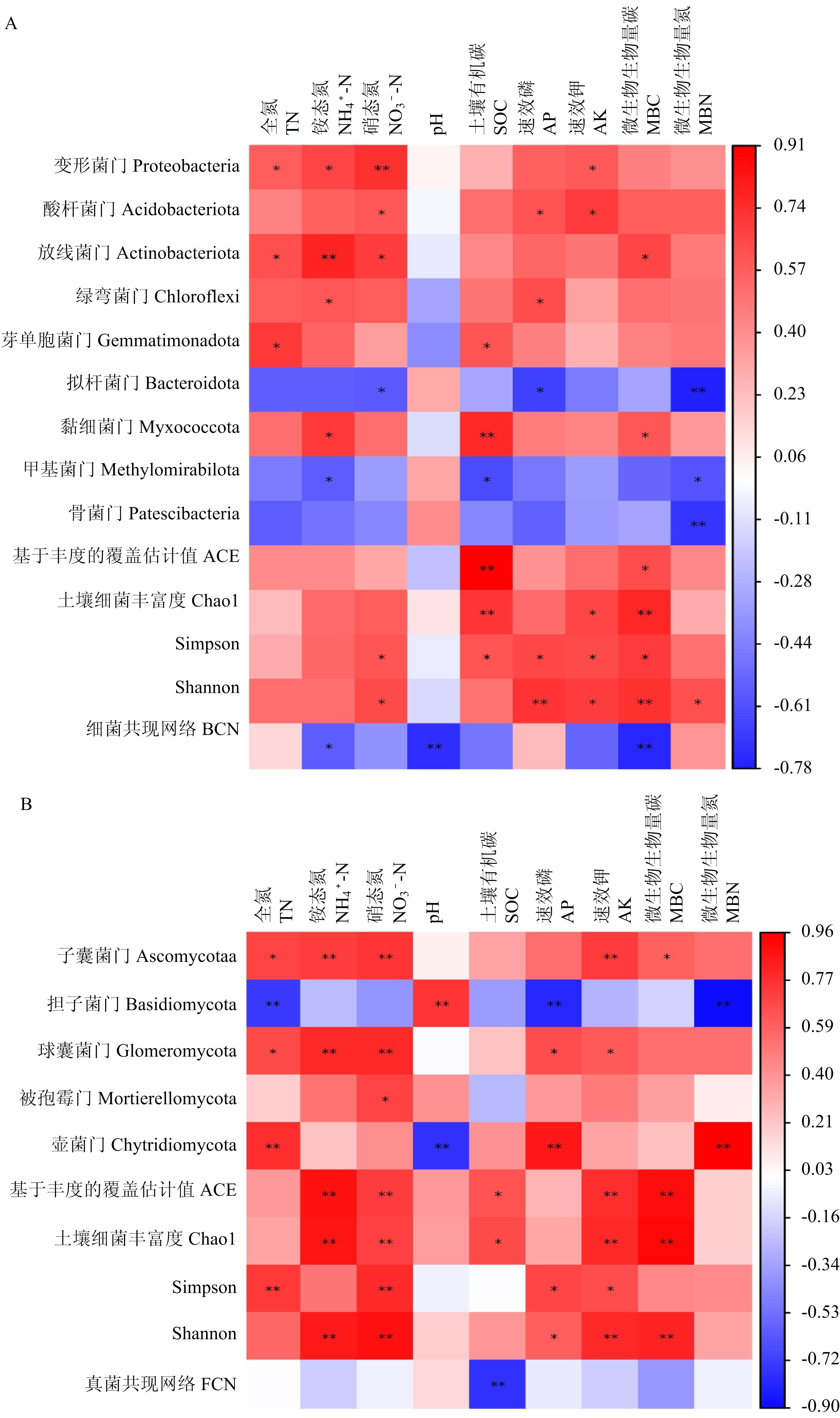
图4
土壤性质与细菌(A)和真菌(B)微生物群落和多样性的相关性分析 *表示P<0.05;**表示P<0.01。BCN:细菌共现网络;FCN:真菌共现网络"
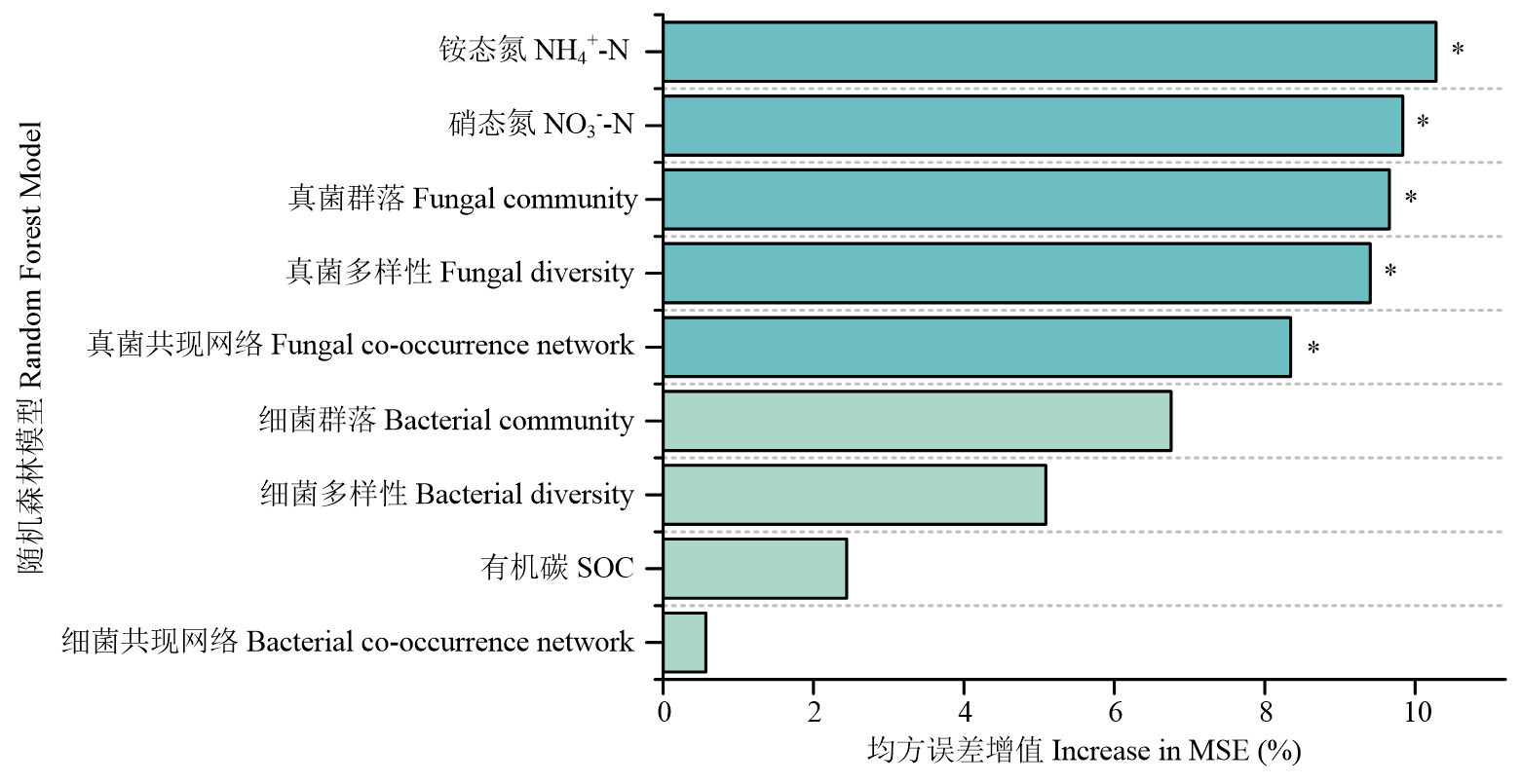
图5
随机森林模型对夏玉米产量的特征重要性排序"
| [1] |
doi: 10.1016/j.still.2018.12.011 |
| [2] |
doi: 10.1016/j.compag.2021.106222 |
| [3] |
李金钰, 谢奎忠, 胡新元, 董博, 陈松虎. 轮作结合秸秆覆盖对连作马铃薯根际土壤真菌群落结构的影响[J]. 中国生态农业学报(中英文), 2026, 34(1): 92-102.
|
|
|
|
| [4] |
doi: 10.1016/j.soilbio.2025.109988 |
| [5] |
李凯娟, 赵艺浓, 侯博洋, 罗培龙, 安晶, 张玉玲, 邹洪涛. 不同轮作制度对大兴安岭南麓农田土壤活性碳氮组分含量及作物产量的影响[J]. 土壤通报, 2025, 56(6): 1645-1654.
|
|
|
|
| [6] |
doi: 10.1016/j.catena.2018.09.043 |
| [7] |
doi: 10.1016/j.geoderma.2016.11.005 |
| [8] |
doi: 10.1016/j.fcr.2025.109816 |
| [9] |
王丽娜, 王迪, 任翠梅, 顾鑫, 姜泽宇, 冯鹏, 齐国超. 玉米—大豆轮作对苏打盐碱作物根际土壤微生物群落结构和功能的影响[J]. 江苏农业科学, 2025, 53(14): 264-270.
|
|
|
|
| [10] |
doi: 10.1016/j.scib.2021.03.008 pmid: 36654173 |
| [11] |
doi: 10.1016/j.ejsobi.2024.103680 |
| [12] |
doi: 10.1016/j.agee.2025.109949 |
| [13] |
周旭东, 韩天华, 申云鑫, 施竹凤, 贺彪, 杨明英, 裴卫华, 何永宏, 杨佩文. 4种轮作模式下长期连作烟田土壤微生态的响应特征[J]. 中国农业科技导报, 2024, 26(3): 174-187.
|
|
|
|
| [14] |
doi: 10.1016/j.still.2022.105360 |
| [15] |
陶邑恒. 覆盖作物功能性状差异及其对覆盖作物和玉米根际微食物网的影响[D]. 南京: 南京农业大学, 2023.
|
|
|
|
| [16] |
doi: 10.1016/j.xplc.2025.101502 |
| [17] |
doi: 10.1016/j.jenvman.2025.126582 |
| [18] |
doi: 10.1016/j.fcr.2022.108541 |
| [19] |
毕研飞, 吴宗伦, 李建礼. 轮作产量对连作障碍农田土壤微生物群落及作物产量的调控[J]. 新农民, 2025(31): 102-104.
|
|
|
|
| [20] |
doi: 10.1016/j.fcr.2025.109834 |
| [21] |
李伟晶, 王洪媛, 徐洋, 李浩, 翟丽梅, 刘宏斌. 稻蟹共生系统稻田水-土界面微生物群落结构特征[J]. 中国农业科学, 2024, 57(18): 3551-3567. DOI:10.3864/j.issn.0578-1752.2024.18.004.
|
|
|
|
| [22] |
郝晓芬, 王根全, 郭二虎, 杨慧卿, 张艾英, 程乔林, 王晓宇, 秦玉忠. 连作、轮作对谷子根际细菌群落结构的影响[J]. 农业环境科学学报, 2022, 41(3): 585-596.
|
|
|
|
| [23] |
鲍士旦. 土壤农化分析[M]. 3版. 北京: 中国农业出版社, 2000.
|
|
|
|
| [24] |
马玉洁, 李旭, 翟英芳, 李敬宇, 付鑫, 彭正萍. 秸秆还田方式和施氮量对土壤有机碳组分及酶活性的影响[J]. 中国农业科学, 2025, 58(12): 2397-2410. DOI:10.3864/j.issn.0578-1752.2025.12.010.
|
|
|
|
| [25] |
doi: 10.1016/j.still.2017.08.008 |
| [26] |
doi: 10.1016/j.scitotenv.2023.165916 |
| [27] |
胡启国, 刘亚军, 王文静, 王祁, 王红刚, 储凤丽. 甘薯轮作与间作对根际土壤微生物群落的影响[J]. 作物杂志, 2021(5): 153-159.
|
|
|
|
| [28] |
牛倩云, 韩彦莎, 徐丽霞, 张艾英, 仪慧兰, 郭二虎. 作物轮作对谷田土壤理化性质及谷子根际土壤细菌群落的影响[J]. 农业环境科学学报, 2018, 37(12): 2802-2809.
|
|
|
|
| [29] |
doi: 10.1016/j.scitotenv.2021.145506 |
| [30] |
周端顼, 柳海燕, 王佩樱. 种植模式对多花黄精土壤理化性质和微生物群落结构及功能类群的影响[J/OL]. 微生物学报, 1-16. https://doi.org/10.13343/j.cnki.wsxb.20260183.
|
|
|
|
| [31] |
doi: 10.1016/j.scitotenv.2018.09.159 |
| [32] |
黄海霞, 黄昆鹏, 杨再军, 曹可心, 潘恒德, 韦学平, 陆福勇, 李俊霖, 罗勤站. 烟-薯套作对根际微生物多样性的影响[J]. 浙江农业科学, 2025, 66 (12): 2901-2909.
doi: 10.16178/j.issn.0528-9017.20240100 |
|
|
|
| [33] |
doi: 10.1016/j.resmic.2023.104079 |
| [34] |
王清慧, 李乃荟, 张一平, 狄成乾, 吴凤芝. 小麦和豌豆填闲对白菜幼苗生长和土壤微生物群落结构的影响[J]. 中国农业科学, 2024, 57(3): 555-569. DOI:10.3864/j.issn.0578-1752.2024.03.010.
|
|
|
|
| [35] |
doi: 10.1016/j.apsoil.2025.106352 |
| [36] |
陈丹梅, 段玉琪, 杨宇虹, 晋艳, 袁玲. 轮作模式对植烟土壤酶活性及真菌群落的影响[J]. 生态学报, 2016, 36(8): 2373-2381.
|
|
|
|
| [37] |
张斯佳, 杨杰, 赵帅, 李莉威, 王贵彦. 华北平原多样化作物与小麦-玉米轮作对土壤质量的影响[J]. 中国农业科学, 2025, 58(2): 238-251. DOI:10.3864/j.issn.0578-1752.2025.02.003.
|
|
|
|
| [38] |
杨杰, 王培烨, 张斯佳, 张建恒, 卢海涛, 由福英, 赵霡, 王贵彦. 不同轮作模式对土壤团聚体稳定性及其结合态碳组分的影响[J/OL]. 环境科学, 1-18. https://doi.org/10.13227/j.hjkx.202508059.
|
|
|
|
| [39] |
doi: 10.1016/j.jenvman.2024.122604 |
| [40] |
王峰, 常云妮, 吴志丹, 孙君, 江福英, 陈玉真, 余文权. 长期施氮对茶园土壤真菌多样性、功能类群及群落构建的影响[J]. 中国农业科学, 2026, 59(2): 368-385. DOI:10.3864/j.issn.0578-1752.2026.02.011.
|
|
|
| [1] | 许杨浩峻, 陈丽明, 杨世奇, 唐奕凡, 谭雪明, 曾勇军, 潘晓华, 曾研华. 长期秸秆还田对双季稻田不同土层有机碳、养分和团聚体的影响[J]. 中国农业科学, 2026, 59(7): 1492-1506. |
| [2] | 王博, 陈浩, 权倍平, 陈明川, 景馨蕊, 许佳豪, 黄朝奕, 李占斌. 陕北黄土区草被覆盖对坡面径流过程的影响[J]. 中国农业科学, 2026, 59(18): 4105-4120. |
| [3] | 张海睿, 贾昂元, 高奇奇, 韩哲群, 南珊珊, 段碧华, 武雪萍. 生物炭配施黄腐酸对滨海盐碱地土壤理化性质、酶活性和多功能性的影响[J]. 中国农业科学, 2025, 58(20): 4178-4188. |
| [4] | 韩哲群, 苏莹, 高奇奇, 刘美英, 贾昂元, 张海睿, 南珊珊, 徐勤政, 王强, 王利军, 武雪萍. 智能滴灌水肥耦合模式实现土壤节水控盐与向日葵产量品质协同提升[J]. 中国农业科学, 2025, 58(20): 4158-4177. |
| [5] | 陈会鲜, 何文, 阮丽霞, 黄小娟, 兰秀, 蔡兆琴, 李恒锐, 黄珍玲, 韦婉羚, 梁振华, 李天元, 曹升, 李喜弟, 韦均参. 间作大豆对木薯生长及连作土壤特性的影响[J]. 中国农业科学, 2025, 58(11): 2176-2189. |
| [6] | 郭鑫虎, 马静, 李仲峰, 初金鹏, 徐海成, 贾殿勇, 代兴龙, 贺明荣. 长期定位条件下栽培模式对麦田土壤理化性质和氮素平衡的影响[J]. 中国农业科学, 2023, 56(12): 2262-2273. |
| [7] | 夏芊蔚,陈浩,姚宇阗,笪达,陈健,石志琦. “优标”水稻体系对稻田土壤环境的影响[J]. 中国农业科学, 2022, 55(17): 3343-3354. |
| [8] | 龚小雅,石记博,方凌,方亚鹏,吴凤芝. 淹水对辣椒连作土壤化学性质与微生物群落结构的影响[J]. 中国农业科学, 2022, 55(12): 2472-2484. |
| [9] | 邵美琪,赵卫松,苏振贺,董丽红,郭庆港,马平. 盐胁迫下枯草芽孢杆菌NCD-2对番茄促生作用及对土壤微生物群落结构的影响[J]. 中国农业科学, 2021, 54(21): 4573-4584. |
| [10] | 赵卫松,郭庆港,李社增,王培培,鹿秀云,苏振贺,张晓云,马平. 花铃期棉花黄萎病抗病与感病品种对 土壤细菌群落结构的影响[J]. 中国农业科学, 2020, 53(5): 942-954. |
| [11] | 李彤,王梓廷,刘露,廖允成,刘杨,韩娟. 保护性耕作对西北旱区土壤微生物空间分布及土壤理化性质的影响[J]. 中国农业科学, 2017, 50(5): 859-870. |
| [12] | 吴凤芝 . 轮套作对黄瓜土壤微生物多样性及产量的影响[J]. 中国农业科学, 2009, 42(1): 209-209 . |
| [13] | 张 伟,王进军,张忠明,秦 蓁. 氯嘧磺隆在土壤中的吸附-解吸特性研究[J]. 中国农业科学, 2007, 40(8): 1730-1737 . |
| [14] | 林英华, 张夫道, 杨学云, 宝德俊, 石孝均, 王胜佳, 王伯仁. 农田土壤动物与土壤理化性质关系的研究[J]. 中国农业科学, 2004, 37(06): 871-871 . |
|
||
