






中国农业科学 ›› 2026, Vol. 59 ›› Issue (15): 3267-3282.doi: 10.3864/j.issn.0578-1752.2026.15.003
吕孝松1( ), 赖上坤2, 朱超3, 刘薇1, 夏前浩2, 姜雷3, 李桂英4, 张执金1, 朱莉1()
收稿日期:2025-12-30
接受日期:2026-02-21
出版日期:2026-08-01
发布日期:2026-08-03
通信作者:
联系方式:
吕孝松,E-mail:lvxiaosong2663@163.com。
基金资助:
LÜ XiaoSong1(), LAI ShangKun2, ZHU Chao3, LIU Wei1, XIA QianHao2, JIANG Lei3, LI GuiYing4, ZHANG ZhiJin1, ZHU Li1()
Received:2025-12-30
Accepted:2026-02-21
Published:2026-08-01
Online:2026-08-03
摘要:
高粱作为全球第五大禾谷类作物,在保障粮食安全、支撑饲料生产及推动酿造工业发展方面具有不可替代的战略价值。高粱特有的产氰糖苷——蜀黍苷(dhurrin),在植物防御与产业应用中呈现双重特性:一方面,作为关键的抗逆代谢产物,蜀黍苷在抵御干旱、盐碱和病虫害等逆境胁迫中发挥重要作用,增强植株的环境适应能力;另一方面,在组织受损或加工过程中,蜀黍苷可被β-葡萄糖苷酶水解,释放出有毒的氰化氢(HCN),不仅对畜禽造成中毒风险,还可能影响酿造产品的风味稳定性与品质。本文系统梳理了蜀黍苷在高粱体内的时空分布规律,深入解析其生物合成、活化、解毒和再循环等环节构成的复杂代谢网络及其调控机制。研究表明,蜀黍苷的生物合成主要依赖细胞色素P450酶家族(CYP79A1和CYP71E1)的级联催化,由UGT85B1等糖基转移酶催化糖基化反应,并通过多酶复合物的协同反应完成;其活化过程与植物组织损伤程度密切相关,β-葡萄糖苷酶的水解作用是关键步骤。在饲用领域,未充分处理的高粱秸秆或青贮饲料中残留的蜀黍苷可能引发动物氢氰酸中毒,限制其饲用安全性;在酿造过程中,蜀黍苷降解产物氰化物可进一步反应生成致癌物氨基甲酸乙酯(ethyl carbamate,EC),对白酒的食品安全构成潜在威胁。针对上述风险,本文归纳了包括物理预处理、酶抑制剂添加,以及微生物发酵降解在内的多种减毒策略。更重要的是,基于对蜀黍苷代谢通路的深入认知,本文进一步提出通过分子设计育种创制无或低蜀黍苷高粱新种质的可行性路径,利用CRISPR/Cas9等基因编辑技术定向敲除关键合成基因,旨在从源头上降低风险。本研究为高粱蜀黍苷的代谢定向调控、安全加工与高效利用提供了系统的理论支持与实践指导,对促进高粱全产业链的绿色可持续发展具有重要意义。
吕孝松, 赖上坤, 朱超, 刘薇, 夏前浩, 姜雷, 李桂英, 张执金, 朱莉. 高粱蜀黍苷生物合成与代谢调控机制及无/低蜀黍苷种质创新策略[J]. 中国农业科学, 2026, 59(15): 3267-3282.
LÜ XiaoSong, LAI ShangKun, ZHU Chao, LIU Wei, XIA QianHao, JIANG Lei, LI GuiYing, ZHANG ZhiJin, ZHU Li. Regulatory Mechanisms of the Biosynthesis and Metabolism of Dhurrin and the Innovation Strategies for Sorghum Germplasm with Non- or Low- Dhurrin Content[J]. Scientia Agricultura Sinica, 2026, 59(15): 3267-3282.
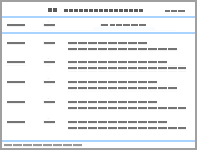
表1
高粱蜀黍苷时空分布特点汇总表"
| 分类维度 Classification dimension | 关键特征 Key characteristics | 主要影响因素 Primary influencing factors | 参考文献 References |
|---|---|---|---|
| 品种差异 Varietal differences | 高氰品种:30.26—136.70 mg·kg-1;低氰品种:<1.00 mg·kg-1;非糯性>糯性;野生种:低氰或无氰;驯化种:高氰 High dhurrin varieties: 30.26-136.70 mg·kg-1; Low dhurrin varieties: <1.00 mg·kg-1; Non-glutinous sorghum > glutinous sorghum; Wild species: low dhurrin or dhurrin-free; Domesticated species: high dhurrin | 基因型(CYP79A1-CYP71E1- UGT85B1) Geneotype (CYP79A1-CYP71E1-UGT85B1) | [ |
| 组织分布 Tissue distribution | 幼苗叶片>茎秆>籽粒(成熟期痕量);新生组织(叶腋)>主茎 Young leaves>Stem>Mature seeds (trace levels); New tissues (leaf axils)>Main stem | 发育阶段与防御需求 Developmental stage and defense demand | [ |
| 环境调控 Environmental regulation | 干旱、施氮、机械损伤等胁迫显著提升含量;西南产区含量普遍低于东北/华中产区 Drought, nitrogen application, mechanical damage significantly increase content; Content in Southwest region generally lower than that in Northeast/Central China | ABA/JA信号通路、环境条件 ABA/JA signaling pathways, environmental conditions | [ |
| 动态变化 Dynamic changes | 幼苗期含量最高,随生长下降;成熟秸秆高于籽粒;再生苗含量回升;受昼夜节律调控 Highest content in seedling stage, decreases with growth; Mature stems higher than seeds; Regenerated seedlings show increased content; may be regulated by the circadian rhythm | 生长阶段与再生防御需求 Growth stage and regeneration defense needs | [ |
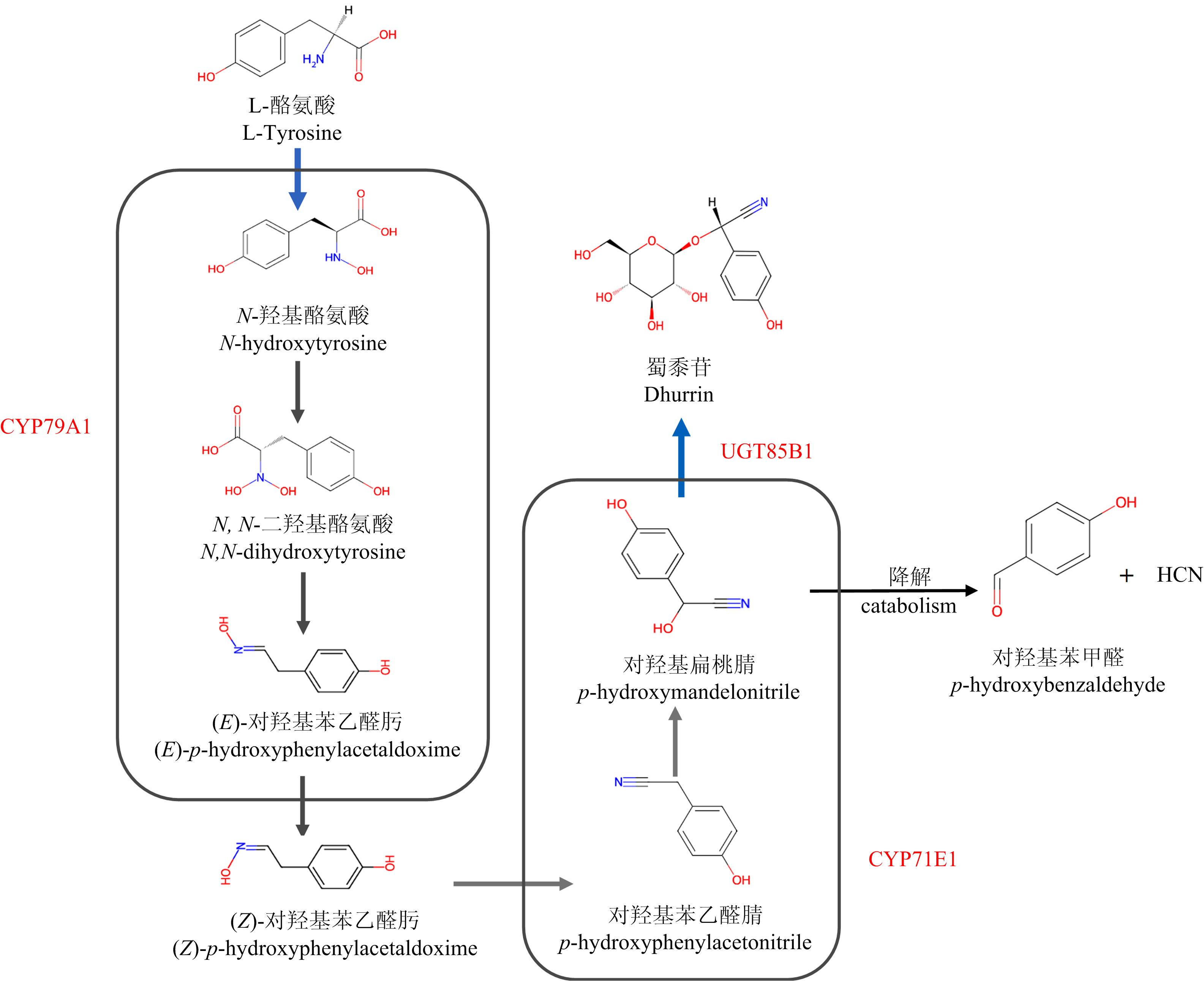
图1
高粱蜀黍苷生物合成途径"
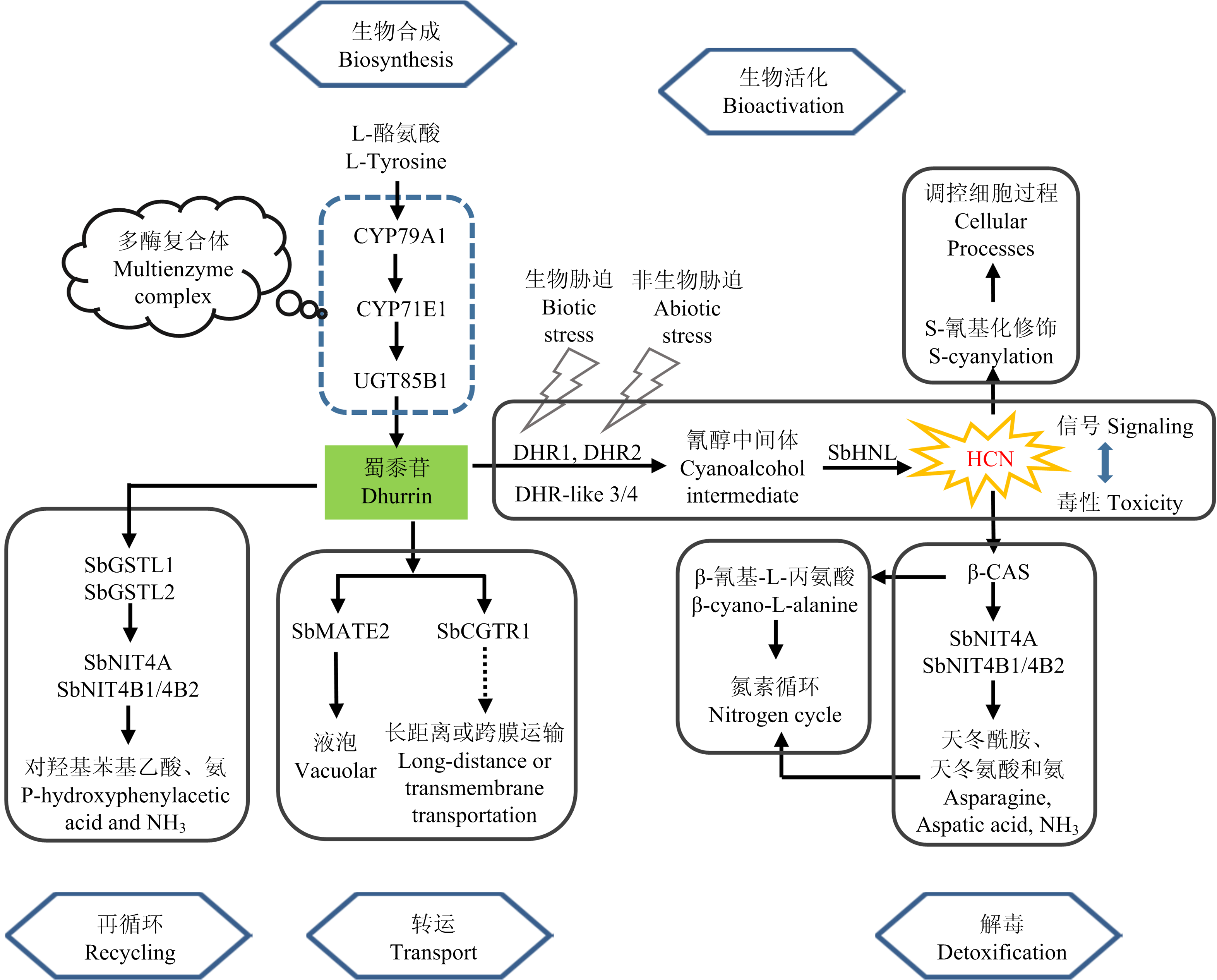
图2
高粱蜀黍苷生物合成、活化、解毒、再循环和转运途径调控网络示意图"
表2
参与高粱蜀黍苷生物合成与代谢过程的关键基因及其功能"
| 基因ID Gene ID | 酶名称 Enzyme name | 主要功能 Main function | 参考文献 References |
|---|---|---|---|
| 蜀黍苷生物合成 Dhurrin biosynthesis | |||
Sobic.001G012300 | 细胞色素酶P450 Cytochrome enzyme P450 SbCYP79A1 | 专一性催化酪氨酸生成对羟基苯乙醛肟,是蜀黍苷生物合成的限速步骤 Specifically catalyze the conversion of tyrosine into p-hydroxyphenylacetaldoxime, and is a key rate-limiting step in the biosynthesis of dhurrin | [ |
Sobic.001G012200 | 细胞色素酶P450 Cytochrome enzyme P450 SbCYP71E1 | 负责催化对羟基苯乙醛肟转化为对羟基乙醛腈,是合成蜀黍苷前体的关键步骤 Response for the conversion of p-hydroxyphenylacetaldoxime to p-hydroxymandelonitrile in dhurrin biosynthesis, which is a crucial step in the synthesis of the precursor of dhurrin | [ |
Sobic.001G012400 | UDP-葡萄糖基转移酶 UDP-glucosyltransferase SbUGT85B1 | 参与多酶复合体的形成,其催化的糖基化反应是蜀黍苷生物合成的最后一个步骤 Participate in the formation of the multi-enzyme complex, and its glycosylation reaction is the final step in dhurrin biosynthesis | [ |
| 蜀黍苷生物活化Dhurrin bioactivation | |||
Sobic.008G079800 Sobic.008G080400 Sobic.008G080100 Sobic.008G080600 | β-葡萄糖苷酶 β -glucosidase DHR1 DHR2 DHR-like 3 DHR-like 4 | 在植物组织受损时负责催化蜀黍苷水解生成氰醇中间体,是释放HCN的关键步骤 When the tissue is damaged, DHR is responsible for the hydrolysis of dhurrin to generate the cyanohydrin intermediate, which is a key step in releasing HCN | [ |
Sobic.004G335500 | α‑羟腈裂解酶 α -hydroxynitrile lyase HNL | 负责将氰醇裂解,释放HCN与对羟基苯甲醛 Responsible for the cleavage of cyanohydrin, releasing HCN and p-hydroxybenzaldehyde (pHB) | [ |
| 蜀黍苷脱毒Dhurrin detoxification | |||
Sobic.006G016900 | β-氰丙氨酸合成酶 β -cyanoalanine synthase β- CAS C1 | 负责催化半胱氨酸与剧毒HCN结合生成低毒的β-氰基-L-丙氨酸,是氰化物解毒的核 心基因 Responsible for catalyzing the combination of cysteine with the highly toxic HCN to generate the less toxic β-cyanomethyl-L-alanine (BCA), and is the core gene for dhurrin detoxification | [ |
Sobic.004G225200 Sobic.004G225100 | 硝化酶 Nitrifying enzyme SbNIT4A SbNIT4B1/4B2 | 负责将HCN中的氮整合生成天冬酰胺、天冬氨酸和氨,以防氰化物中毒 Responsible for integrating the nitrogen in HCN to form asparagine, aspartic acid and ammonia, in order to prevent cyanide poisoning | [ |
| 蜀黍苷再循环Dhurrin recycling | |||
Sobic.002G421200 Sobic.009G033200 | 谷胱甘肽S转移酶 Glutathione S-transferase SbGSTL1 SbGSTL2 | 无组织损伤条件下,负责将蜀黍苷转化为对羟基苯基乙腈,并与硝化酶协同作用将蜀黍苷衍生物定向转化为对羟基苯基乙酸(pHPAAc)和游离氨(NH3),且不释放氰化氢 Under non-destructive conditions of the tissue, responsible for converting dhurrin into p- hydroxyphenylacetonitrile, and cooperate with NIT4A/B2 to specifically convert dhurrin derivatives into p-hydroxyphenylacetic acid (pHPAAc) and NH3, without releasing HCN | [ |
| 蜀黍苷转运 Dhurrin transport | |||
Sobic.001G012600 | MATE家族液泡转运蛋白 MATE family vacuole transport proteins SbMATE2 | SbMATE2具有底物选择性,仅转运非内源蜀黍氰苷,但不能转运花青素-3-O-葡萄糖苷或硫代葡萄糖苷吲哚-3-甲基硫代葡萄糖苷,主要介导蜀黍苷的液泡区室化储存 SbMATE2 has substrate selectivity and only transports non-endogenous dhurrin, but not the anthocyanin cyanidin 3-O-glucoside or the glucosinolate indol-3-yl-methyl glucosinolate. It is mainly mediates the compartmentalized storage of dhurrin in the vacuole. | [ |
Sobic.001G133900 | NPF家族转运蛋白 NPF family transporter proteins SbCGTR1 | 与木薯氰苷转运蛋白显著同源,具有长程或跨细胞器转运蜀黍苷的潜力,以避免自毒 SbCGTR1 is highly homologous to the cassava cyanogenic glycoside transporter and has the potential for long- distance or inter-organelle transport of dhurrin to avoid autotoxicity | [ |
| 蜀黍苷生物合成调控因子 Transcription factors regulating the dhurrin biosynthesis | |||
| Sobic.010G173400 | GATA转录因子 GATA transcription factor SbGATA22 | 属于具LLM结构域的GATA转录因子,可能是蜀黍苷生物合成负调控因子 Belongs to B-GATA transcription factor with LLM domain and may act as a negative regulator of dhurrin biosynthesis in sorghum | [ |
| [1] |
|
| [2] |
|
| [3] |
|
| [4] |
|
| [5] |
|
| [6] |
张顺荣. 白酒中氨基甲酸乙酯形成的氰化物途径研究[D]. 无锡: 江南大学, 2016.
|
|
|
|
| [7] |
魏铭, 何宏魁, 李玥, 刘卓, 汪啸天, 常晓娇, 王耀鹏. 我国主要种植高粱品种蜀黍氰苷含量比较分析[J]. 粮油食品科技, 2025, 33(2): 105-110.
|
|
|
|
| [8] |
周韩玲, 安明哲, 赵东, 郭艳, 宋廷富, 李隆淼, 郑佳. 不同产地及品种高粱中蜀黍氰苷含量的差异化分析[J]. 中国酿造, 2023, 42(7): 209-213.
|
|
|
|
| [9] |
|
| [10] |
|
| [11] |
|
| [12] |
|
| [13] |
|
| [14] |
|
| [15] |
|
| [16] |
|
| [17] |
|
| [18] |
|
| [19] |
|
| [20] |
|
| [21] |
|
| [22] |
|
| [23] |
|
| [24] |
|
| [25] |
|
| [26] |
|
| [27] |
|
| [28] |
|
| [29] |
|
| [30] |
|
| [31] |
|
| [32] |
|
| [33] |
|
| [34] |
|
| [35] |
|
| [36] |
|
| [37] |
|
| [38] |
|
| [39] |
|
| [40] |
|
| [41] |
|
| [42] |
|
| [43] |
|
| [44] |
|
| [45] |
|
| [46] |
|
| [47] |
|
| [48] |
|
| [49] |
|
| [50] |
|
| [51] |
|
| [52] |
|
| [53] |
|
| [54] |
|
| [55] |
|
| [56] |
|
| [57] |
|
| [58] |
|
| [59] |
|
| [60] |
|
| [61] |
|
| [62] |
|
| [63] |
|
| [64] |
|
| [65] |
|
| [66] |
|
| [67] |
|
| [68] |
|
| [69] |
|
| [70] |
|
| [71] |
|
| [72] |
|
| [73] |
|
| [74] |
|
| [75] |
|
| [76] |
|
| [77] |
|
| [78] |
|
| [79] |
|
| [80] |
|
| [81] |
|
| [82] |
|
| [83] |
|
| [84] |
|
| [85] |
周韩玲, 安明哲, 赵东, 乔宗伟, 廖勤俭, 郭艳, 李杨华. 高粱中蜀黍氰苷与浓香型白酒中氰化物及氨基甲酸乙酯关系的研究[J]. 中国酿造, 2022, 41(10): 25-29.
|
|
|
|
| [86] |
吴荣, 牛江帅, 岩温香, 程欣然, 牛庭莉, 杜吉到, 戴凌燕. 高粱蜀黍苷的研究进展[J]. 中国粮油学报, 2021, 36(12): 172-178.
|
|
|
|
| [87] |
|
| [88] |
|
| [1] | 刘晓华, 梁健平, 刘燕, 吴诚煜, 张益诚, 黄显会, 李向梅. 基于UPLC-Q-Exactive Orbitrap MS分析天维菌素在大鼠和犬肝微粒体的代谢产物[J]. 中国农业科学, 2026, 59(9): 2016-2028. |
| [2] | 葛玉彬, 贺春贵, 王宁, 张国琴, 张正英, 吕鑫. 基于表型性状的热带高粱种质资源遗传多样性分析与创新利用[J]. 中国农业科学, 2026, 59(8): 1622-1638. |
| [3] | 马兆惠, 全成哲, 程海涛, 杨衎劼, 李欣蕊, 吕文彦. 中科发5号背景下东北粳稻育种目标与策略的思考[J]. 中国农业科学, 2026, 59(5): 927-936. |
| [4] | 陈冰嬬, 唐玉劼, 张丽霞, 周宇飞, 于淼, 石贵山, 王新鼎, 李扬, 高士杰, 陆晓春, 王鼐, 刁现民. 中国粒用杂交高粱的绿色革命[J]. 中国农业科学, 2025, 58(8): 1494-1507. |
| [5] | 蔡海林, 黄馨瑢, 曾维爱, 彭治鑫, 赵阿娟, 薄纯斌, 向世鹏, 高鹏程, 张成省, 赵栋霖. 菌核青霉HY5中3,5-二甲基苔色酸类混源萜的结构及其除草活性[J]. 中国农业科学, 2025, 58(22): 4673-4687. |
| [6] | 杨永念, 曾祥翠, 刘青松, 李如月, 龙瑞才, 陈林, 王雪, 何飞, 康俊梅, 李明娜. 盐碱胁迫下的紫花苜蓿幼苗蛋白组差异分析[J]. 中国农业科学, 2025, 58(21): 4512-4527. |
| [7] | 孟姿诺, 付长青, 张玲玉, 高顺娟, 常金华, 崔江慧. 高粱芽苗期耐盐性评价及耐盐种质筛选[J]. 中国农业科学, 2025, 58(16): 3317-3326. |
| [8] | 乔钲岩, 于淼, 唐玉劼, 石贵山, 刘新宇, 刘晓涵, 王新鼎, 李扬, 王鼐, 陈冰嬬. 粒用高粱幼苗期耐苏打盐碱综合评价与指标鉴选[J]. 中国农业科学, 2025, 58(1): 30-42. |
| [9] | 韩立杰, 才宏伟. 高粱遗传转化研究进展[J]. 中国农业科学, 2024, 57(3): 454-468. |
| [10] | 杨文辉, 罗灏程, 董二伟, 王劲松, 王媛, 刘秋霞, 黄晓磊, 焦晓燕. 长期不同施肥和深翻对玉米高粱轮作体系作物钾利用及土壤钾形态的影响[J]. 中国农业科学, 2024, 57(12): 2390-2403. |
| [11] | 谷闻东, 刘春娟, 李邦, 刘畅, 周宇飞. 外源色氨酸对低氮胁迫下高粱苗期叶片碳氮平衡和衰老特性的影响[J]. 中国农业科学, 2023, 56(7): 1295-1310. |
| [12] | 张一中, 张晓娟, 梁笃, 郭琦, 范昕琦, 聂萌恩, 王绘艳, 赵文博, 杜维俊, 柳青山. 基于表型性状的高粱育种材料遗传多样性分析及综合评价[J]. 中国农业科学, 2023, 56(15): 2837-2853. |
| [13] | 王劲松,董二伟,刘秋霞,武爱莲,王媛,王立革,焦晓燕. 行距和密度对籽粒饲用高粱产量和品质的影响[J]. 中国农业科学, 2022, 55(16): 3123-3133. |
| [14] | 史晓龙, 郭佩, 任婧瑶, 张鹤, 董奇琦, 赵新华, 周宇飞, 张正, 万书波, 于海秋. 基于花生//高粱间作模式的花生盐胁迫耐受性效应研究[J]. 中国农业科学, 2022, 55(15): 2927-2937. |
| [15] | 徐晓,任根增,赵欣蕊,常金华,崔江慧. 中国高粱地方品种和育成品种穗部表型性状精准鉴定及综合评价[J]. 中国农业科学, 2022, 55(11): 2092-2108. |
|
||
