






中国农业科学 ›› 2026, Vol. 59 ›› Issue (10): 2214-2228.doi: 10.3864/j.issn.0578-1752.2026.10.011
林诗韵1,2( ), 马迪1,3(), 叶广英1, 陈和明1, 肖文芳1(), 吕复兵1()
收稿日期:2025-12-29
接受日期:2026-01-29
出版日期:2026-05-16
发布日期:2026-05-20
通信作者:
联系方式:
林诗韵,E-mail:ROSIES1998@163.com。马迪,E-mail:madi00963@163.com。林诗韵和马迪为同等贡献作者。
基金资助:
LIN ShiYun1,2(), MA Di1,3(), YE GuangYing1, CHEN HeMing1, XIAO WenFang1(), LÜ FuBing1()
Received:2025-12-29
Accepted:2026-01-29
Published:2026-05-16
Online:2026-05-20
摘要:
【背景】蝴蝶兰是全球商品化程度最高的兰科观赏植物,花香是其核心观赏性状之一,腺毛则是花香物质合成与释放的关键生理结构。目前对蝴蝶兰花香合成机制已有初步探索,但腺毛分布规律及其与挥发性成分的关联仍不明确。【目的】明确蝴蝶兰花香释放的生理结构基础,解析腺毛分布与挥发性成分的关联性,为蝴蝶兰花香的释放机制及香花育种提供理论支撑。【方法】以浓香型‘香玉’蝴蝶兰、中香型‘萨拉金’蝴蝶兰、淡香型‘红漪’蝴蝶兰和无香型‘红梅’蝴蝶兰为试验材料,采用中性红染色、扫描电镜观察、组织化学染色和顶空-固相微萃取-气相色谱-质谱联用技术,系统分析腺毛形态、分布、细胞后含物积累特征及挥发性成分差异,通过相关性分析明确腺毛密度与挥发物含量、香气强度值(OAV)的关联。【结果】蝴蝶兰腺毛主要分布于萼片和花瓣近轴面,以头状腺毛为主,远轴面分布极少;香气强度越高,腺毛分布密度越大,呈浓香型>中香型>淡香型>无香型。香花型品种花器官细胞同时积累淀粉与脂质,无香型‘红梅’仅积累淀粉,脂质积累量与香气强度密切相关。萼片为主要释香部位,代表性挥发性成分为芳樟醇、桉叶油醇、月桂烯和α-蒎烯;中萼片和侧萼片近轴面腺毛密度与挥发性成分总含量、总香气强度值呈极显著正相关关系(P<0.01)。【结论】蝴蝶兰花器官腺毛主要存在萼片近轴面,以头状腺毛为主,其分布密度与代表性挥发性成分含量、香气强度值呈正相关关系,且花器官细胞脂质积累是香花型蝴蝶兰的重要物质特征。研究明确了蝴蝶兰释香的结构与物质基础,可为解析花香释放机制及香花品种选育提供依据。
林诗韵, 马迪, 叶广英, 陈和明, 肖文芳, 吕复兵. 蝴蝶兰花器官腺毛的分布规律及与挥发性成分的关联分析[J]. 中国农业科学, 2026, 59(10): 2214-2228.
LIN ShiYun, MA Di, YE GuangYing, CHEN HeMing, XIAO WenFang, LÜ FuBing. Distribution of Glandular Trichome and Correlation with Volatile Compounds in Phalaenopsis Floral Organs[J]. Scientia Agricultura Sinica, 2026, 59(10): 2214-2228.
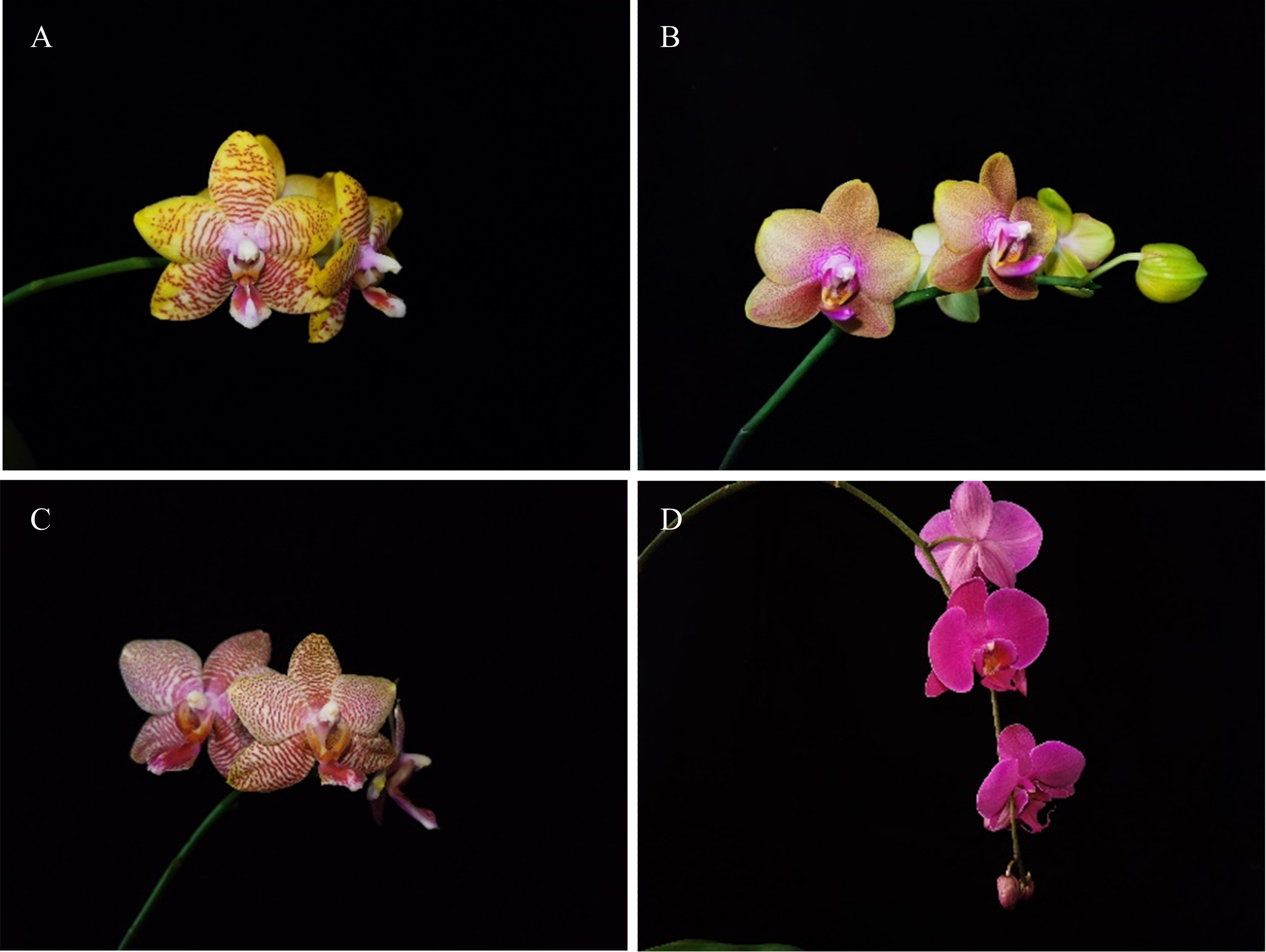
图1
4个蝴蝶兰品种盛花期示意图 A:‘香玉’‘Frigdaas Huang Chan’;B:‘萨拉金’‘Brother Sara Gold’;C:‘红漪’‘Frigdaas Hongyi’;D:‘红梅’‘Frigdaas Peach’"
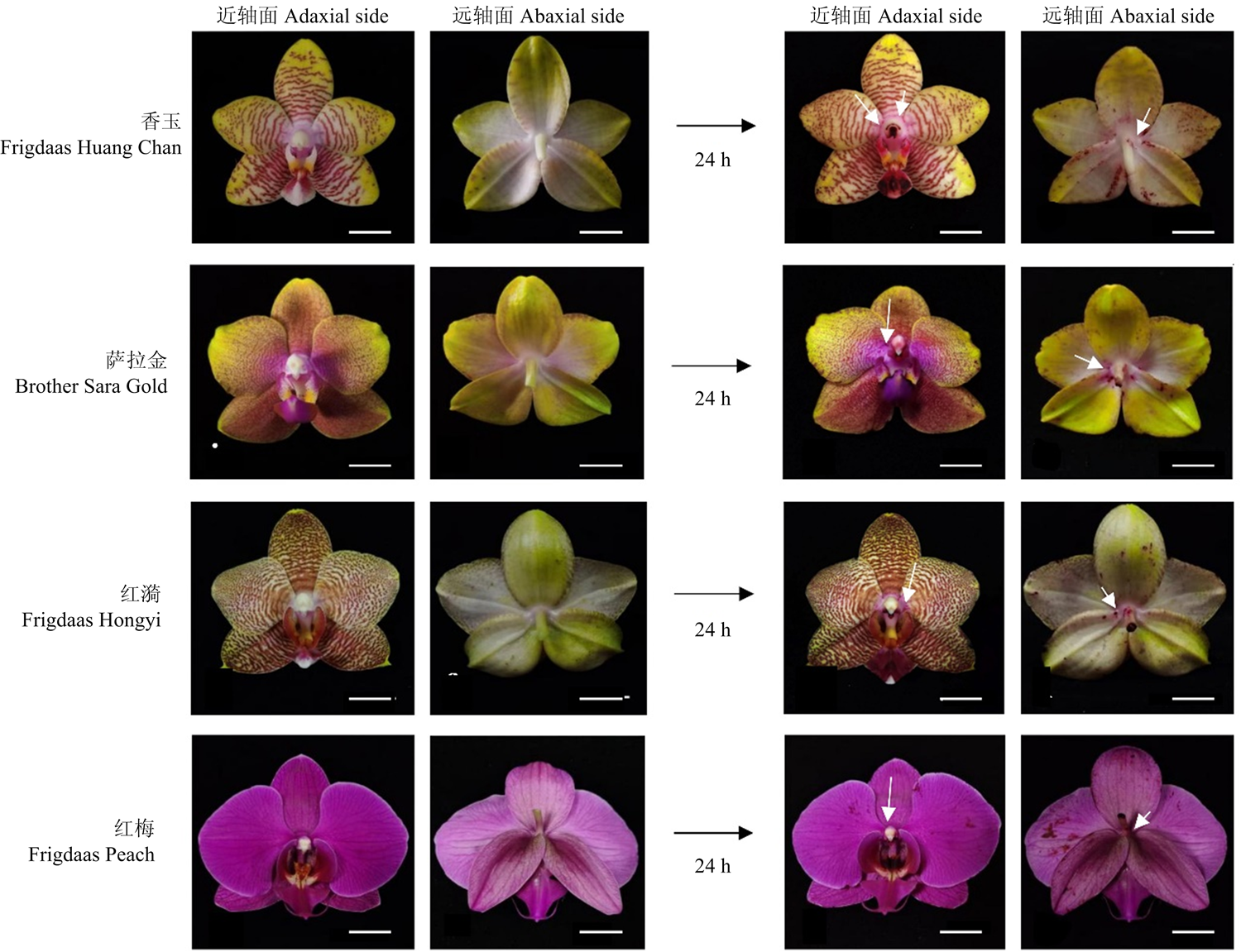
图2
中性红浸染蝴蝶兰花朵24 h前后对比 白色箭头所指区域为近合蕊柱部分,比例尺为1 cm"
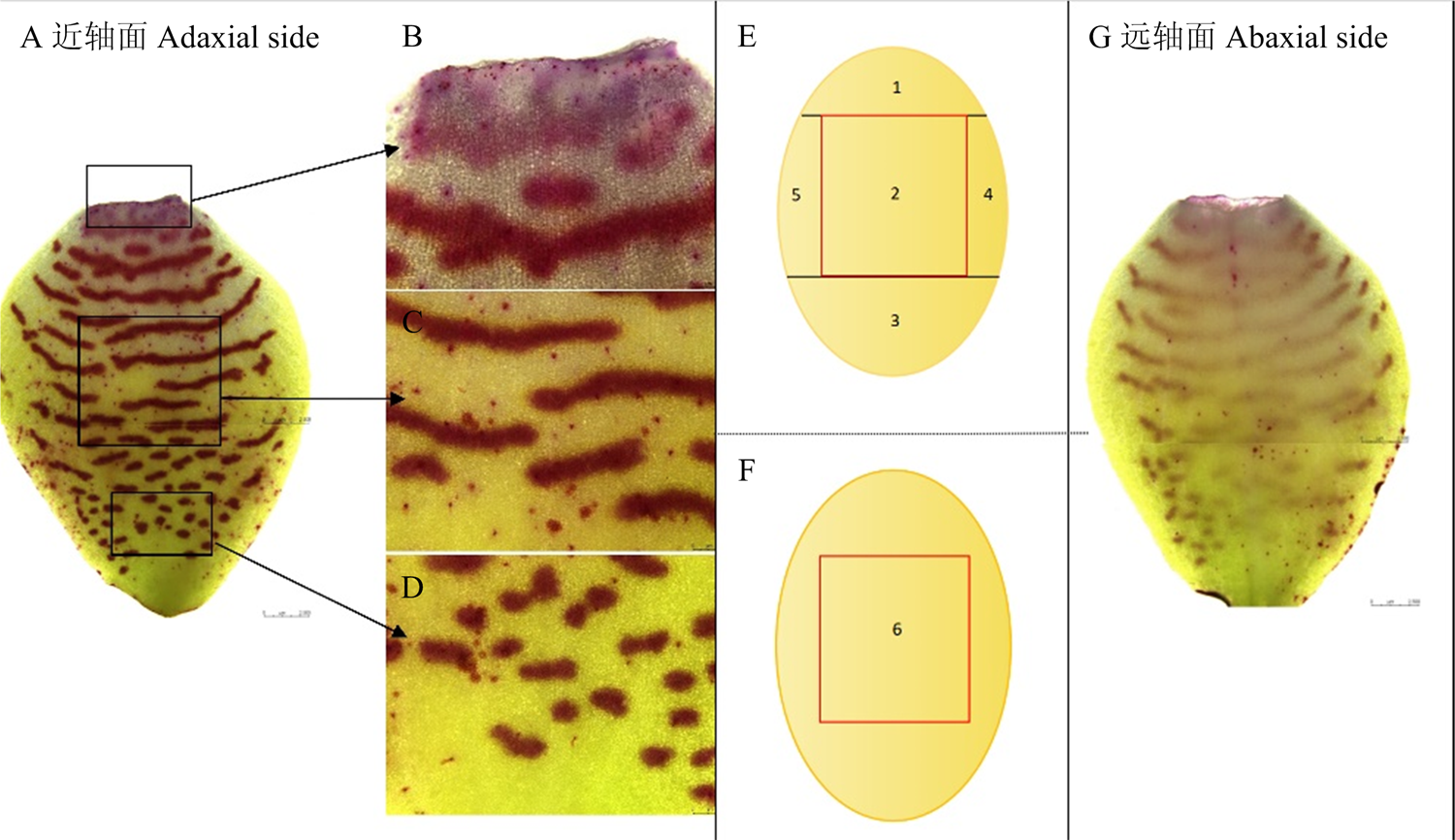
图3
腺毛在蝴蝶兰花器官中的分布特征(以‘香玉’蝴蝶兰的花瓣为例) A:花瓣经过中性红染色后的近轴面Adaxial side of petals after neutral red staining;B、C、D:花瓣近轴面顶端、面中、下端Apical, mid and lower ends of adaxial side of petals;E、F:花器官近轴面和远轴面不同分区Adaxial and abaxial partitions of floral organs;G:花瓣经过中性红染色后的远轴面Abaxial side of petals after neutral red staining"

图4
4个蝴蝶兰品种花器官近轴面与远轴面腺毛结构 大写字母Capital letter:扫描电镜观察Observed by scanning electron microscopy;小写字母Lowercase letter:体视显微镜观察Observed by somatic microscopy"
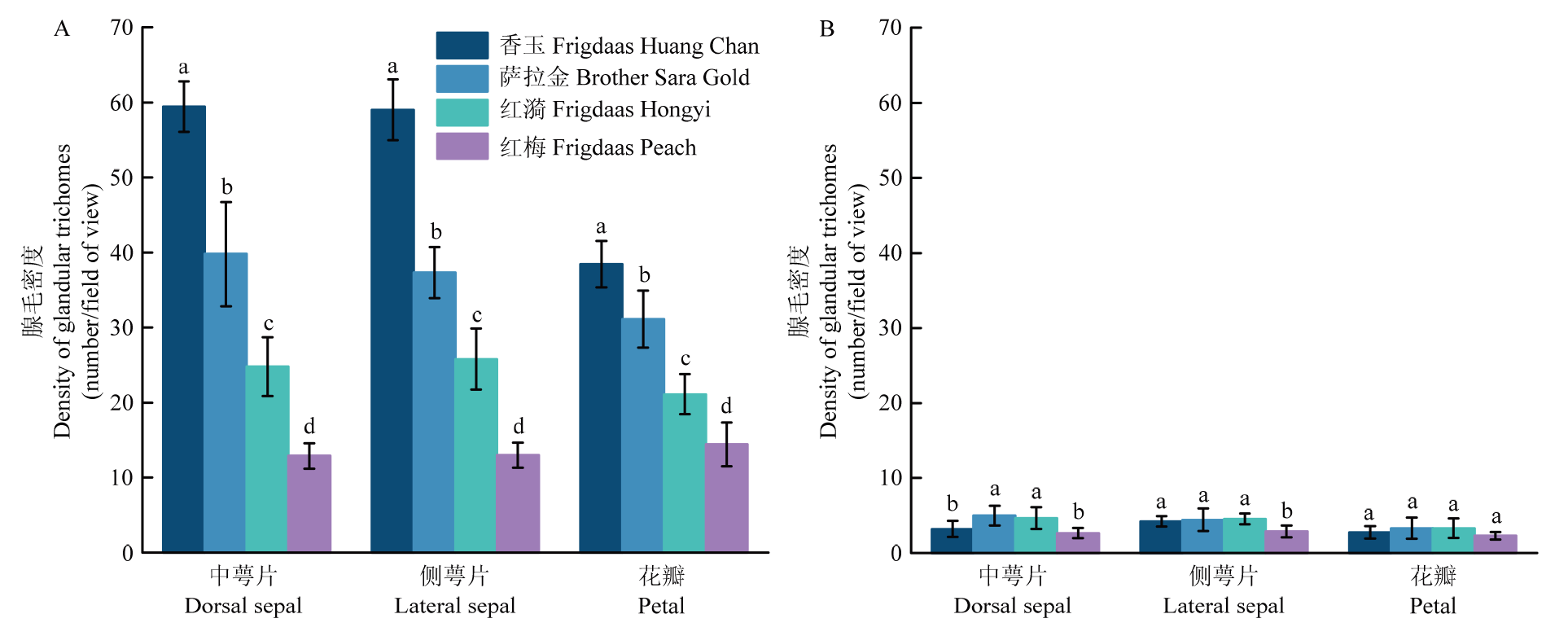
图5
4个蝴蝶兰品种花器官近轴面(A)与远轴面(B)的腺毛密度 柱上不同小写字母表示品种间差异显著(n=45,P<0.05);腺毛密度为显微镜下每个视野范围内所能观察到的腺毛数量"
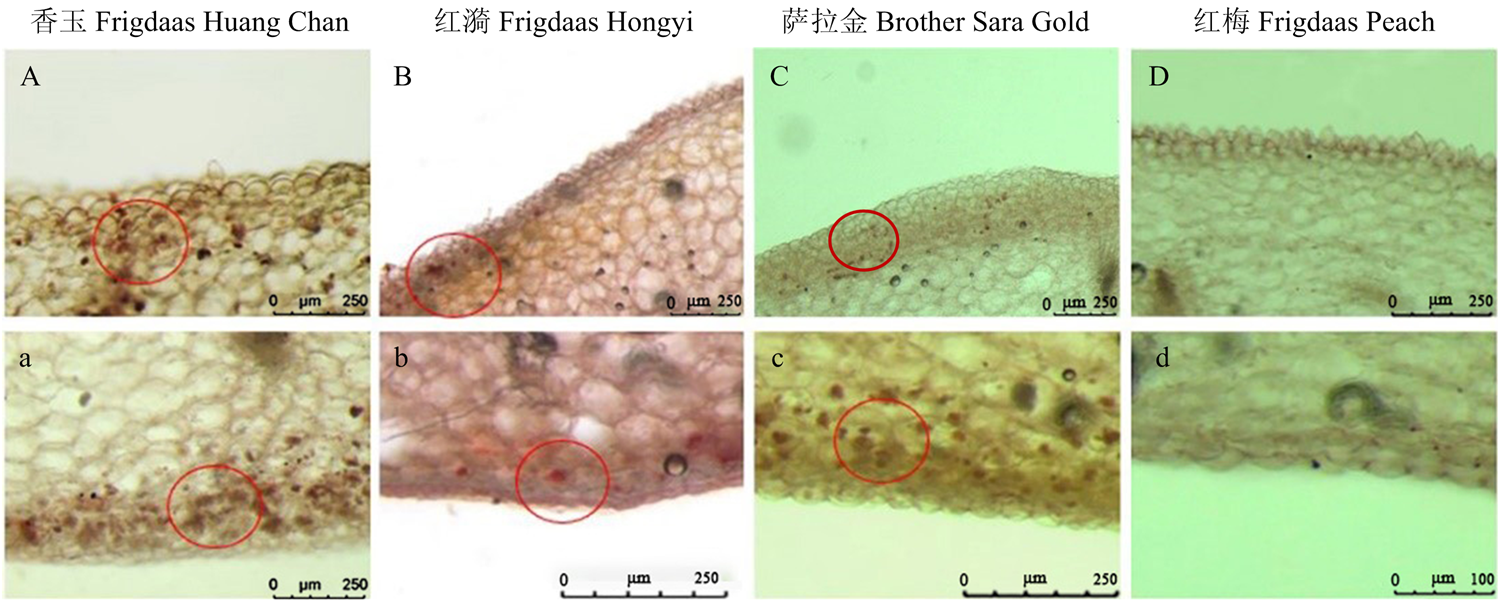
图6
苏丹IV检测花器官中脂类(以花瓣为例) 大写字母Capital letter:表皮细胞Epidermal cell;小写字母Lowercase letter:皮下细胞Subcutaneous cell。圈内区域Area within the circle:细胞中脂类物质Lipids in the cells"
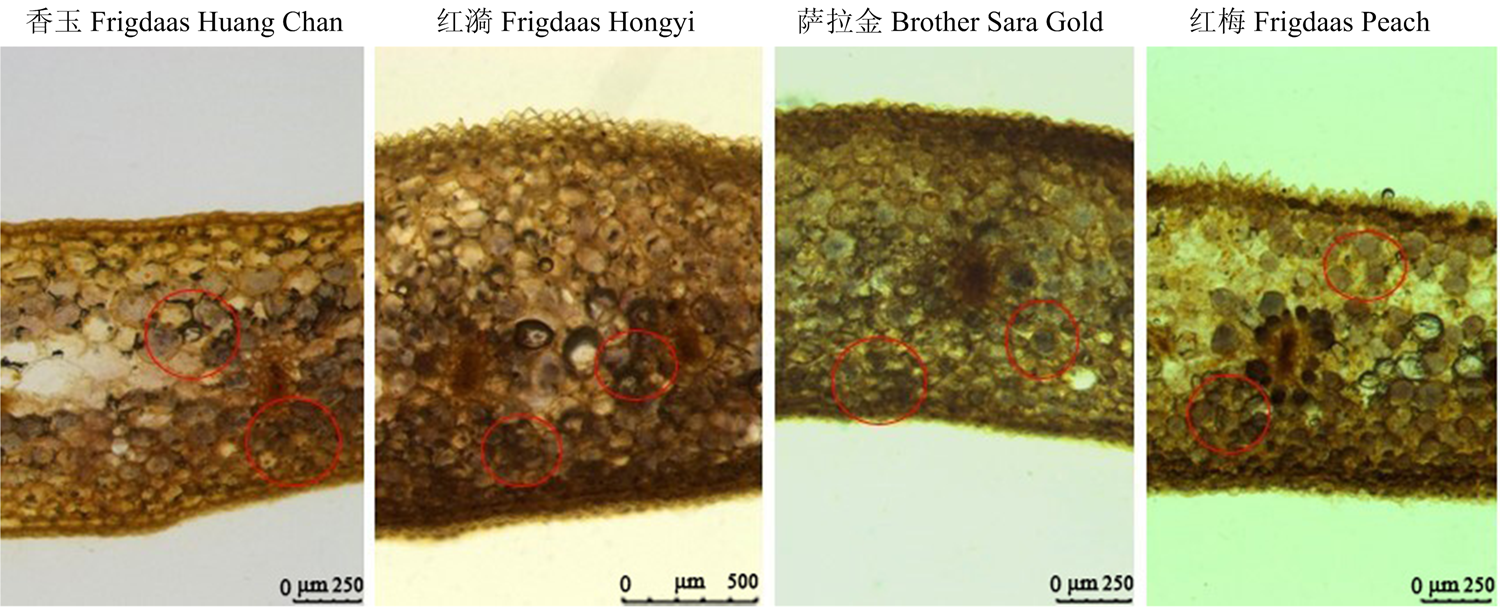
图7
Lugol’s碘液检测花器官中淀粉(以花瓣为例) 圈内区域为细胞中淀粉The area within the circle is starch in the cells"
表1
4个蝴蝶兰品种花器官的组织化学染色反应"
| 花器官 Floral organ | 材料 Material | 苏丹IV(脂质)Sudan IV (for lipids) | Lugol’s碘液(淀粉)Lugol’s iodine (for starch) | ||
|---|---|---|---|---|---|
| 反应Reaction | 反应位点Reaction site | 反应Reaction | 反应位点Reaction site | ||
| 花瓣 Petal | 香玉Frigdaas Huang Chan | + | 角质层、表皮、皮下细胞StC, Ep, CST | + | 皮下细胞、薄壁细胞CST, ScC |
| 萨拉金Brother Sara Gold | + | 表皮、皮下细胞Ep, CST | + | 皮下细胞、薄壁细胞CST, ScC | |
| 红漪Frigdaas Hongyi | + | 表皮、皮下细胞Ep, CST | + | 皮下细胞、薄壁细胞CST, ScC | |
| 红梅Frigdaas Peach | - | — | + | 皮下细胞、薄壁细胞CST, ScC | |
| 中萼片 Dorsal sepal | 香玉Frigdaas Huang Chan | + | 角质层、表皮、皮下细胞StC, Ep, CST | + | 皮下细胞、薄壁细胞CST, ScC |
| 萨拉金Brother Sara Gold | + | 表皮、皮下细胞Ep, CST | + | 皮下细胞、薄壁细胞CST, ScC | |
| 红漪Frigdaas Hongyi | + | 表皮、皮下细胞Ep, CST | + | 皮下细胞、薄壁细胞CST, ScC | |
| 红梅Frigdaas Peach | - | — | + | 皮下细胞、薄壁细胞CST, ScC | |
| 侧萼片 Lateral sepal | 香玉Frigdaas Huang Chan | + | 角质层、表皮、皮下细胞StC, Ep, CST | + | 皮下细胞、薄壁细胞CST, ScC |
| 萨拉金Brother Sara Gold | + | 表皮、皮下细胞Ep, CST | + | 皮下细胞、薄壁细胞CST, ScC | |
| 红漪Frigdaas Hongyi | + | 表皮、皮下细胞Ep, CST | + | 皮下细胞、薄壁细胞CST, ScC | |
| 红梅Frigdaas Peach | - | — | + | 皮下细胞、薄壁细胞CST, ScC | |
表2
4个蝴蝶兰品种各花器官14种主要挥发性成分"
| 化合物 Compound | 香玉Frigdaas Huang Chan | 萨拉金Brother Sara Gold | ||||||||
|---|---|---|---|---|---|---|---|---|---|---|
| 中萼片DS | 侧萼片LS | 花瓣Pe | 唇瓣Li | 合蕊柱Co | 中萼片DS | 侧萼片LS | 花瓣Pe | 唇瓣Li | 合蕊柱Co | |
| α-水芹烯α-Phellandrene | 2.62±0.64a | 3.10±0.29a | 2.80±0.39a | 0.75±0.14b | 0.38±0.11b | 1.14±0.42a | 0.82±0.41ab | 1.05±0.44a | 0.17±0.07c | 0.25±0.15bc |
| (+)-α-蒎烯(+)-α-Pinene | 5.36±1.72a | 6.17±0.57a | 0.55±0.09b | 0.11±0.02b | 0.08±0.01b | 2.65±0.27a | 2.08±0.41a | 2.46±0.38a | 0.54±0.20c | 1.28±0.55b |
| β-水芹烯β-Phellandrene | 2.97±0.84a | 3.73±0.29a | 3.32±0.72a | 0.97±0.24b | 0.51±0.12b | 1.47±0.70a | 1.12±0.72ab | 1.40±0.72a | 0.31±0.02b | 0.30±0.18b |
| β-蒎烯β-Pinene | 1.42±0.43a | 1.65±0.11a | 1.54±0.28a | 0.31±0.08b | 0.26±0.06b | 1.35±0.25a | 1.02±0.25a | 1.24±0.26a | 0.20±0.06b | 0.55±0.31b |
| 月桂烯Myrcene | 7.11±1.67a | 8.25±1.28a | 0.71±0.07b | 0.23±0.05b | 0.08±0.01b | 1.01±0.12a | 0.79±0.18a | 0.87±0.18a | 0.18±0.02b | 0.09±0.01b |
| (+)-4-蒈烯(+)-4-Carene | 2.23±0.53a | 2.57±0.32a | 2.38±0.25a | 0.51±0.13b | 0.23±0.07b | 1.03±0.25a | 0.76±0.27a | 0.87±0.29a | 0.13±0.02b | 0.10±0.01b |
| 间异丙基甲苯β-Cymene | 1.78±0.47a | 1.89±0.30a | 1.77±0.20a | 0.55±0.10b | 0.32±0.10b | 0.81±0.25a | 0.67±0.23a | 0.76±0.25a | 0.23±0.01b | 0.23±0.11b |
| 桉叶油醇Eucalyptol | 28.44±4.68a | 31.04±3.33a | 2.85±0.42b | 0.61±0.20b | 0.03±0.01b | 13.37±3.44a | 13.48±0.65a | 8.05±2.28b | 2.58±0.14c | 0.53±0.10c |
| δ-3-蒈烯δ-3-Carene | 0.11±0.05a | 0.07±0.01ab | 0.11±0.06a | 0.04±0.02bc | — | 0.13±0.02a | 0.11±0.01ab | 0.09±0.01b | — | — |
| γ-松油烯γ-Terpinene | 2.94±0.52a | 3.26±0.31a | 3.00±0.09a | 0.84±0.16b | 0.41±0.10b | 1.44±0.32a | 1.12±0.34a | 1.26±0.36a | 0.18±0.08b | 0.36±0.24b |
| 芳樟醇Linalool | 13.39±3.62b | 18.95±5.14a | 1.39±0.64c | 0.05±0.03c | 0.74±0.03c | 2.83±0.28a | 2.36±0.67a | 2.35±0.54a | 1.40±0.27b | 0.22±0.10c |
| L-α-松油醇 L-α-Terpineol | — | — | — | — | — | 0.40±0.33a | 0.47±0.31a | 0.57±0.72a | — | 0.06±0.04a |
| 阿司匹林甲酯 Aspirin methyl ester | 0.43±0.38a | 0.59±0.56a | 0.16±0.11a | 0.29±0.03a | 0.26±0.17a | 1.49±0.42a | 0.99±0.76ab | 1.28±0.28a | 0.43±0.27bc | 0.17±0.04c |
| (E,E)-α-法尼烯(E,E)-α-Farnesene | 0.44±0.20a | 0.31±0.08ab | 0.35±0.14ab | 0.24±0.05ab | 0.08±0.01b | — | 0.85±1.07a | 0.07±0.02a | — | — |
| 化合物 Compound | 红漪Frigdaas Hongyi | 红梅Frigdaas Peach | ||||||||
| 中萼片DS | 侧萼片LS | 花瓣Pe | 唇瓣Li | 合蕊柱Co | 中萼片DS | 侧萼片LS | 花瓣Pe | 唇瓣Li | 合蕊柱Co | |
| α-水芹烯α-Phellandrene | 1.00±0.30a | 1.04±0.16a | 0.80±0.65ab | 0.24±0.1bc | 0.13±0.01c | — | — | — | — | — |
| (+)-α-蒎烯(+)-α-Pinene | 0.20±0.06a | 0.19±0.03a | 0.21±0.03a | — | 0.06±0.01b | 0.16±0.13a | 0.17±0.18a | 0.15±0.10a | 0.13±0.04a | — |
| β-水芹烯β-Phellandrene | 1.37±0.41a | 1.37±0.22a | 1.55±0.16a | 0.32±0.13b | 0.17±0.01b | — | — | — | — | — |
| β-蒎烯β-Pinene | 0.48±0.15a | 0.48±0.08a | 0.51±0.10a | 0.26±0.21ab | 0.12±0.02b | — | — | — | — | — |
| 月桂烯Myrcene | 0.37±0.11a | 0.34±0.07a | 0.32±0.16a | 0.12±0.01b | — | — | — | — | — | — |
| (+)-4-蒈烯(+)-4-Carene | 0.72±0.28a | 0.72±0.15a | 0.78±0.27a | 0.17±0.02b | 0.11±0.01b | — | — | — | — | — |
| 间异丙基甲苯β-Cymene | 0.62±0.12a | 0.64±0.04a | 0.46±0.37ab | 0.20±0.07bc | 0.12±0.01c | — | — | — | — | — |
| 桉叶油醇Eucalyptol | 1.16±0.49a | 1.07±0.27a | 0.99±0.75ab | 0.23±0.01b | 0.25±0.03b | — | — | — | — | — |
| δ-3-蒈烯δ-3-Carene | 0.13±0.03a | 0.12±0.01a | — | — | — | 4.86±1.29a | 4.93±1.91a | 5.02±0.79a | 4.69±0.41a | 1.30±0.30b |
| γ-松油烯γ-Terpinene | 1.09±0.37a | 1.15±0.22a | 0.93±0.73ab | 0.29±0.11bc | 0.17±0.03c | — | — | — | — | — |
| 芳樟醇Linalool | 0.93±0.8ab | 1.13±0.61a | 0.32±0.12ab | 0.57±0.22ab | 0.13±0.02b | — | — | — | — | — |
| L-α-松油醇 L-α-Terpineol | 0.11±0.09a | 0.18±0.02a | 0.18±0.07a | — | — | — | — | — | — | — |
| 阿司匹林甲酯 Aspirin methyl ester | 0.89±0.32a | 0.71±0.07a | 0.70±0.31a | 0.12±0.01b | 0.07±0.01b | 0.06±0.01b | 0.09±0.01b | 0.42±0.21a | — | 0.05±0.01b |
| (E,E)-α-法尼烯(E,E)-α-Farnesene | 0.72±0.31a | 0.68±0.13a | 0.90±0.49a | 0.41±0.17ab | — | 0.15±0.07a | 0.19±0.12a | 0.19±0.03a | 0.16±0.01a | — |
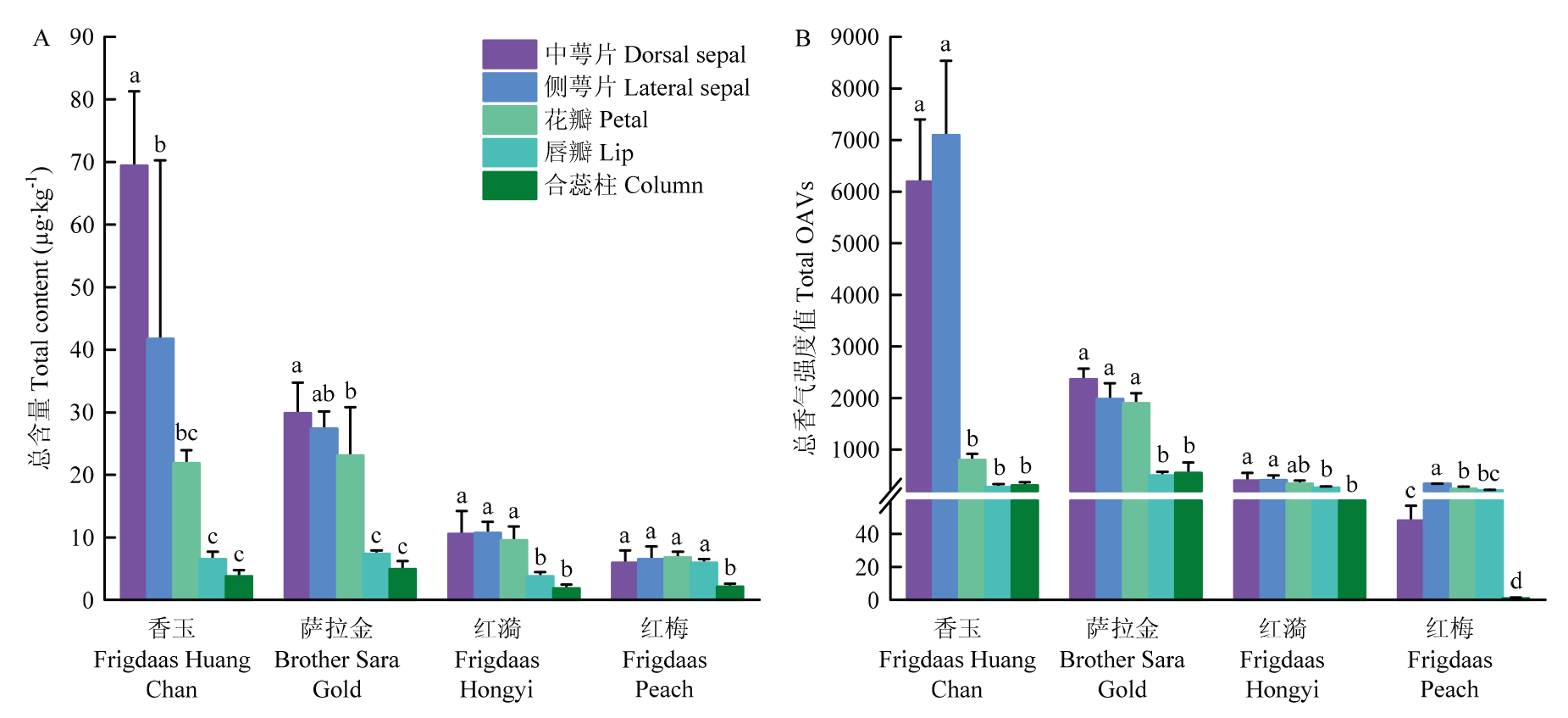
图8
14种挥发性成分在各花器官中的总含量和总香气强度值 总含量和总香气强度值为14种挥发性成分在各品种和花器官上的总和The total content and total OAVs represent the sum of the 14 volatile components across all varieties and floral organs;柱上不同小写字母表示差异显著Different lowercase letters on the bars indicate significant difference (n=3, P<0.05)。图9同The same as Fig. 9"
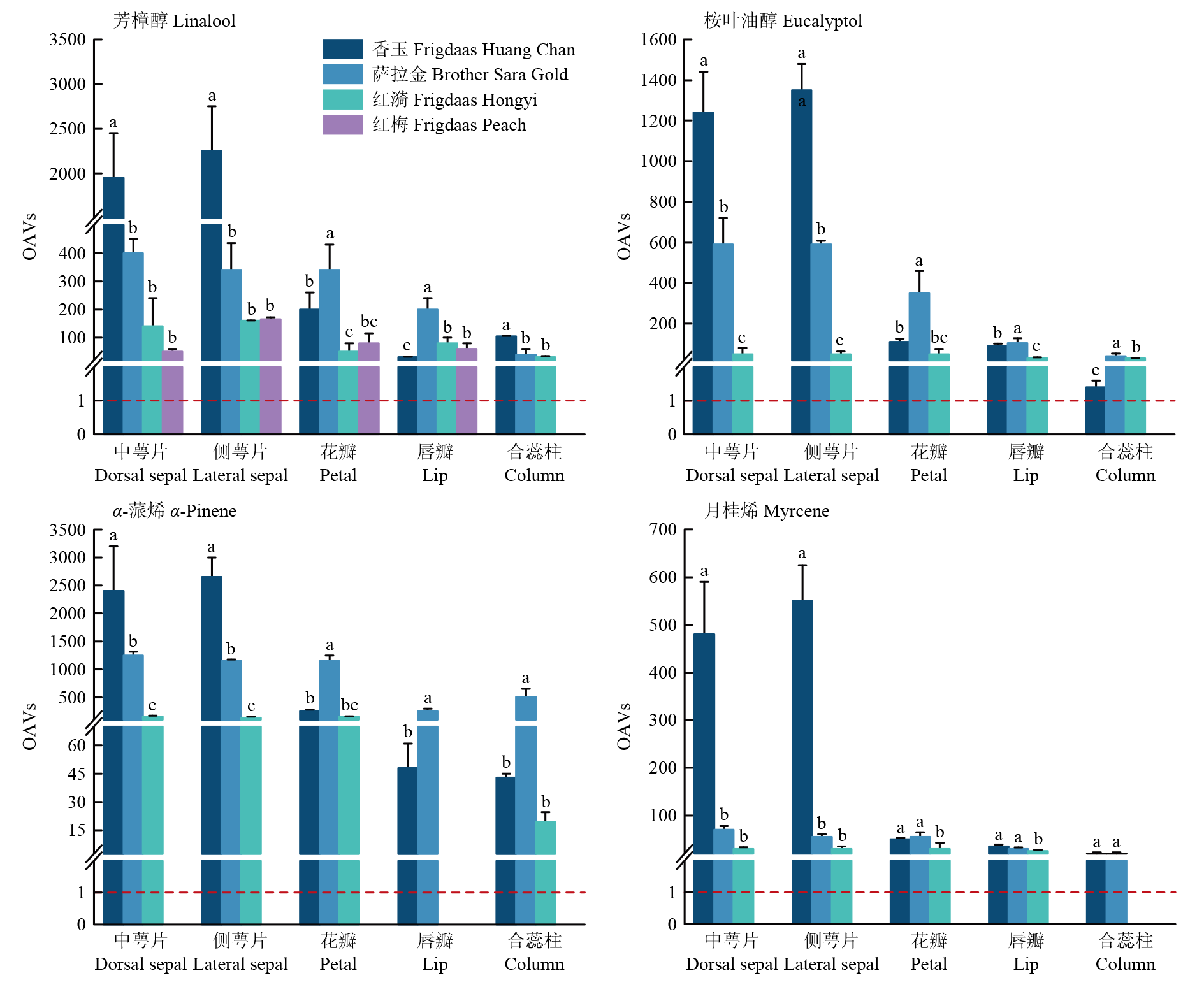
图9
4个蝴蝶兰品种主要香气物质的香气强度值"
表3
蝴蝶兰各花器官部位与挥发性物质总含量及相应总香气强度值相关性分析"
| 部位 Organ | 指标对 Indicator pair | 相关系数 Correlation coefficient (r) | 显著性 Significance (P) | 相关性判定 Correlation judgment |
|---|---|---|---|---|
| 中萼片 Dorsal sepal | 近轴腺毛密度vs挥发物总含量 Adaxial glandular trichome density vs total volatile content | 0.987 | 0.003 | ** |
| 近轴腺毛密度vs总OAV Adaxial glandular trichome density vs total OAVs | 0.992 | 0.001 | ** | |
| 远轴腺毛密度vs挥发物总含量 Abaxial glandular trichome density vs total volatile content | 0.625 | 0.375 | ns | |
| 远轴腺毛密度vs总OAV Abaxial glandular trichome density vs total OAVs | 0.581 | 0.419 | ns | |
| 侧萼片 Lateral sepal | 近轴腺毛密度vs挥发物总含量 Adaxial glandular trichome density vs total volatile content | 0.976 | 0.006 | ** |
| 近轴腺毛密度vs总OAV Adaxial glandular trichome density vs total OAVs | 0.985 | 0.002 | ** | |
| 远轴腺毛密度vs挥发物总含量 Abaxial glandular trichome density vs total volatile content | 0.702 | 0.298 | ns | |
| 远轴腺毛密度vs总OAV Abaxial glandular trichome density vs total OAVs | 0.658 | 0.342 | ns | |
| 花瓣 Petal | 近轴腺毛密度vs挥发物总含量 Adaxial glandular trichome density vs total volatile content | 0.786 | 0.214 | ns |
| 近轴腺毛密度vs总OAV Adaxial glandular trichome density vs total OAVs | 0.823 | 0.177 | ns | |
| 远轴腺毛密度vs挥发物总含量 Abaxial glandular trichome density vs total volatile content | 0.915 | 0.085 | ns | |
| 远轴腺毛密度vs总OAV Abaxial glandular trichome density vs total OAVs | 0.887 | 0.113 | ns |
| [1] |
赵玉安, 王世尧, 张果, 王瑞华, 蒋拴丽, 杨书才. 蝴蝶兰种质资源生物学性状综合评价. 北方园艺, 2024(1): 54-59.
|
|
|
|
| [2] |
王瑞华, 王俊. 中国蝴蝶兰产业现状及发展建议. 湖北农业科学, 2018, 57(3): 45-47, 50.
|
|
|
|
| [3] |
|
| [4] |
童妍, 张燕萍, 胡美娟, 曹映辉, 章杨婷, 仝恩慧, 王文君, 赵凯, 彭东辉, 周育真. 蝴蝶兰新型杂交品种挥发性成分分析. 广西植物, 2023, 43(6): 1016-1026.
|
|
|
|
| [5] |
马迪, 肖文芳, 李佐, 张俊卫, 陈和明, 吕复兵. 兰科植物花香成分研究进展. 中国农学通报, 2023, 39(16): 52-60.
doi: 10.11924/j.issn.1000-6850.casb2022-0928 |
|
doi: 10.11924/j.issn.1000-6850.casb2022-0928 |
|
| [6] |
肖文芳, 李佐, 陈和明, 吕复兵. 基于HS-SPME-GC-MS的4种不同蝴蝶兰种质资源花朵挥发性成分比较分析. 中国农业大学学报, 2021, 26(3): 38-52.
|
|
|
|
| [7] |
张英杰, 李奥, 吕云飞, 孙纪霞, 刘民晓, 张京伟, 刘学庆, 刘晓华, 郭文姣, 郭对田. 蝴蝶兰成花过程内源激素含量的变化和植物生长调节剂的作用. 热带亚热带植物学报, 2022, 30(1): 104-110.
|
|
|
|
| [8] |
章杨婷, 张燕萍, 黄静妍, 王文君, 童妍, 赵凯, 周育真. 一心维纳斯蝴蝶兰花香物质合成相关基因RT-qPCR内参基因筛选. 热带作物学报, 2023, 44(11): 2188-2195.
doi: 10.3969/j.issn.1000-2561.2023.11.006 |
|
|
|
| [9] |
刘秀云, 孙纪霞, 董春燕, 明凤, 董文明, 郭文姣, 张京伟, 刘民晓, 张英杰. 3个黄色香花蝴蝶兰品种花香成分鉴别与调控基因初探. 种子, 2025, 44(2): 201-209.
|
|
|
|
| [10] |
doi: 10.1111/j.1469-8137.1988.tb04159.x pmid: 33873942 |
| [11] |
查旻昱, 吴悠, 张梁. 茶叶中挥发性香气物质研究进展. 食品安全质量检测学报, 2020, 11(13): 4298-4303.
|
|
|
|
| [12] |
|
| [13] |
崔长杰, 邹璞, 廖景平. 长萼兰花蕉(Orchidantha chinensis var. longisepala)气味腺结构探究. 植物科学学报, 2015, 33(5): 602-607.
|
|
|
|
| [14] |
|
| [15] |
doi: 10.1002/ajb2.1983.70.issue-8 |
| [16] |
|
| [17] |
|
| [18] |
doi: 10.1002/ajb2.1987.74.issue-9 |
| [19] |
doi: 10.1086/337247 |
| [20] |
doi: 10.1023/A:1026568428770 |
| [21] |
doi: 10.1086/669911 |
| [22] |
doi: 10.1186/1471-2229-6-14 |
| [23] |
doi: 10.1007/s00709-021-01625-1 |
| [24] |
李晓颍, 王海静, 徐宁伟, 曹翠玲, 刘建珍, 武春成, 张立彬. 顶空固相微萃取-气相色谱-质谱联用法分析欧李果实挥发性成分. 中国农业科学, 2019, 52(19): 3448-3459. doi: 10.3864/j.issn.0578-1752.2019.19.014.
|
|
|
|
| [25] |
孔慧娟, 赵国玲, 汪雯岚, 阎卫东. 6种水果中键合态香气成分的气相色谱-质谱法鉴定与比较. 食品科学, 2015, 36(14): 140-144.
doi: 10.7506/spkx1002-6630-201514027 |
|
doi: 10.7506/spkx1002-6630-201514027 |
|
| [26] |
姚红, 尹小庆, 颜宇鸽, 阚建全, 武运, 戚晨晨, 王治国,
doi: 10.13995/j.cnki.11-1802/ts.034239 |
|
|
|
| [27] |
doi: 10.1002/jsfa.v104.15 |
| [28] |
施婷婷, 杨秀莲, 王良桂. 3个桂花品种花香组分动态特征及花被片结构解剖学观测. 南京林业大学学报(自然科学版), 2020, 44(4): 12-20.
doi: 10.3969/j.issn.1000-2006.202003047 |
|
|
|
| [29] |
罗乐, 杨玉勇, 张启翔. 中国蔷薇属. 北京: 中国林业出版社, 2024.
|
|
|
|
| [30] |
|
| [31] |
doi: 10.1002/ajb2.1991.78.issue-5 |
| [32] |
doi: 10.1007/s00606-010-0294-1 |
| [33] |
doi: 10.1007/s00709-018-1274-5 |
| [34] |
doi: 10.1186/s13104-017-2872-6 |
| [35] |
doi: 10.1104/pp.17.00727 pmid: 28724619 |
| [36] |
屈亚芳, 许明录, 曹建敏, 孙惠青, 尤祥伟, 王国平, 蒋彩虹, 王元英, 常爱霞. 不同基因型烟草腺毛主要分泌物差异分析. 中国烟草学报, 2018, 24(1): 45-52.
|
|
|
|
| [37] |
张思琦, 何佳, 周方, 徐世晓, 王袁, 刘超, 张安乾, 陈芳, 孙志浩, 杨铁钊. 不同烤烟品种(系)叶片组织结构、腺毛及分泌物比较分析. 中国农业科技导报, 2019, 21(1): 132-140.
doi: 10.13304/j.nykjdb.2018.0025 |
|
doi: 10.13304/j.nykjdb.2018.0025 |
|
| [38] |
doi: 10.3390/plants11111410 |
| [39] |
doi: S1360-1385(19)30350-4 pmid: 31983619 |
| [40] |
周秀梅, 刘会超, 李保印. 木香薷叶表皮毛的类型、分布及腺毛的分泌过程. 园艺学报, 2016, 43(8): 1555-1565.
doi: 10.16420/j.issn.0513-353x.2016-0154 |
|
|
| [1] | 曾跃辉, 邹文广, 赵福铭, 肖长春, 黄建鸿, 马彬林, 杨旺兴, 韦新宇, 许旭明. 一个新的水稻颖花开裂基因OsSG2的图位克隆与功能验证[J]. 中国农业科学, 2025, 58(11): 2062-2080. |
| [2] | 彭海霞, 卡得艳, 张天星, 周梦蝶, 吴林楠, 辛转霞, 赵惠贤, 马猛. 过量表达小麦TaCYP78A5增加花器官的大小[J]. 中国农业科学, 2023, 56(9): 1633-1645. |
| [3] | 王珊珊,赵晨辉,李红莲,张冰冰,梁英海,宋宏伟. 东北地区10份李种质资源果实香气成分分析[J]. 中国农业科学, 2021, 54(11): 2476-2486. |
| [4] | 李晓颍,王海静,徐宁伟,曹翠玲,刘建珍,武春成,张立彬. 顶空固相微萃取-气相色谱-质谱联用法分析 欧李果实挥发性成分[J]. 中国农业科学, 2019, 52(19): 3448-3459. |
| [5] | 杨成聪,梁容,秦冉,曾冬冬,金晓丽,石春海. 水稻花器官数目异常突变体afon1的表型分析与基因定位[J]. 中国农业科学, 2017, 50(20): 3837-3847. |
| [6] | 陈立凯,黄明,刘永柱,王慧,陈志强,郭涛. 水稻开颖半不育突变体的观察、遗传分析和基因定位[J]. 中国农业科学, 2016, 49(1): 1-13. |
| [7] | 黄俊宝,何永明,曾晓春,向妙莲,付永琦. 水稻颖花开放前花器官茉莉酸水平变化及浆片茉莉酸信号基因表达分析[J]. 中国农业科学, 2015, 48(6): 1219-1227. |
| [8] | 张玲,郭爽,汪玲,张天泉,庄慧,龙珏臣,何光华,李云峰. 水稻矮化并花发育异常突变体dwarf and deformed flower 2 (ddf2)的基因定位与候选基因分析[J]. 中国农业科学, 2015, 48(10): 1873-1881. |
| [9] | 李洪有, 王婵, 李丽林, 王永勤, 赵瑞. 洋葱花器官B类MADS-box基因AcPI的克隆及表达分析[J]. 中国农业科学, 2012, 45(23): 4759-4769. |
| [10] | 李燕, 李玲, 李少旋, 王慧, 叶宝兴, 高东升. 高温对设施甜樱桃花器官发育的影响[J]. 中国农业科学, 2011, 44(10): 2101-2108. |
| [11] | 崔广荣,张子学,张从宇,胡能兵,隋益虎,李杰勤 . 秋水仙素对蝴蝶兰试管苗叶切片胚状体发生期的化学诱变[J]. 中国农业科学, 2009, 42(9): 3368-3373 . |
| [12] | 印 芳,葛 红,彭克勤,赵伶俐,周玉杰,李秋香. 蝴蝶兰组培褐变与酚酸类物质及相关酶活性的关系[J]. 中国农业科学, 2008, 41(7): 2197-2203 . |
| [13] | 孟庆瑞,王文凤,梁隐泉,聂庆娟,李彦慧,杜绍华,杨建民. 杏品种花器官过冷却点及结冰点的研究[J]. 中国农业科学, 2008, 41(4): 1128-1133 . |
| [14] | 李辛雷,陈发棣,赵宏波. 菊属种间杂种若干花器官性状的表现[J]. 中国农业科学, 2008, 41(3): 786-794 . |
| [15] | @吴先军$四川农业大学水稻研究所!温江6. 水稻长颖花突变体LRS的鉴定[J]. 中国农业科学, 2004, 37(03): 453-453 . |
|
||
