






中国农业科学 ›› 2026, Vol. 59 ›› Issue (6): 1244-1254.doi: 10.3864/j.issn.0578-1752.2026.06.008
刘佳1,2( ), 周诗琪3, 周艳1,2, 申光茂1,2()
收稿日期:2025-11-25
接受日期:2025-12-22
出版日期:2026-03-16
发布日期:2026-03-24
通信作者:
联系方式:
刘佳,E-mail:liu_j2328@163.com。
基金资助:
LIU Jia1,2(), ZHOU ShiQi3, ZHOU Yan1,2, SHEN GuangMao1,2()
Received:2025-11-25
Accepted:2025-12-22
Published:2026-03-16
Online:2026-03-24
摘要:
【背景】化学农药的长期使用引发了抗药性和环境残留等问题,因此有害生物的绿色防控需要更加安全、高效的活性物质。植物是防治病虫害的天然活性物质的最大来源,其中食虫植物具有捕捉和消化昆虫的能力,其分泌的消化液成分具有潜在的杀虫活性。【目的】鉴定捕蝇草(Dionaea muscipula)消化液中的蛋白成分,并结合捕蝇草受猎物诱导后的转录组数据筛选出具有杀虫活性的蛋白。【方法】将橘小实蝇(Bactrocera dorsalis)成虫投入捕虫夹中,观察记录捕蝇草消化橘小实蝇的动态过程,明确捕蝇草具有消化橘小实蝇的能力。通过分析捕蝇草的捕虫夹和腺体的转录组数据鉴定对猎物刺激具有应激表达的基因,结合捕虫夹内消化液蛋白组测序,明确在消化过程中起重要作用的蛋白酶。利用大肠杆菌体外表达重组蛋白,注射法和触杀法处理橘小实蝇成虫,检测重组蛋白的杀虫活性。【结果】通过观察捕蝇草消化橘小实蝇的过程发现,捕蝇草具有消化橘小实蝇的能力,分泌的消化液可以破坏橘小实蝇体壁,捕蝇草消化一只橘小实蝇需要10—13 d,消化后仅留下部分表皮结构。受到猎物刺激后,DNA结合转录因子、丝氨酸羧肽酶、钙调蛋白和钾离子摄取蛋白同时在转录组差异表达基因和蛋白组数据中被鉴定到,可能在捕蝇草消化猎物的过程发挥重要作用。捕虫夹和腺体中的丝氨酸羧肽酶基因DmSCBP1、DmSCBP2、DmSCBP5和DmSCBP8表达水平在猎物诱导后显著上调,其中DmSCBP1的表达水平上调最为显著,在消化液的蛋白组测序中同样检测到该基因编码的蛋白。通过原核表达系统诱导表达了DmSCBP1重组蛋白,生物测定结果显示该蛋白对橘小实蝇无触杀效果,但是注射的方法可导致高死亡率,且在一定范围内死亡率随时间和剂量增加而增加。【结论】重组DmSCBP1对橘小实蝇具有致死活性,其有效使用方法有待进一步完善。
刘佳, 周诗琪, 周艳, 申光茂. 捕蝇草丝氨酸羧肽酶DmSCBP1对橘小实蝇的致死活性分析[J]. 中国农业科学, 2026, 59(6): 1244-1254.
LIU Jia, ZHOU ShiQi, ZHOU Yan, SHEN GuangMao. Analysis of the Lethal Activity of Serine Carboxypeptidase DmSCBP1 from Dionaea muscipula Against Bactrocera dorsalis[J]. Scientia Agricultura Sinica, 2026, 59(6): 1244-1254.
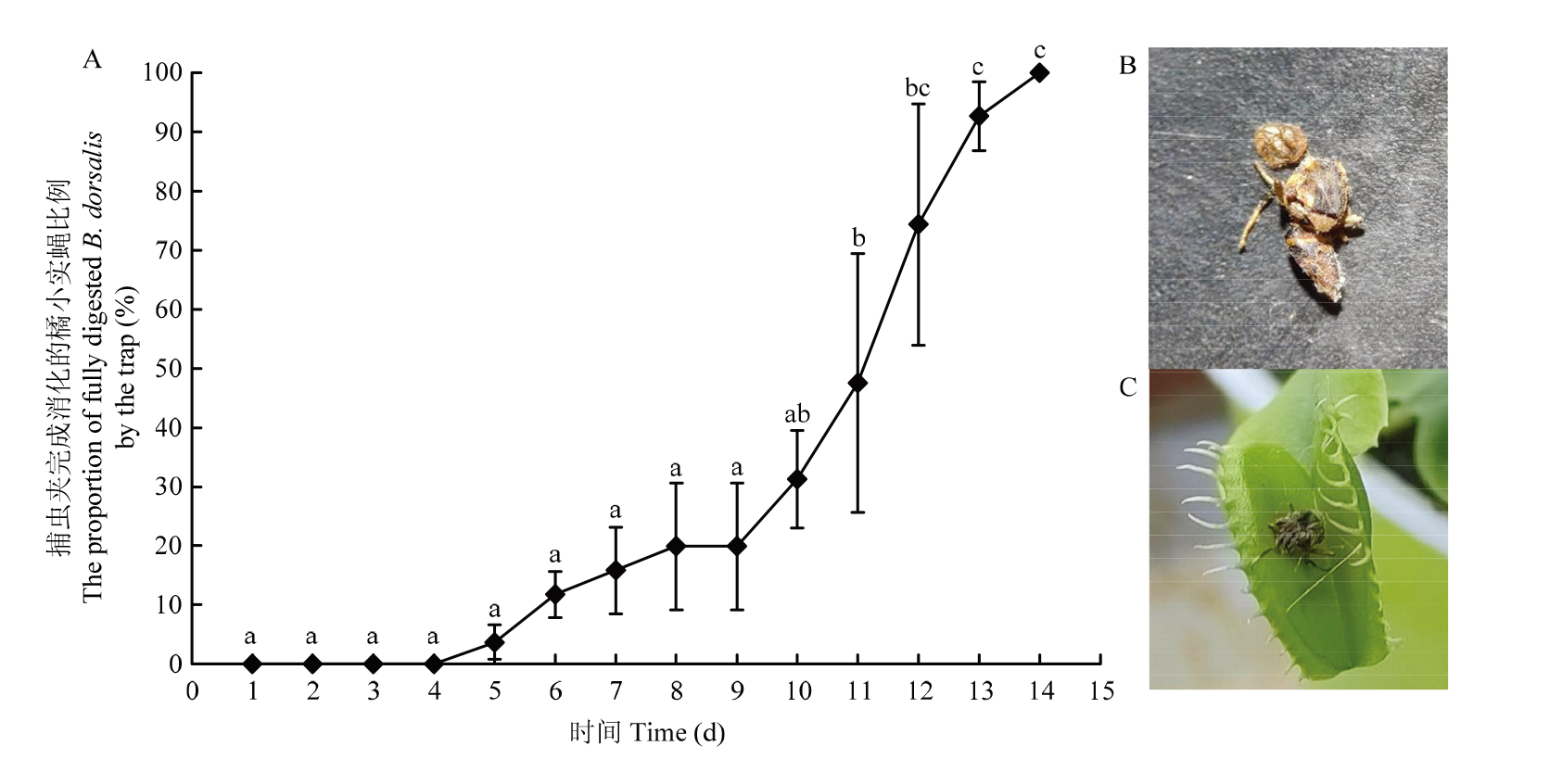
图1
捕蝇草消化橘小实蝇的过程 A:消化过程,图中不同字母表示通过方差分析结合Tukey事后多重比较得出的显著差异Digestion process, different letters in the figure indicate significant difference determined by ANOVA with Tukey’s post hoc test (P<0.05);B:消化后的橘小实蝇残骸Residual of digested B. dorsalis;C:自然重新张开的捕虫夹Naturally reopened trap of D. muscipula"
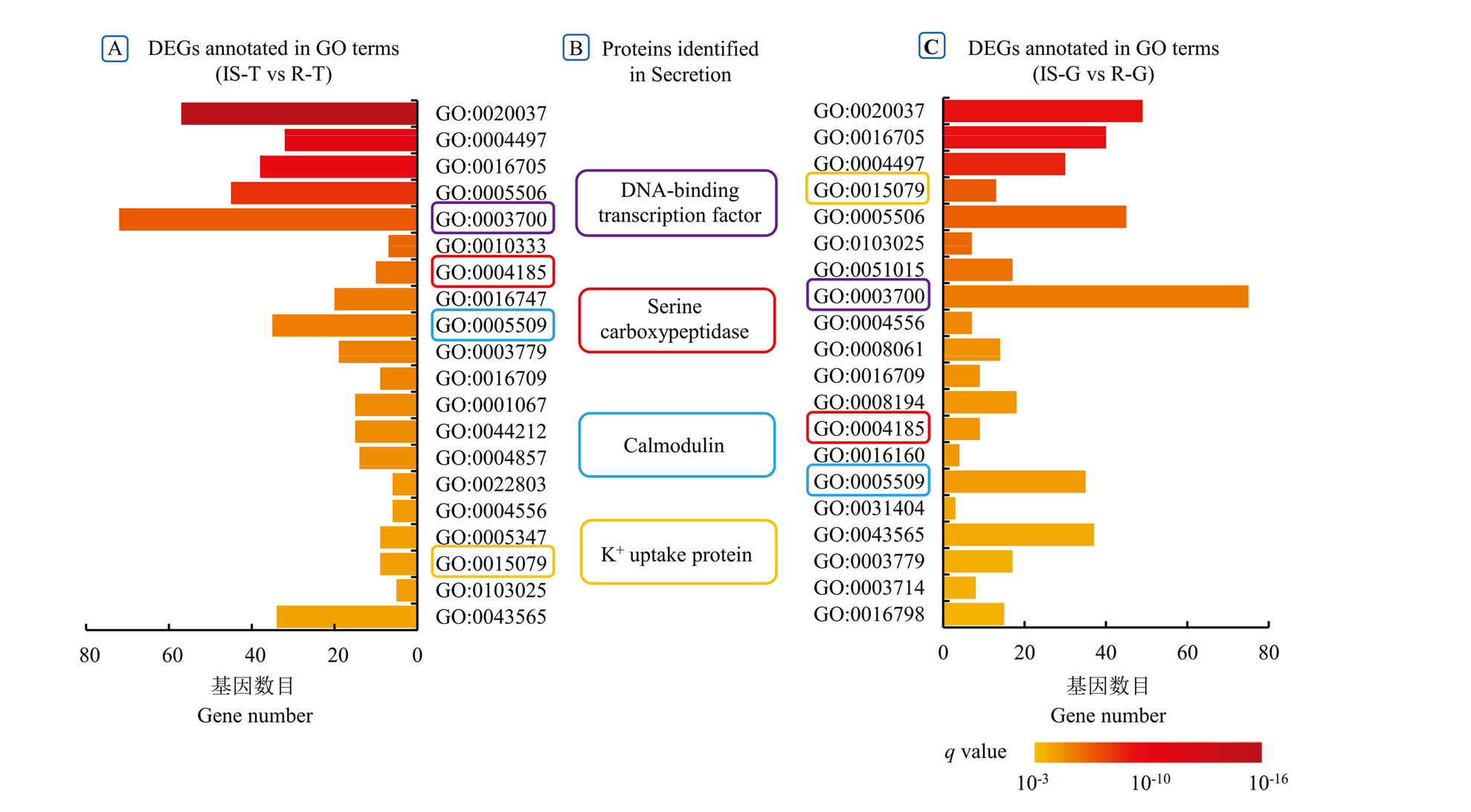
图2
捕蝇草的捕虫夹和腺体转录组中鉴定的关键基因以及捕蝇草分泌物中测序的蛋白质 A:昆虫刺激捕虫夹与静止捕虫夹相比,前20位(基于q值)上调差异表达基因的GO注释GO annotation of Top 20 (based on q value) up-regulated DEGs in insect-stimulated traps (IS-T) vs rest traps (R-T);B:捕虫夹和腺体差异表达基因中具有相同GO注释的分泌蛋白Secretion proteins with the same GO annotation in both DEGs of traps and glands;C:昆虫刺激腺体与静止腺体相比,前20位(基于q值)上调差异表达基因的GO注释GO annotation of Top 20 (based on q value) up-regulated DEGs in insect-stimulated glands (IS-G) vs rest glands (R-G)"
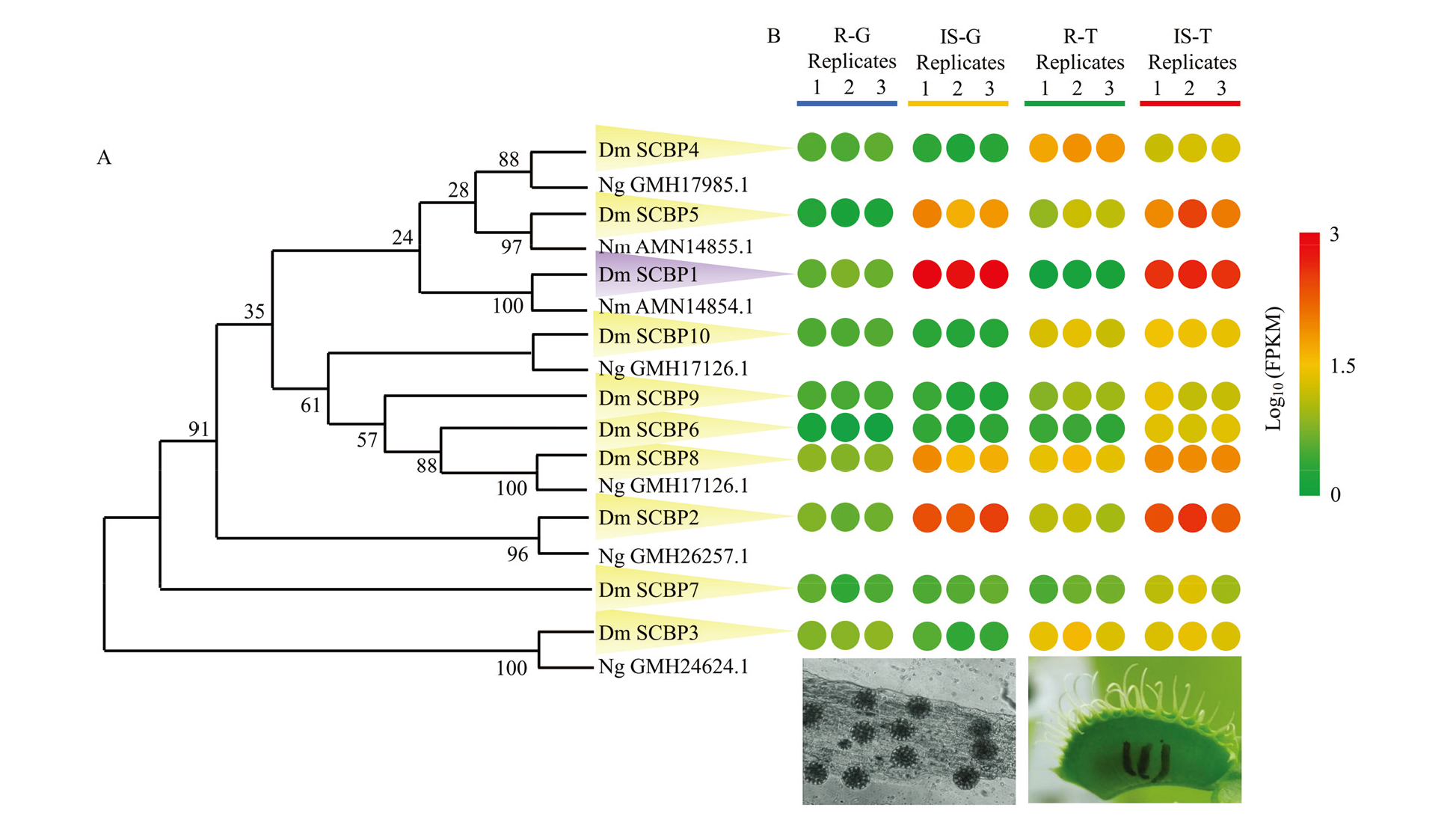
图3
捕蝇草丝氨酸羧肽酶基因的系统发育树及表达信息 A:丝氨酸羧肽酶基因的系统发育树Phylogenetic tree of genes belonging to serine carboxypeptidase。DM:捕蝇草基因Genes from D. muscipula;SCBP:丝氨酸羧肽酶Serine carboxypeptidase;Ng:长茎猪笼草基因,后面的数字为NCBI中的序列登录号Genes from N. gracilis, the number behind Ng is the sequence accession number in NCBI;Nm:奇异猪笼草基因,后面的数字为NCBI中的序列登录号Genes from N. mirabilis, the number behind Nm is the sequence accession number in NCBI。B:捕蝇草腺体和捕虫夹中丝氨酸羧肽酶基因对昆虫刺激的表达响应。表达数据基于每种处理的lgFPKM,每个颜色点代表一个重复样本Expression response of serine carboxypeptidase genes to insect stimulation in glands and traps of D. muscipula. The expression data are based on lgFPKM of each treatment, each color point presents a replicate。R-G:静止腺体Rest gland;IS-G:昆虫刺激腺体Insect stimulated gland;R-T:静止捕虫夹Rest trap;IS-T:昆虫刺激捕虫夹Insect stimulated trap"
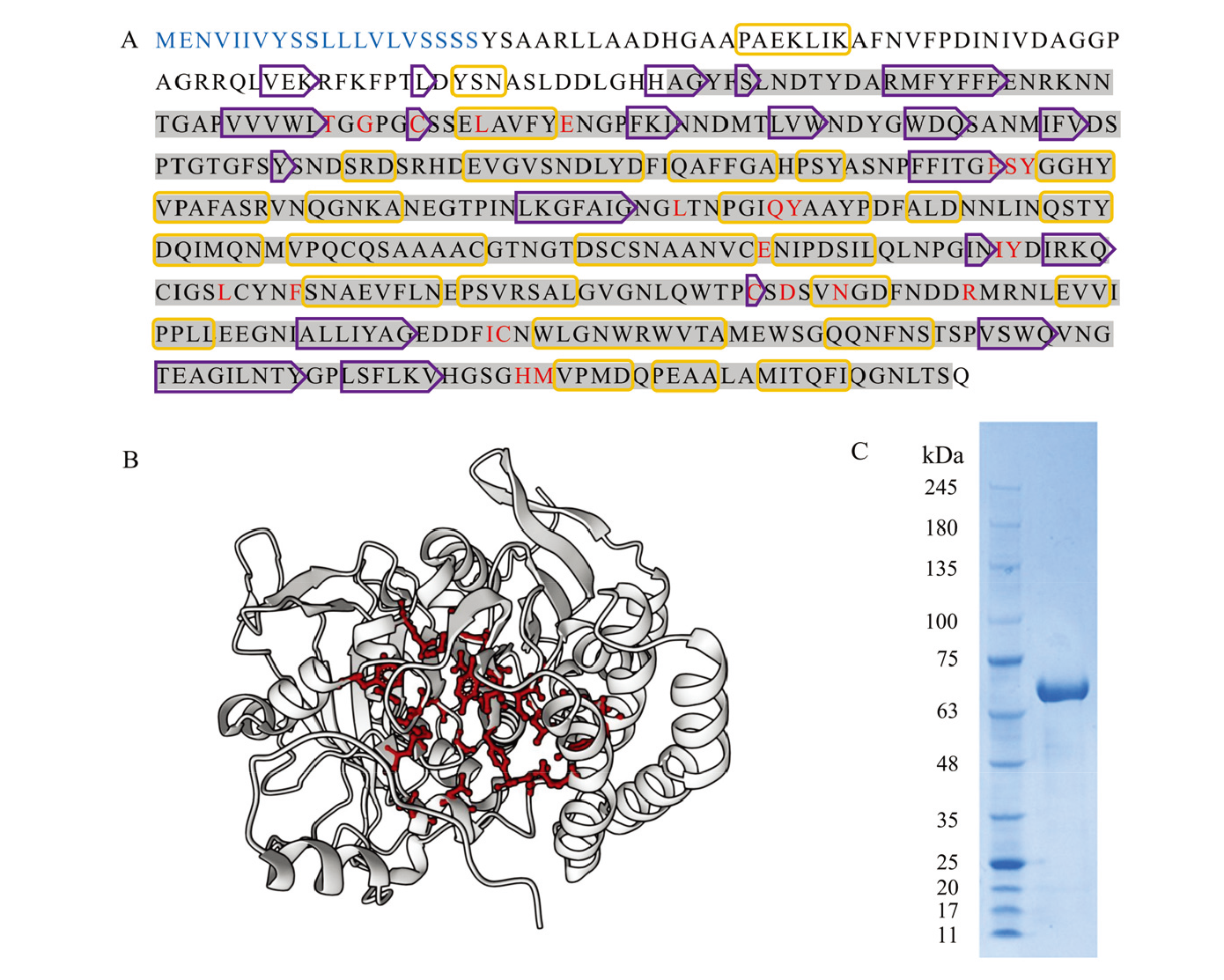
图4
捕蝇草DmSCBP1的蛋白质序列信息 A:DmSCBP1的氨基酸序列。被阴影覆盖的字母是“peptidase_S10”保守结构域,红色字母表示预测的活性位点,蓝色字母表示在重组蛋白中已被去除的信号肽区域,黄色方框显示α螺旋的氨基酸序列,紫色箭头表示β折叠的氨基酸序列Amino acid sequence of DmSCBP1. The shaded letter is the conserved domain of “peptidase_S10”. Red letters indicate the predicted active sites. Blue letters indicate the signal peptide region which has been removed in the recombinant protein. Yellow box shows the amino acids consisting α-helices. Purple arrow shows the amino acids consisting β-strands。B:DmSCBP1的蛋白质结构模型。用红色标注的氨基酸为预测的活性位点Protein structural models of DmSCBP1. Amino acids labeled in red show the location of predicted active sites。C:纯化后的重组DmSCBP1的蛋白电泳图Protein electrophoresis of purified recombinant DmSCBP1"
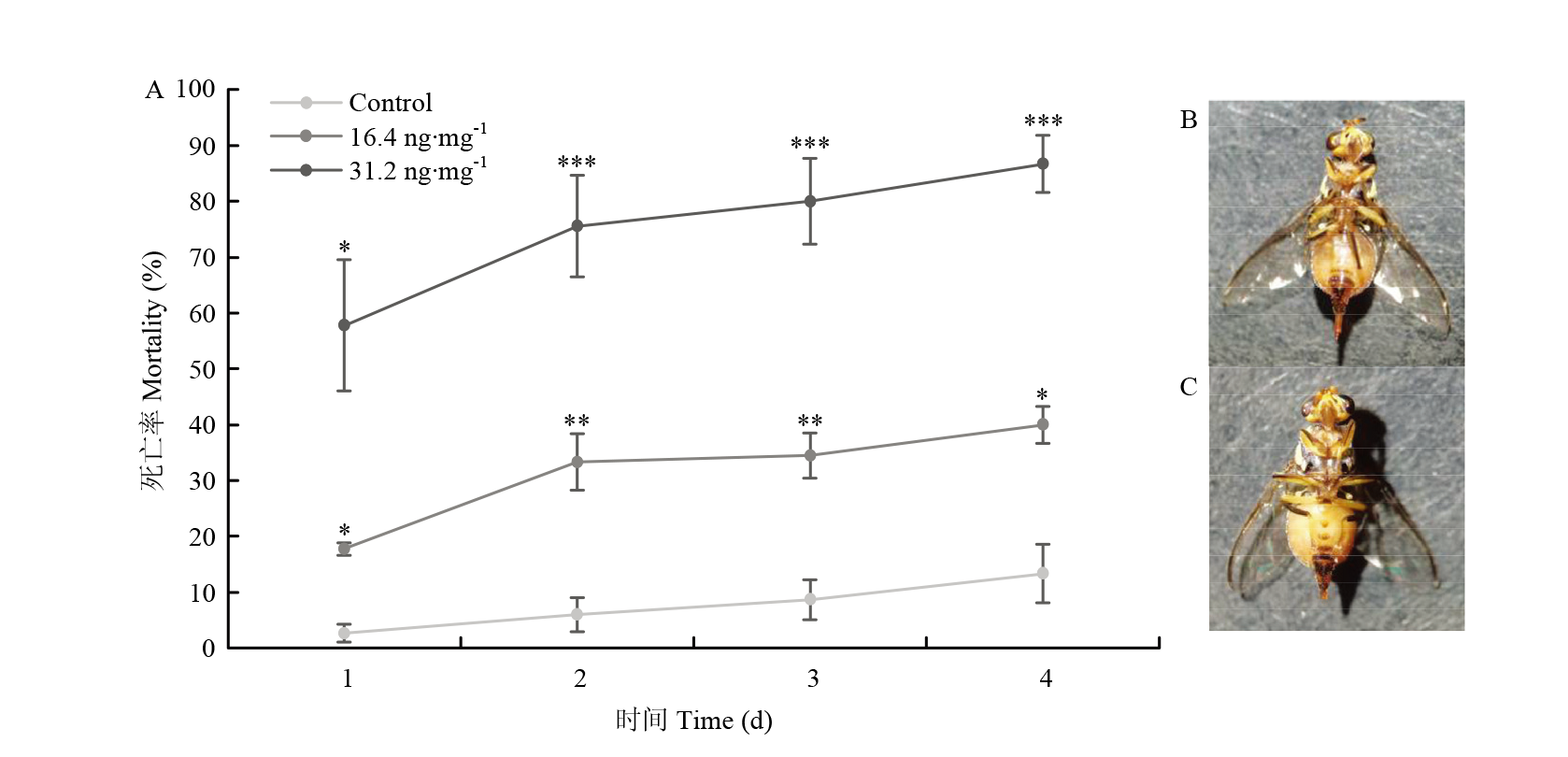
图5
注射重组DmSCBP1对橘小实蝇的致死效果 A:试虫死亡率,星号代表经过t检验或非参数检验得出的与对照组的显著性差异Mortality of the tested insects, an asterisk indicates a significant difference from the control group as determined by t-test or non-parametric test;B、C:表型Phenotype"
| [1] |
杨琴, 杨大全, 柴永飞, 杨毅娟, 龚占斌, 谭安超, 张秀英, 王顺富, 王斌, 李云国, 等. 橘小实蝇食饵剂筛选及田间抗性检测. 应用昆虫学报, 2025, 62(2): 506-513.
|
|
|
|
| [2] |
doi: 10.1002/ps.v67.3 |
| [3] |
胡维月, 李振, 李凯, 李振亚, 席玉强, 尹新明. 橘小实蝇成虫的防治药剂筛选及抗性监测. 河南农业大学学报, 2023, 57(2): 269-276, 287.
|
|
|
|
| [4] |
doi: 10.1016/j.marpolbul.2024.116613 |
| [5] |
doi: 10.1016/j.envpol.2024.125526 |
| [6] |
张天竞, 杨旭, 周倩, 张涵钦, 刘蕊, 杨海荣, 袁野, 邢立国. 噻虫嗪对3种常见熊蜂单头工蜂的急性毒性. 农药, 2023, 62(9): 647-650.
|
|
|
|
| [7] |
邱一蕾, 吴帆, 张莉, 李红亮. 亚致死剂量吡虫啉对中华蜜蜂神经代谢基因表达的影响. 中国农业科学, 2022, 55(8): 1685-1694. doi: 10.3864/j.issn.0578-1752.2022.08.018.
|
|
|
|
| [8] |
刘京国, 赵晓萌, 杨爱珍, 师光禄. 含有α-胰凝乳蛋白酶作用位点的Cry3A突变体的构建、表达、纯化以及杀虫活性分析. 中国农业科学, 2011, 44(7): 1384-1389. doi: 10.3864/j.issn.0578-1752.2011.07.010.
|
|
|
|
| [9] |
doi: 10.1021/acs.jafc.2c06938 |
| [10] |
doi: 10.1038/srep21065 |
| [11] |
doi: 10.1098/rsbl.2007.0607 pmid: 18198137 |
| [12] |
doi: 10.1098/rsbl.2009.0161 pmid: 19429649 |
| [13] |
doi: 10.1080/17429145.2022.2038710 |
| [14] |
doi: 10.1093/aob/mcab071 pmid: 34111238 |
| [15] |
doi: 10.1146/annurev-arplant-080620-010429 pmid: 33434053 |
| [16] |
doi: 10.1111/nph.19113 pmid: 37424515 |
| [17] |
doi: 10.3389/fpls.2022.970320 |
| [18] |
|
| [19] |
|
| [20] |
doi: 10.1016/j.plaphy.2021.06.014 |
| [21] |
doi: 10.1093/jxb/erad359 |
| [22] |
doi: 10.3390/ijms24065305 |
| [23] |
doi: 10.3390/ijms25021320 |
| [24] |
doi: 10.3390/ijms242015045 |
| [25] |
|
| [26] |
doi: 10.1016/j.cub.2023.01.053 |
| [27] |
doi: 10.1038/s41564-024-01766-y |
| [28] |
doi: 10.1093/jxb/eraa159 |
| [29] |
doi: 10.1186/s12870-020-02663-2 |
| [30] |
doi: 10.1016/j.plaphy.2011.11.007 pmid: 22305064 |
| [31] |
doi: 10.1093/jxb/err219 |
| [32] |
doi: 10.1093/aob/mcz191 pmid: 31760424 |
| [33] |
doi: 10.3390/biology12101356 |
| [34] |
doi: 10.3390/plants11233304 |
| [35] |
doi: 10.1101/gr.202200.115 pmid: 27197216 |
| [36] |
doi: 10.1038/nbt.1883 pmid: 21572440 |
| [37] |
doi: 10.1038/75556 |
| [38] |
doi: 10.1038/nbt.1621 pmid: 20436464 |
| [39] |
|
| [40] |
pmid: 27537616 |
| [41] |
doi: 10.1093/molbev/msm092 pmid: 17488738 |
| [42] |
doi: 10.1093/bioinformatics/bti770 |
| [43] |
doi: 10.1093/nar/gkac389 pmid: 35609995 |
| [44] |
周奕轩, 张晨夕, 别之龙, 成金桃. 捕蝇草的捕虫机理及应用前景研究进展. 植物生理学报, 2020, 56(10): 2047-2060.
|
|
|
|
| [45] |
doi: 10.1371/journal.pone.0104424 |
| [46] |
doi: 10.1111/tpj.v123.3 |
| [47] |
doi: 10.1016/j.cub.2013.07.028 |
| [48] |
doi: 10.1007/s00709-021-01667-5 |
| [49] |
doi: 10.7717/peerj.4914 |
| [50] |
doi: S0981-9428(19)30470-X pmid: 31734521 |
| [51] |
叶玲飞, 罗光宇, 向建华, 刘爱玲, 陈信波. 丝氨酸羧肽酶及其类蛋白的研究进展. 植物生理学报, 2013, 49(2): 122-126.
|
|
|
|
| [52] |
doi: 10.1186/s12870-021-03045-y pmid: 34116634 |
| [53] |
doi: 10.3390/plants9060696 |
| [54] |
doi: 10.1371/journal.pone.0159737 |
| [55] |
doi: 10.1016/j.cj.2022.09.009 |
| [56] |
doi: 10.1111/pbi.v22.6 |
| [57] |
doi: 10.1016/j.dci.2020.103820 |
| [58] |
许再福. 普通昆虫学. 北京: 科学出版社, 2009: 65-68.
|
|
|
|
| [59] |
曹伟平, 丰硕, 程佳旭, 陈丹, 吴青君, 宋健. 布氏白僵菌菌株JG-17的鉴定及对3种金龟子的毒力测定. 中国农业科学, 2024, 57(12): 2364-2377. doi: 10.3864/j.issn.0578-1752.2024.12.008.
|
|
|
|
| [60] |
doi: 10.1038/srep07345 pmid: 25475694 |
| [61] |
doi: 10.1186/s12934-023-02176-1 |
| [62] |
doi: 10.1002/ps.v79.1 |
| [63] |
doi: 10.1002/ps.v79.9 |
| [1] | 孙政, 赖忠晓, 赵晓敏, 江志利, 陈光友, 马志卿. 渭北旱塬苹果病虫害全程生物防控技术应用效果评价[J]. 中国农业科学, 2023, 56(6): 1102-1112. |
| [2] | 宫庆涛, 李淼, 高晓兰, 张坤鹏, 李桂祥, 董晓民, 李素红, 张安宁. 橘小实蝇产卵抗/感非挥发性决策性状筛选及评价[J]. 中国农业科学, 2023, 56(19): 3799-3813. |
| [3] | 李星星, 周国富, 骆官雨, 陈思蓉, 张金龙, 陈国华, 张晓明. 橘小实蝇对不同品种苹果的选择偏好及适应性[J]. 中国农业科学, 2023, 56(17): 3358-3371. |
| [4] | 关若冰,李海超,苗雪霞. RNA生物农药的商业化现状及存在问题[J]. 中国农业科学, 2022, 55(15): 2949-2960. |
| [5] | 丛林,蒋玄赵,杨文佳,许抗抗,豆威,冉春,王进军. 橘小实蝇蜕皮激素合成通路基因鉴定分析及饥饿对幼虫发育的影响[J]. 中国农业科学, 2015, 48(22): 4469-4482. |
| [6] | 申光茂,王晓娜,黄勇,豆威,王进军. 橘小实蝇幼虫解毒酶系基因应对高效氯氰菊酯胁迫的组织特异性表达[J]. 中国农业科学, 2015, 48(19): 3857-3865. |
| [7] | 魏冬, 王涛, 豆威, 王进军. 橘小实蝇谷氨酸脱羧酶的生化及分子特性[J]. 中国农业科学, 2014, 47(16): 3184-3194. |
| [8] | 申光茂, 豆威, 王进军. 橘小实蝇羧酸酯酶基因BdCAREB1的克隆及其表达模式解析[J]. 中国农业科学, 2014, 47(10): 1947-1955. |
| [9] | 黄素青, 徐汉虹, 田永清, 魏孝义. 微红新月蕨的杀虫活性和活性组分的分离及鉴定[J]. 中国农业科学, 2012, 45(1): 77-84. |
| [10] | 刘京国,赵晓萌,杨爱珍,师光禄. 含有α-胰凝乳蛋白酶作用位点的Cry3A突变体的构建、表达、纯化以及杀虫活性分析[J]. 中国农业科学, 2011, 44(7): 1384-1389. |
| [11] | 张姝,王敏,韩梅琳,陈强,马荣才,高俊莲 . 酵母提取物诱导重组大肠杆菌合成HrpNEcc蛋白的研究[J]. 中国农业科学, 2009, 42(11): 3880-3887 . |
| [12] | 柴一秋,金轶伟,刘又高,厉晓腊,陈官菊,王根锷. 蝉拟青霉杀虫活性成分的分离[J]. 中国农业科学, 2007, 40(9): 1952-1958 . |
| [13] | 李有志,徐汉虹. 湘西黑藤的杀虫活性及其杀虫成分[J]. 中国农业科学, 2007, 40(8): 1688-1696 . |
| [14] | 陈小军,徐汉虹,王玉健,胡珊,张志祥,张耀谋. 二苯基噻吩活性氧量子产率、杀虫活性及稳定性研究[J]. 中国农业科学, 2006, 39(01): 81-87 . |
| [15] | 邓业成. 广西地不容的杀虫活性及有效成分研究[J]. 中国农业科学, 2005, 38(03): 523-527 . |
|
||
