






中国农业科学 ›› 2026, Vol. 59 ›› Issue (6): 1231-1243.doi: 10.3864/j.issn.0578-1752.2026.06.007
杜梦园1( ), 侯艳红1(), 刘迪1, 陈莉1, 范志业1, 王文豪1, 沈海龙1, 王参观1, 李世民1, 黄建荣2(), 陈琦1()
收稿日期:2025-11-24
接受日期:2025-12-19
出版日期:2026-03-16
发布日期:2026-03-24
通信作者:
联系方式:
杜梦园,E-mail:du8880330@163.com。侯艳红,E-mail:402056286@qq.com。杜梦园和侯艳红为同等贡献作者。
基金资助:
DU MengYuan1(), HOU YanHong1(), LIU Di1, CHEN Li1, FAN ZhiYe1, WANG WenHao1, SHEN HaiLong1, WANG CanGuan1, LI ShiMin1, HUANG JianRong2(), CHEN Qi1()
Received:2025-11-24
Accepted:2025-12-19
Published:2026-03-16
Online:2026-03-24
摘要:
【目的】明确异色瓢虫(Harmonia axyridis)在河南省漯河市诱虫灯下的种群动态、迁飞规律及其变化趋势,为有效保护和利用异色瓢虫进行生物防治提供数据支撑。【方法】于2015—2024年在河南省漯河市,通过高空诱虫灯与地面测报灯对异色瓢虫进行系统监测,每年3月1日至11月30日逐日分拣并统计两种诱虫灯下的异色瓢虫数量,根据两种灯下异色瓢虫的年诱虫量、月诱虫量、始见日、终见日情况,分析异色瓢虫的上灯规律和变化趋势;根据每日诱虫量占全年诱虫量的百分比以及不同季节高峰日的分布,分析异色瓢虫的种群动态;根据优化后的高空灯与地面灯诱虫数量的比值,分析异色瓢虫的迁飞规律。【结果】10年间,高空灯累计诱集异色瓢虫19 771头,地面灯诱集11 061头,高空灯的诱虫量呈显著下降趋势,地面灯诱虫量呈显著上升趋势,两种灯的诱虫量年际间呈显著负相关关系(P<0.05)。除2021—2023年地面灯诱虫量高于高空灯,其余年份均为高空灯诱虫量更多。异色瓢虫在高空灯下被监测到的时间更长,始见日比地面灯早约20 d,终见日晚约19.5 d。高空灯下存在特大诱虫高峰日,而地面灯无此现象。异色瓢虫在高空灯下有3个高峰期:5月下旬至6月中旬、7月中下旬、9月下旬至10月中旬,其中5月下旬至6月中旬的诱虫量最多,地面灯高峰日集中在6月上旬至8月中旬,无明显高峰期,其中7月下旬至8月中旬的诱虫量最多。空地比值显示异色瓢虫有3个迁飞高峰期,分别为5月下旬至6月上旬、7月上中旬、9月中旬至10月下旬,其中10月份异色瓢虫的迁飞强度最高。近10年异色瓢虫的南迁量明显减少,年度内迁飞天数呈显著减少趋势(P<0.01)。【结论】高空灯和地面灯下的年诱异色瓢虫量和数量动态有较大差异,高空灯诱集虫口的高峰期更明显、突增突减性更强;高空灯下的始见日早,终见日晚,其在监测异色瓢虫迁飞方面更具优势;受全球变暖的影响,异色瓢虫在漯河的发生量正在增加,而迁飞量正在减少。高空灯和地面灯联用,可以更精准地分析迁飞行为,量化迁飞强度。
杜梦园, 侯艳红, 刘迪, 陈莉, 范志业, 王文豪, 沈海龙, 王参观, 李世民, 黄建荣, 陈琦. 两种诱虫灯下异色瓢虫的种群动态和迁飞状态分析[J]. 中国农业科学, 2026, 59(6): 1231-1243.
DU MengYuan, HOU YanHong, LIU Di, CHEN Li, FAN ZhiYe, WANG WenHao, SHEN HaiLong, WANG CanGuan, LI ShiMin, HUANG JianRong, CHEN Qi. Analysis of Population Dynamics and Migration Status of Harmonia axyridis Under Searchlight Trap and Ground Light Trap[J]. Scientia Agricultura Sinica, 2026, 59(6): 1231-1243.
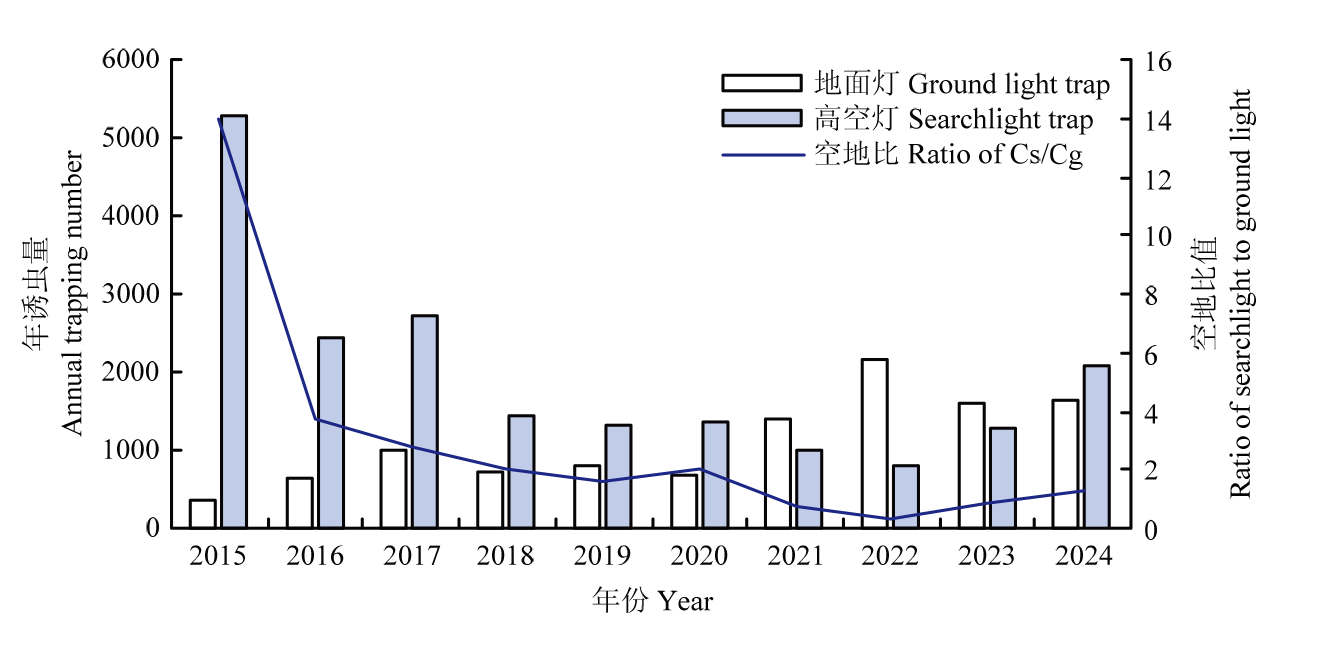
图1
2015—2024年高空灯和地面灯下异色瓢虫的诱虫量及空地比值"
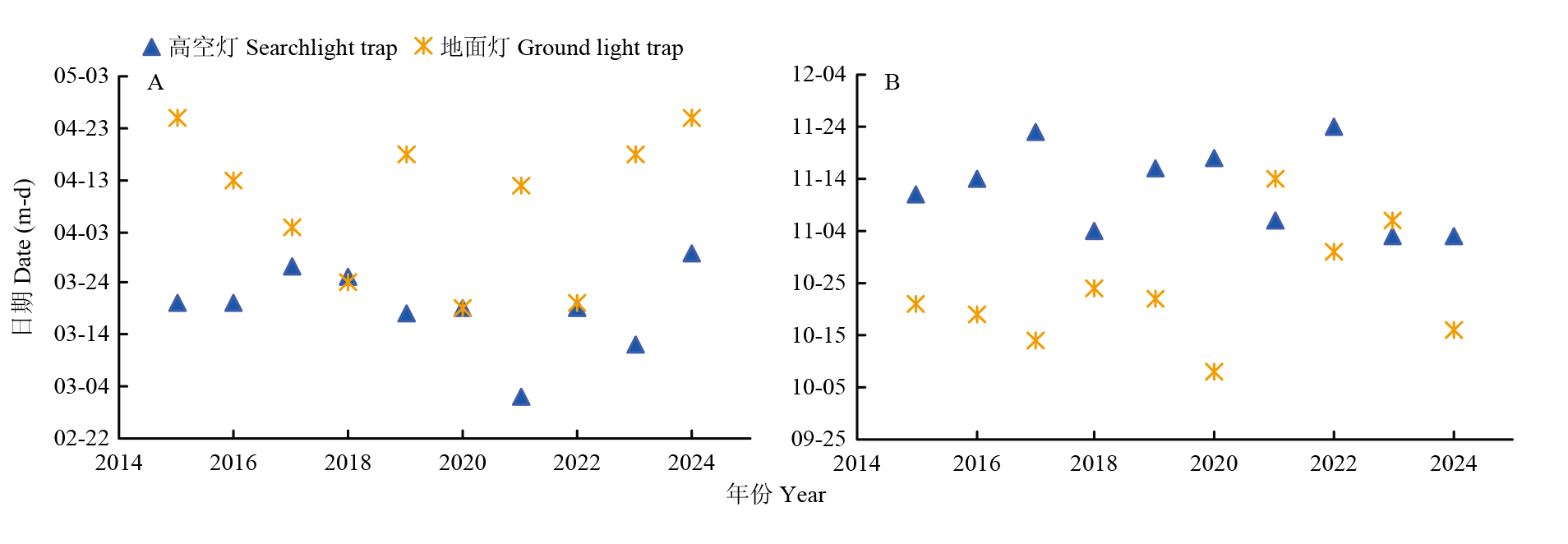
图2
2015—2024 年高空灯和地面灯下异色瓢虫的始见日(A)和终见日(B)"
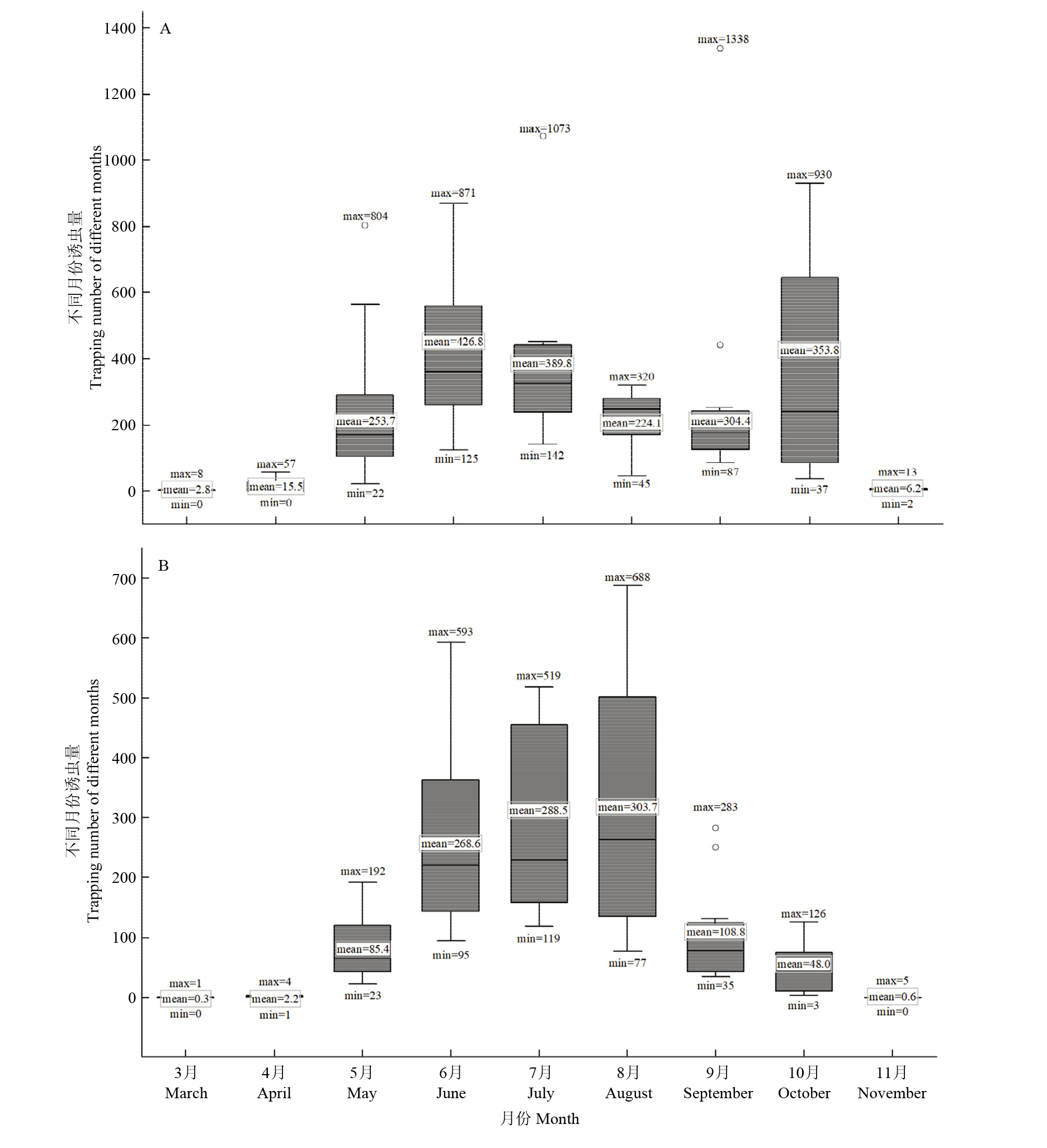
图3
2015—2024年高空灯(A)和地面灯(B)不同月份的诱虫量"
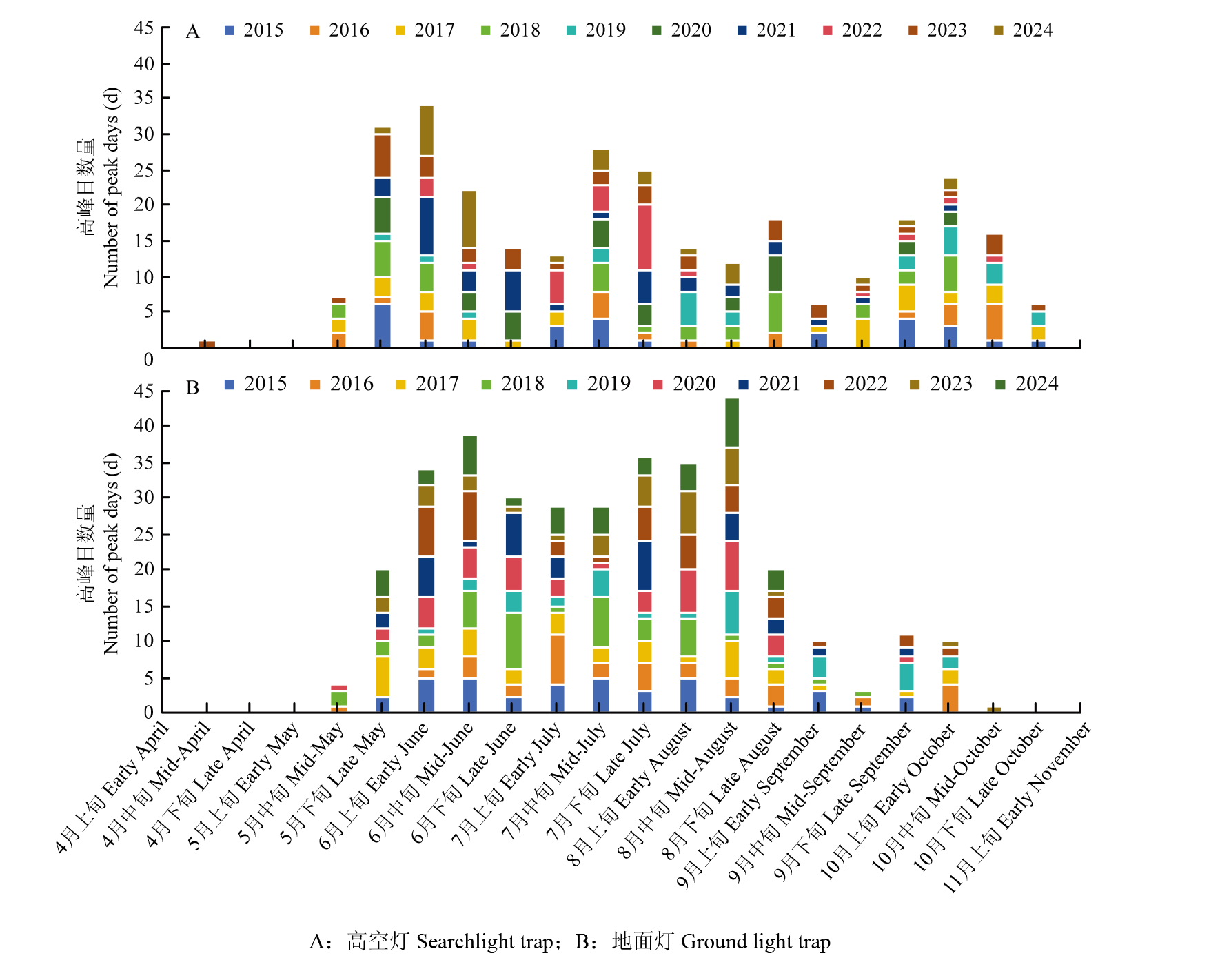
图4
2015—2024年不同旬高峰日的数量 A:高空灯Searchlight trap;B:地面灯Ground light trap"
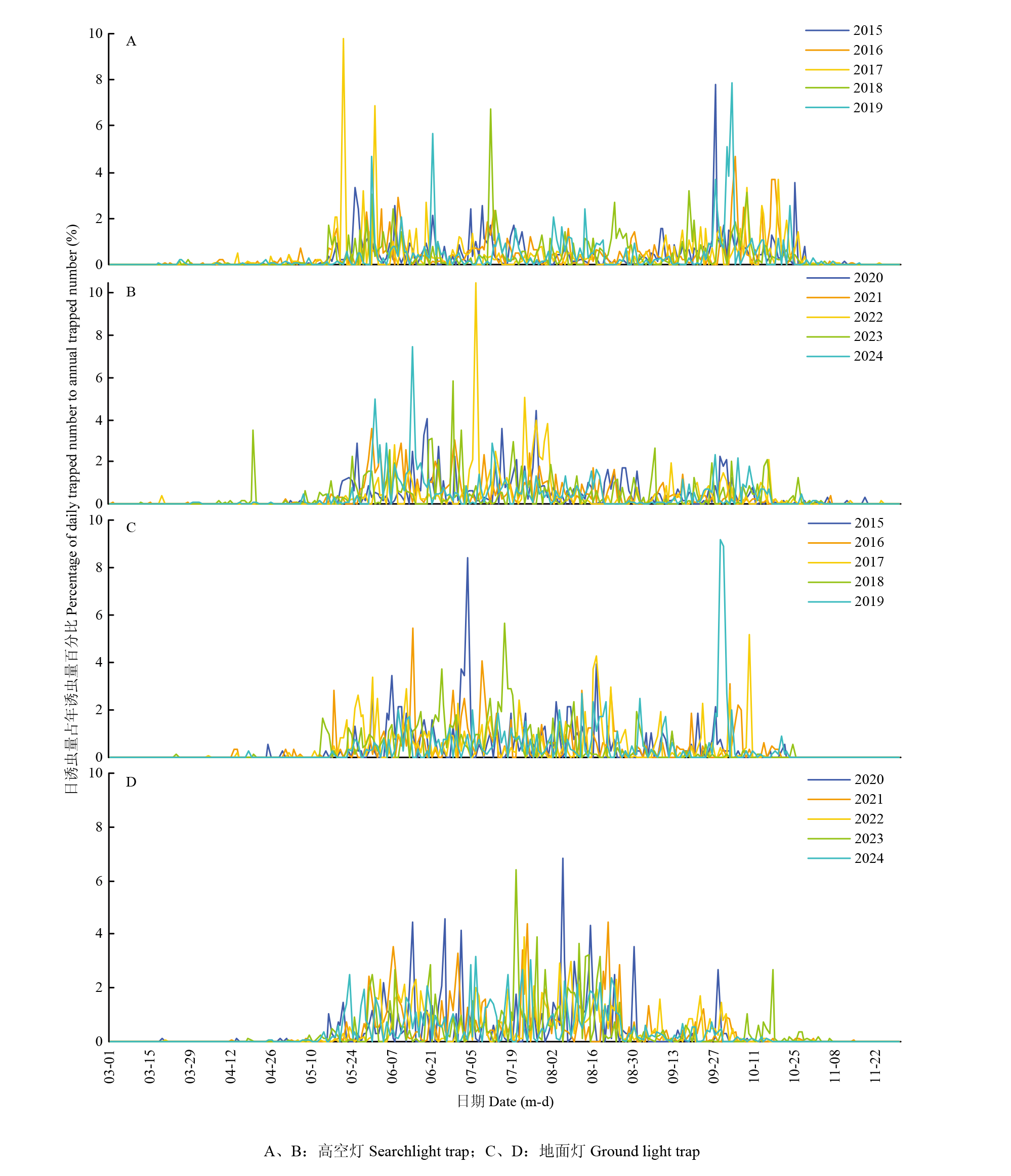
图5
2015—2024年两种诱虫灯日诱虫量占全年诱虫量的百分比 A、B:高空灯Searchlight trap;C、D:地面灯Ground light trap"
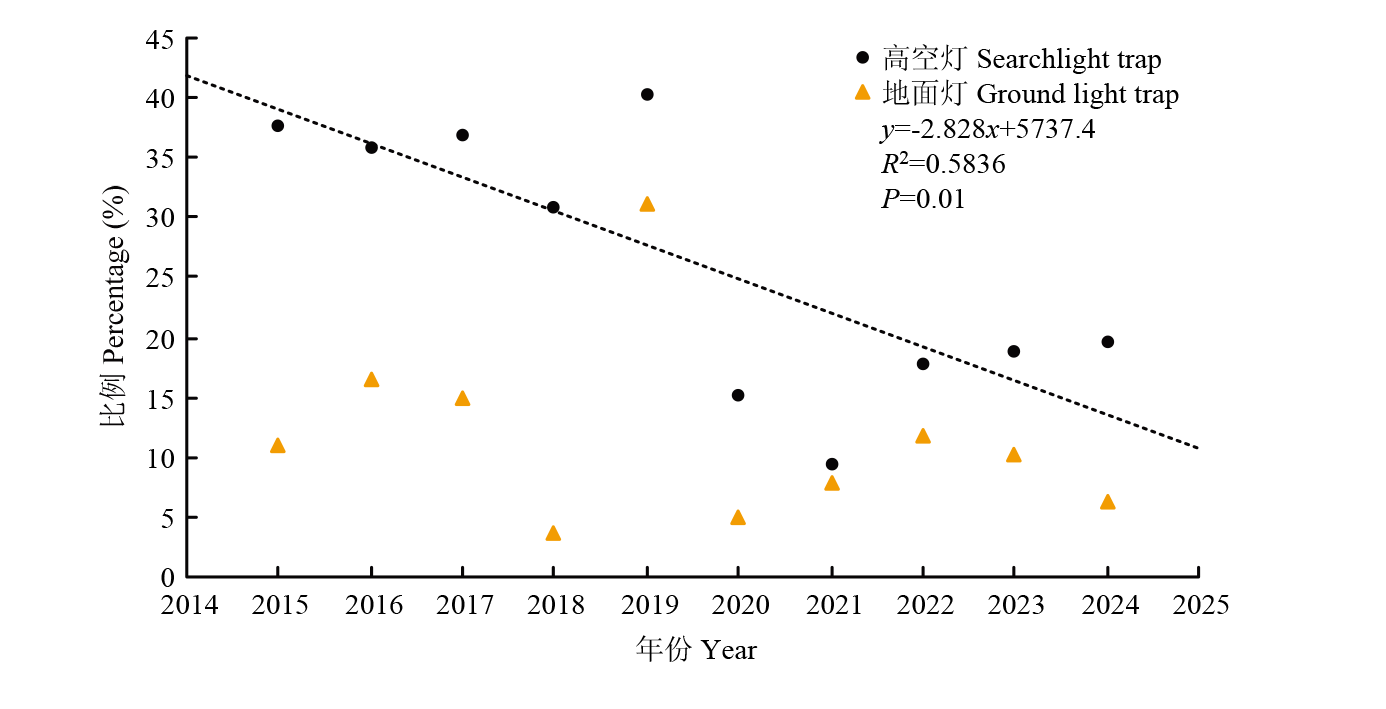
图6
2015—2024年9月中旬至10月下旬两种灯下异色瓢虫虫量占全年的比例"
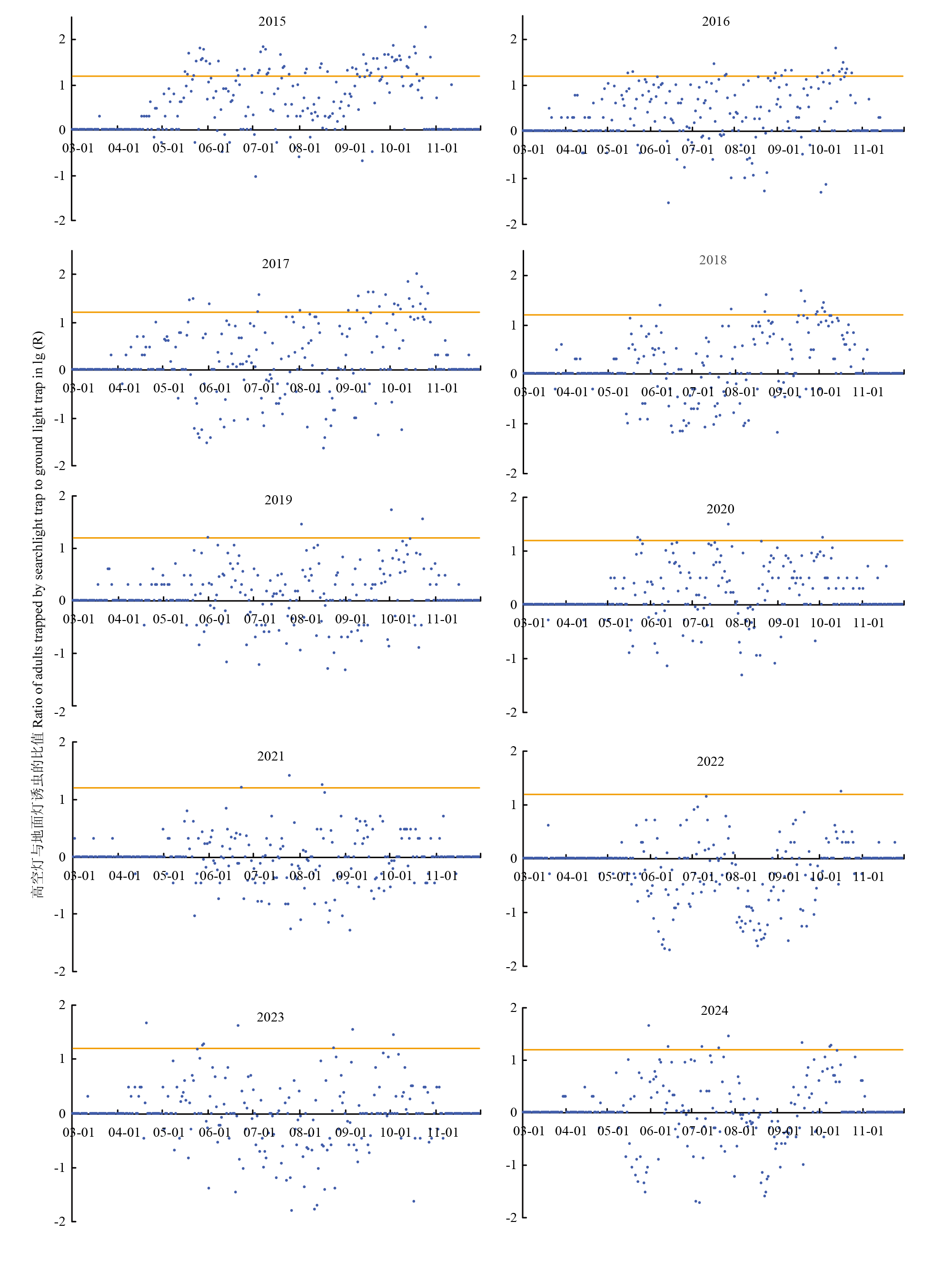
图7
2015—2024年高空灯与地面灯日诱虫量比值"
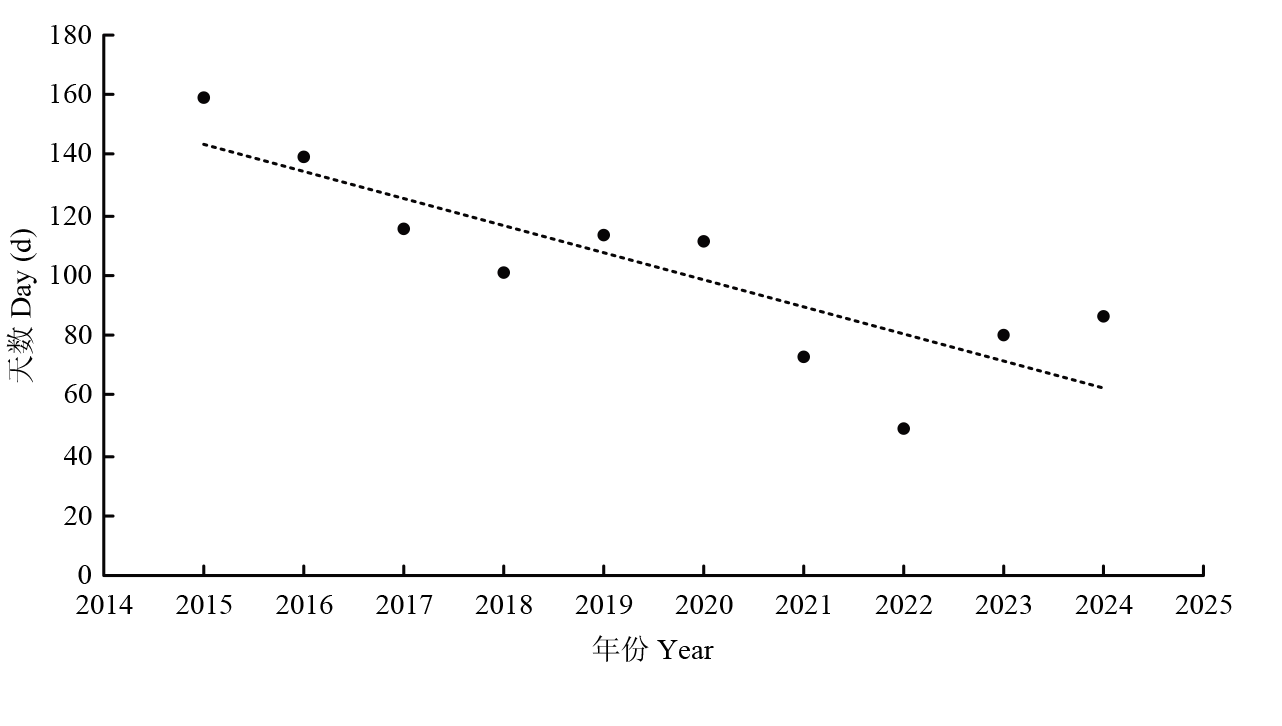
图8
2015—2024年高空灯与地面灯诱虫比值大于1的天数"
| [1] |
吴钰薇, 郑林浩, 高鹏, 石文倩, 王昱, 康健, 李启云, 徐文静. 异色瓢虫生物生态学及其应用研究进展. 黑龙江农业科学, 2022(10): 109-114.
|
|
|
|
| [2] |
|
| [3] |
王小艺, 沈佐锐. 异色瓢虫的应用研究概况. 昆虫知识, 2002, 39(4): 255-261.
|
|
|
|
| [4] |
李天奇, 李天娇, 陈琦, 侯艳红, 陈莉, 杜梦园, 师兴凯, 李世民. 河南漯河小麦和玉米轮作田瓢虫科天敌种类及种群动态. 山西农业科学, 2024, 52(3): 102-108.
|
|
|
|
| [5] |
王甦, 张润志, 张帆. 异色瓢虫生物生态学研究进展. 应用生态学报, 2007, 18(9): 2117-2126.
|
|
|
|
| [6] |
|
| [7] |
doi: 10.1111/ele.12407 pmid: 25611117 |
| [8] |
doi: 10.1002/ps.v78.2 |
| [9] |
赵天璇, 袁明龙. 我国异色瓢虫的生物生态学特性. 草业科学, 2017, 34(3): 614-629.
|
|
|
|
| [10] |
翟保平. 天敌伴迁与生物多样性. 生物多样性, 2001, 9(2): 176-180.
|
|
doi: 10.17520/biods.2001027 |
|
| [11] |
任频频, 李保国, 黄峰. 农作物种植结构演变下的黄淮海旱作区小麦玉米生产时空格局. 资源科学, 2022, 44(3): 436-449.
doi: 10.18402/resci.2022.03.02 |
|
doi: 10.18402/resci.2022.03.02 |
|
| [12] |
高倩, 杨秀丽, 吴林源, 李祥瑞, 朱勋, 张云慧. 黄淮海地区小麦穗期蚜虫的优势种及在麦株上的垂直分布生态位. 昆虫学报, 2025, 68(2): 163-173.
|
|
|
|
| [13] |
王振营, 王晓鸣. 我国玉米病虫害发生现状、趋势与防控对策. 植物保护, 2019, 45(1): 1-11.
|
|
|
|
| [14] |
张云慧. 东北与华北地区迁飞昆虫的垂直昆虫雷达监测与虫源分析[D]. 北京: 中国农业科学院, 2008.
|
|
|
|
| [15] |
吴先福, 封洪强, 薛芳森, 吴孔明. 昆虫迁飞过程中的定向行为. 植物保护, 2006, 32(5): 1-5.
|
|
|
|
| [16] |
宋海燕, 李丽莉, 张晴晴, 孙晨可, 李超, 卢增斌, 朱振国, 于毅, 门兴元. 山东省探照灯诱虫器和地面灯诱虫器诱集昆虫群落结构. 应用昆虫学报, 2021, 58(3): 724-735.
|
|
|
|
| [17] |
邓望喜, 许克进, 荣秀兰, 许甲柱. 飞机网捕褐稻虱及白背飞虱的研究初报. 昆虫知识, 1980, 17(3): 97-102.
|
|
|
|
| [18] |
周燕. 渤海湾地区棉铃虫-草蛉同步迁飞行为的研究[D]. 北京: 中国农业科学院, 2022.
|
|
|
|
| [19] |
封洪强. 华北地区空中昆虫群落及昆虫季节性迁移的雷达观测[D]. 北京: 中国农业科学院, 2003.
|
|
|
|
| [20] |
程登发, 封洪强, 吴孔明. 扫描昆虫雷达与昆虫迁飞监测. 北京: 科学出版社, 2005: 1-20.
|
|
|
|
| [21] |
doi: 10.1603/0046-225X-33.5.1253 |
| [22] |
王丽丽, 栾炳辉, 王洪涛, 王培松, 高兴祥, 刘保友. 两种诱虫灯下亚洲玉米螟种群动态及迁飞状态分析. 中国农业科学, 2024, 57(20): 4071-4081. doi: 10.3864/j.issn.0578-1752.2024.20.012.
|
|
|
|
| [23] |
宋海燕, 李丽莉, 张晴晴, 宋莹莹, 朱振国, 卢增斌, 于毅, 门兴元. 昆虫经山东省向南迁飞的种类及迁飞路线探讨. 应用昆虫学报, 2021, 58(3): 592-600.
|
|
|
|
| [24] |
徐练, 文礼章, 易倩, 胡亮, 彭云鹏. 不同光波、光源距离及环境温度对异色瓢虫成虫趋光行为的影响. 中国农学通报, 2016, 32(10): 106-113.
doi: 10.11924/j.issn.1000-6850.casb15100034 |
|
|
|
| [25] |
刘超华, 汪红武, 陈利珍, 王小平, 雷朝亮. 苎麻田灯下主要害虫及天敌成分分析. 环境昆虫学报, 2013, 35(4): 422-427.
|
|
|
|
| [26] |
贾艺凡. 三种重要夜蛾科害虫灯下种群动态与上灯行为节律研究[D]. 南京: 南京农业大学, 2016.
|
|
|
|
| [27] |
doi: 10.1093/jee/97.6.1874 |
| [28] |
程云霞, 康爱国, 王泱洋, 高峰, 江幸福. 高空灯与黑光灯对草地螟成虫监测效果的差异分析. 植物保护, 2025, 51(3): 62-68.
|
|
|
|
| [29] |
韩海亮, 章金明, 董航顺, 陈斌, 王桂跃, 徐红星, 吕仲贤, 赵福成. 两种测报灯对浙中地区玉米田害虫的种群监测与动态分析. 上海农业学报, 2023, 39(4): 78-84.
|
|
|
|
| [30] |
焦桂华, 曾娟, 尚秀梅, 刘杰. 高空测报灯与自动虫情测报灯监测黏虫的比较试验. 中国植保导刊, 2017, 37(8): 41-44, 47.
|
|
|
|
| [31] |
梁晓辰. 七星瓢虫与异色瓢虫麦田种群动态及影响因子分析[D]. 泰安: 山东农业大学, 2017.
|
|
|
|
| [32] |
侯艳红, 杜梦园, 李卫华, 陈莉, 沈海龙, 王文豪, 刘迪, 陈琦, 范志业, 师兴凯, 李世民, 黄建荣. 漯河地区亚洲玉米螟越冬代种群与温度关系分析. 玉米科学, 2026, 34(1): 111-117.
|
|
|
|
| [33] |
余金咏, 于泉林. 冀东地区亚洲玉米螟化性探讨. 玉米科学, 2013, 21(3): 140-143, 148.
|
|
|
|
| [34] |
张鹤, 林进添. 昆虫对全球气候变暖的响应. 环境昆虫学报, 2015, 37(6): 1280-1286.
|
|
|
|
| [35] |
侯艳红, 杜梦园, 陈琦, 刘迪, 王文豪, 李雷雷, 沈海龙, 陈莉, 范志业, 李世民, 黄建荣. 2010—2021年河南漯河玉米螟和桃蛀螟种群动态演变. 中国植保导刊, 2023, 43(7): 39-43.
|
|
|
|
| [36] |
段云, 陈琦, 董嘉欣, 高凌云, 李世民, 武予清. 2015年—2020年河南漯河越冬代劳氏黏虫的种群动态及虫源性质分析. 植物保护, 2023, 49(1): 334-339, 345.
|
|
|
|
| [37] |
doi: 10.1002/ece3.v9.21 |
| [38] |
doi: 10.1007/s10340-019-01187-5 |
| [39] |
|
| [40] |
徐扬, 张琦, 郭线茹, 赵曼, 李为争, 席玉强, 王高平, 胡明鑫, 张利娟. 当前和未来气候下龟纹瓢虫在中国的适生区预测. 环境昆虫学报, 2024, 46(6): 1391-1400.
|
|
|
|
| [41] |
张智, 祁俊锋, 张瑜, 林培炯, 张云慧. 迁飞性害虫监测预警技术发展概况与应用展望. 应用昆虫学报, 2021, 58(3): 530-541.
|
|
|
|
| [42] |
付晓伟. “渤海湾通道”迁飞性昆虫群落结构及种群动态研究[D]. 北京: 中国农业科学院, 2015.
|
|
|
|
| [43] |
杨俊成, 李春晓, 沈佐锐. 异色瓢虫越冬地的选择及迁入、迁出量的测定//中国昆虫学会2000年学术年会论文集. 北京: 中国科学技术出版社, 2000: 1047-1050.
|
|
|
|
| [44] |
张云慧, 陈林, 程登发, 姜玉英, 吕英. 草地螟2007年越冬代成虫迁飞行为研究与虫源分析. 昆虫学报, 2008, 51(7): 720-727.
|
|
|
| [1] | 黄圣琳, 许怡博, 孔祥义, 史彩华, 焦晓国, 张友军, 吴明月, 谢文. 海南豇豆豆大蓟马周年种群动态分析[J]. 中国农业科学, 2025, 58(21): 4439-4450. |
| [2] | 王丽丽, 栾炳辉, 王洪涛, 王培松, 高兴祥, 刘保友. 两种诱虫灯下亚洲玉米螟种群动态及迁飞状态分析[J]. 中国农业科学, 2024, 57(20): 4071-4081. |
| [3] | 石娜, 路杨, 隋丽, 王佳江, 赵宇, 李启云, 张正坤. 莱氏绿僵菌与异色瓢虫协同增效防治蚜虫研究[J]. 中国农业科学, 2024, 57(17): 3398-3407. |
| [4] | 葛欣竺,史宇星,王莎莎,刘智慧,蔡文杰,周敏,王世贵,唐斌. 异色瓢虫丙酮酸激酶基因序列分析及其调控海藻糖代谢功能[J]. 中国农业科学, 2021, 54(23): 5021-5031. |
| [5] | 闫硕,熊晓菲,褚艳娜,李贞,巫鹏翔,杨清坡,崔维娜,徐金涛,徐丽霞,张青文,刘小侠. 异色瓢虫胁迫对棉铃虫生长发育及压力蛋白基因表达的影响[J]. 中国农业科学, 2017, 50(21): 4118-4128. |
| [6] | 汪慧娟,赵静,施佐堃,邱玲玉,王甦,张帆,王世贵,唐斌. 异色瓢虫3个小分子热激蛋白序列及低温诱导表达分析[J]. 中国农业科学, 2017, 50(16): 3145-3154. |
| [7] | 邬梦静,徐青叶,刘雅,施兴荣,沈祺达,杨萌萌,王世贵,唐斌. 异色瓢虫低温胁迫下过冷却点变化及抗寒基因表达分析[J]. 中国农业科学, 2016, 49(4): 677-685. |
| [8] | 赵静,肖达,张帆,王甦. 恒温和温室波动温度下异色瓢虫种群生命表[J]. 中国农业科学, 2015, 48(16): 3176-3185. |
| [9] | 王甦, 谭晓玲, 徐红星, 张帆. 三种捕食性瓢虫的种间竞争作用[J]. 中国农业科学, 2012, 45(19): 3980-3987. |
| [10] | 李号宾,吴孔明,杨秀荣,徐遥,姚举,汪飞,马祁. 新疆南部棉区棉铃虫发生趋势及Bt棉花的控制效率[J]. 中国农业科学, 2006, 39(01): 199-205 . |
| [11] | 万鹏,黄民松,吴孔明,吴金萍. 转Cry1A基因棉对棉蚜生长发育及种群动态的影响[J]. 中国农业科学, 2003, 36(12): 1484-1488 . |
| [12] | 翟保平,程家安,黄恩友,商晗武,郑雪浩,吴建,方勇军,夏万清,吕旭剑. 浙江省双季稻区稻水象甲的发生动态[J]. 中国农业科学, 1997, 30(06): 23-29 . |
| [13] | 王华弟,张左生,程家安,汪信庚,汤金仪,章连观. 水稻三化螟预测预报与防治对策研究[J]. 中国农业科学, 1997, 30(03): 14-20 . |
| [14] | 王华弟,罗会华,汪恩国,金思明,罗增明. 长江流域稻区黑线姬鼠发生动态与防治指标研究[J]. 中国农业科学, 1993, 26(06): 36-43 . |
|
||
