






中国农业科学 ›› 2026, Vol. 59 ›› Issue (7): 1552-1563.doi: 10.3864/j.issn.0578-1752.2026.07.013
钟荣阳( ), 魏守辉, 王晓珊, 史对宏, 闵磊国, 王文华, 王江波, 肖雪梅()
收稿日期:2025-09-14
接受日期:2026-01-13
出版日期:2026-04-08
发布日期:2026-04-08
通信作者:
联系方式:
钟荣阳,Tel:18523981256;E-mail:2028384535@qq.com。
基金资助:
ZHONG RongYang(), WEI ShouHui, WANG XiaoShan, SHI DuiHong, MIN LeiGuo, WANG WenHua, WANG JiangBo, XIAO XueMei()
Received:2025-09-14
Accepted:2026-01-13
Published:2026-04-08
Online:2026-04-08
摘要:
【目的】系统解析芫荽叶片在5个关键生长时期的挥发性成分变化,明确其香气形成的关键阶段与特征成分,为芫荽的高品质栽培、适时采收及深加工利用提供理论依据。【方法】以‘四季大油叶’芫荽为材料,于播种后15、25、35、45和55 d时分别取样。采用顶空固相微萃取-气相色谱-质谱联用技术(HS-SPME/GC-MS)分析叶片挥发性物质的组成与含量,并通过电子鼻(E-Nose)系统获取其气味整体响应特征。进一步利用香气活性值(odor activity value,OAV)筛选关键香气成分(OAV>1)。通过Pearson相关性分析探讨挥发性物质与电子鼻传感器响应之间的关联。【结果】GC-MS共鉴定出119种挥发性成分,包括醛类(38种)、醇类(17种)、烃类(25种)、酯类(8种)、酸类(10种)、酮类(8种)及其他(13种)。挥发性物质种类数与总含量均呈先升后降趋势,均在35 d达到峰值,种类数达69种,总含量较15 d时显著增长37.3%(P<0.05)。醛类为主要成分,其含量在35 d时较15 d增长45.5%,其中反-2-十四烯醛、反-2-癸烯醛等长链醛为主要贡献成分。电子鼻分析表明,传感器W2W(芳香与硫化物)、W5S(氮氧化物)和W1C(芳香化合物)响应最强,其信号变化与生长阶段显著相关。OAV分析共筛选出17种关键香气成分(OAV>1),其中15种为醛类。反-2-十四烯醛在25 d时OAV值最高(175 850),是形成“清香-柑橘香”特征的主导物质。雷达指纹图谱显示,不同生长阶段香气轮廓差异显著:15 d时以“清香”为主,25—35 d时“柑橘香”与“油脂香”增强,45 d时“果香”与“樟脑香”突出,55 d时“花香”特征显著。相关性分析进一步揭示关键醛类物质与电子鼻传感器响应之间存在显著正相关或负相关,存在一定的特异性关联。【结论】电子鼻与GC-MS联合分析可有效识别芫荽不同生长阶段的香气变化特征,并建立了传感器响应与挥发性成分之间的关联模型,明确了芫荽叶片挥发性物质的动态变化规律。
钟荣阳, 魏守辉, 王晓珊, 史对宏, 闵磊国, 王文华, 王江波, 肖雪梅. GC-MS和E-Nose联合解析芫荽不同生长阶段芳香物质变化规律[J]. 中国农业科学, 2026, 59(7): 1552-1563.
ZHONG RongYang, WEI ShouHui, WANG XiaoShan, SHI DuiHong, MIN LeiGuo, WANG WenHua, WANG JiangBo, XIAO XueMei. Aroma Formation and Key Volatile Compounds in Coriander Leaves Across Growth Stages Based on GC-MS and E-Nose[J]. Scientia Agricultura Sinica, 2026, 59(7): 1552-1563.
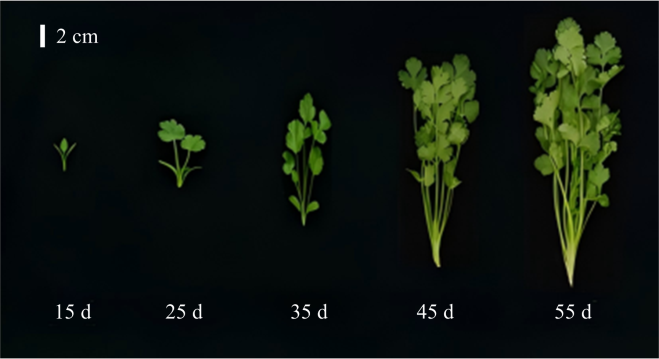
图1
不同生长阶段芫荽的形态照片"
表1
霍格兰营养液使用配方"
| 化合物 Compound | 化合物质量浓度 Concentration of compound (mg·L-1) | |
|---|---|---|
| A液 | KNO3 | 505.5 |
| Ca(NO)3·4H2O | 1180.9 | |
| B液 | MgSO4·7H2O | 492.94 |
| KH2PO4 | 136.09 | |
| C液 | H3BO3 | 2.78 |
| MnCl4·4H2O | 1.98 | |
| ZnSO4·7H2O | 0.23 | |
| H2MoO4 | 0.06 | |
| CuSO4·5H2O | 0.08 | |
| 铁盐 Ferric salt | EDTA铁钠盐 EDTA ferric-sodium salt | 7.45 |
表2
电子鼻传感器性能描述"
| 序号 Serial number | 传感器名称 Sensor name | 性能描述 Performance description |
|---|---|---|
| 1 | W1C | 对芳香成分、苯类灵敏 Sensitive to aromatic components and benzene compounds |
| 2 | W5S | 对氮氧化物灵敏 Sensitive to nitrogen oxides |
| 3 | W3C | 对氨类、芳香成分灵敏 Sensitive to ammonia and aromatic components |
| 4 | W6S | 对氢化物灵敏 Sensitive to hydrogen |
| 5 | W5C | 对短链烷烃、芳香成分灵敏 Sensitive to hydrocarbons and aromatic components |
| 6 | W1S | 对甲烷类灵敏 Sensitive to methane |
| 7 | W1W | 对硫化物、萜烯类灵敏 Sensitive to sulfides and terpenoids |
| 8 | W2S | 对醇类、部分醛酮类灵敏 Sensitive to alcohols and some aldehydes and ketones |
| 9 | W2W | 对有机硫化物、芳香成分灵敏 Sensitive to organic sulfur and aromatic components |
| 10 | W3S | 对长链烷烃灵敏 Sensitive to long-chain alkanes |
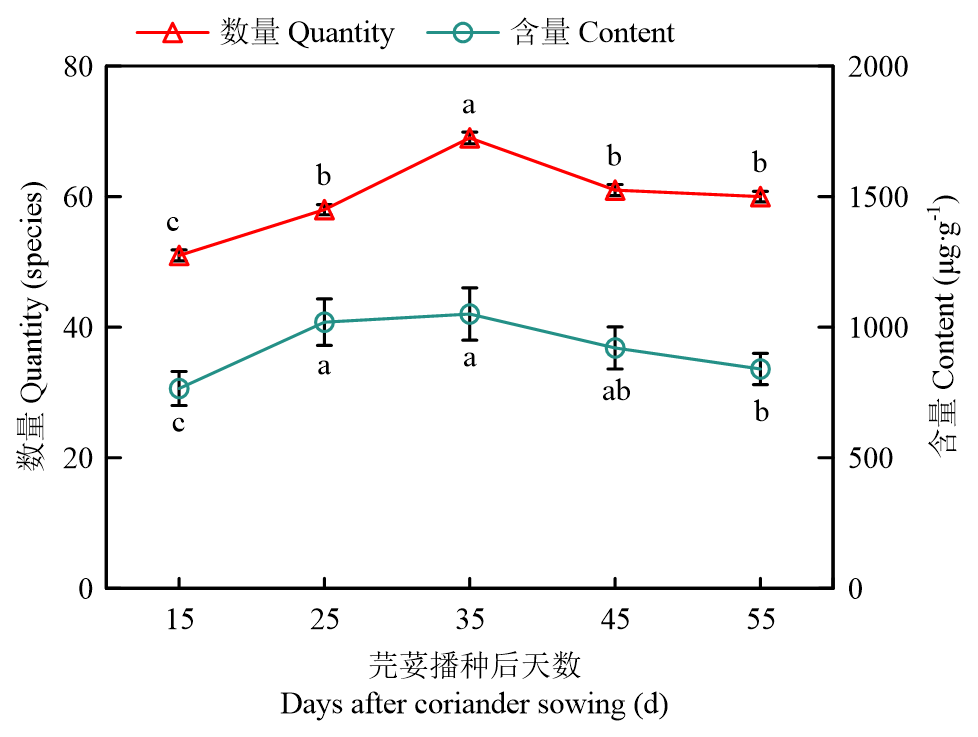
图2
芫荽不同生长阶段挥发性物质的总数量和总含量 不同小写字母表示差异显著(P<0.05)。下同"
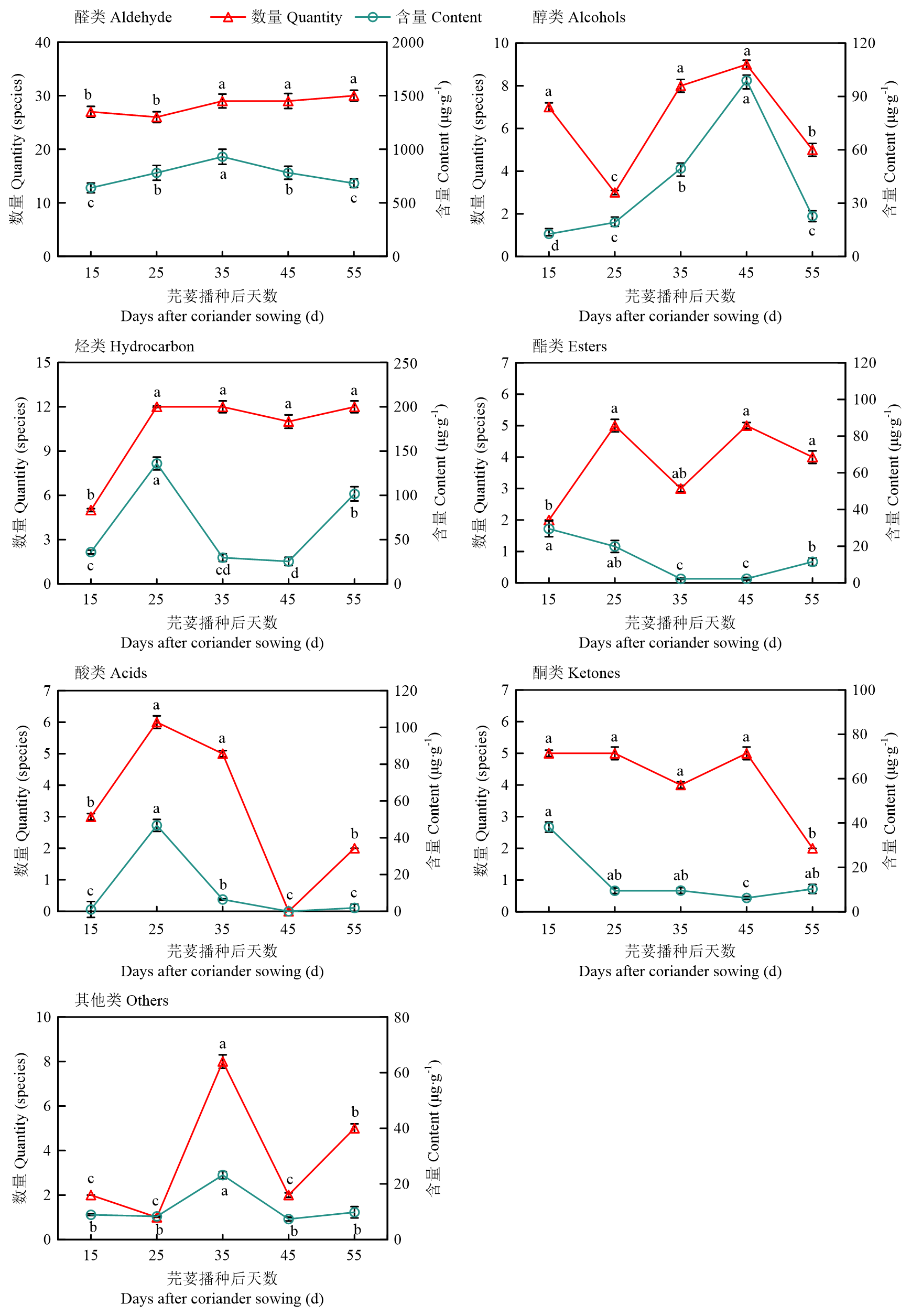
图3
不同生长阶段芫荽各类挥发性物质数量和含量"
表3
芫荽不同生长阶段的差异香气OAV值"
| 名称 Name | 类型 Type | 香气描述 Description of the aroma | 阈值 Threshold (μg·g-1) | OAV | ||||
|---|---|---|---|---|---|---|---|---|
| 15 d | 25 d | 35 d | 45 d | 55 d | ||||
| γ-松油烯 γ-Terpinene | 烯烃类 Olefin | 柑橘味 Orange | 1 | — | — | — | <1 | — |
| β-石竹烯 β-Caryophyllene | 烯烃类 Olefin | 留兰香、油脂味、芳香和辛香 Spearmint, Fatty, Fragrant, Spicy | 64 | — | — | — | <1 | — |
| 芳樟醇 Linalool | 醇类 Alcohols | 柑橘、铃兰香、花香 Orange, Muguet, Floral | 0.22 | 2.05 | — | 4.32 | 9.14 | — |
| 橙花醇 Nerol | 醇类 Alcohols | 果香、花香、甜香 Fruity, Floral, Sweet | 0.4 | — | — | 1.13 | — | — |
| 植物醇 Phytol | 醇类 Alcohols | 油脂、青草香 Fatty, Grassy | 0.64 | 2.94 | 4.47 | <1 | — | <1 |
| 苯乙醛Phenylacetaldehyde | 醛类 Aldehydes | 花香、甜香 Floral, Sweet | 6.3 | <1 | <1 | — | — | — |
| 2-己烯醛 2-Hexenal | 醛类 Aldehydes | 果香、青草香 Fruity, Grassy | 0.85 | — | — | 1.76 | <1 | 7.48 |
| 反-2-己烯醛 Trans-2-Hexenal | 醛类 Aldehydes | 油脂、青草香 Fatty, Grassy | 0.424 | — | — | — | <1 | <1 |
| 辛醛 Octanal | 醛类 Aldehydes | 柑橘香气 Orange | 0.056 | 23 | 22 | 31 | 40 | 58 |
| 反,反-2,4-癸二烯醛Trans,trans-2,4-Decadienal | 醛类 Aldehydes | 油脂 Fatty | 0.07 | — | — | — | — | 50.57 |
| β-环柠檬醛 β-cyclocitral | 醛类 Aldehydes | 樟脑气味 Camphoraceous | 0.005 | — | — | 100 | 110 | 102 |
| 壬醛 Nonanal | 醛类 Aldehydes | 柑橘香气、清香 Orange,Fresh | 3.5 | <1 | — | <1 | 1.90 | 1.55 |
| 苯甲醛 Benzaldehyde | 醛类 Aldehydes | 杏仁气味 Almond | 41.7 | <1 | — | <1 | <1 | <1 |
| 十一醛 Undecanal | 醛类 Aldehydes | 花香、柑橘香气 Floral, Orange | 5 | 1.04 | 1 | 2.06 | 3.20 | 3.49 |
| 反-2-十一烯醛 Trans-2-Undecenol | 醛类 Aldehydes | 果香、柑橘香气 Fruity, Orange | 0.005 | 1430 | 2230 | 3720 | 9100 | 5018 |
| 反-2-癸烯醛 E-2-Decenal | 醛类 Aldehydes | 油脂、柑橘香气 Fatty, Orange | 0.01 | 4148 | 4411 | 8659 | 5328 | 2784 |
| 2-十二烯醛 Trans-2-Dodecenal | 醛类 Aldehydes | 油脂 Fatty | 0.0014 | 4700 | 12364 | 8585 | 25878 | 15850 |
| 十二醛 Dodecyl aldehyde | 醛类 Aldehydes | 柑橘香气、清香 Orange, Fresh | 0.01 | 286 | 25119 | 1524 | 2915 | 1069 |
| 反-2-十二烯醛 (E)-2-decenal | 醛类 Aldehydes | 油脂、柑橘香气 Fatty, Orange | 0.0014 | 27435 | 38900 | 104364 | 94071 | 96307 |
| 癸醛 Decanal | 醛类 Aldehydes | 柑橘香气 Orange | 10 | 5.9 | 4.60 | 7.09 | 7.93 | 5.03 |
| 十三醛 Tridecanal | 醛类 Aldehydes | 柑橘香气、清香 Orange, Fresh | 0.07 | 76 | 47 | 74 | 68 | 40 |
| 反-2-十三烯醛 (E)-2-tridecen-1-al | 醛类 Aldehydes | 油脂、柑橘香气 Fatty, Orange | 0.0008 | 14662 | 39375 | 53012 | 7812 | 37700 |
| 十四醛 Tetradecanal | 醛类 Aldehydes | 油脂 Fatty | 0.11 | 21 | 204 | 113 | 45 | 86 |
| 反-2-十四烯醛 Trans-2-Tetradecenal | 醛类 Aldehydes | 清香、柑橘香气 Fresh, Orange | 0.002 | 151585 | 175850 | 151375 | 92850 | 50025 |
| 十五醛 Pentadecanal | 醛类 Aldehydes | 甜香 Sweet | 0.43 | 3.35 | — | — | — | — |
| β-紫罗酮 β-ionone | 酮类 Ketones | 果香、花香 Fruity, Floral | 0.007 | — | — | — | 296 | 121 |
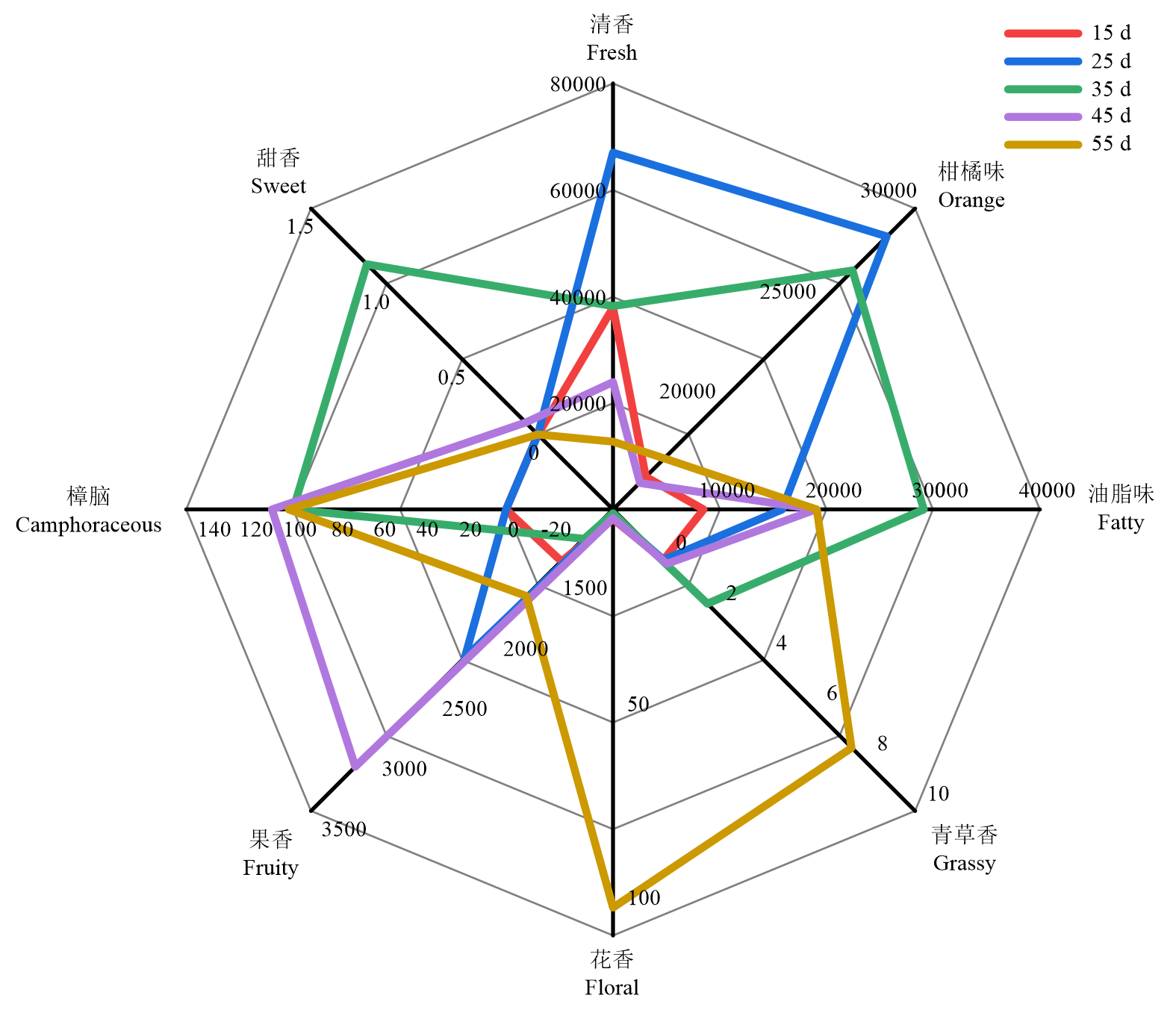
图4
不同生长阶段芫荽挥发性物质的雷达指纹图谱"
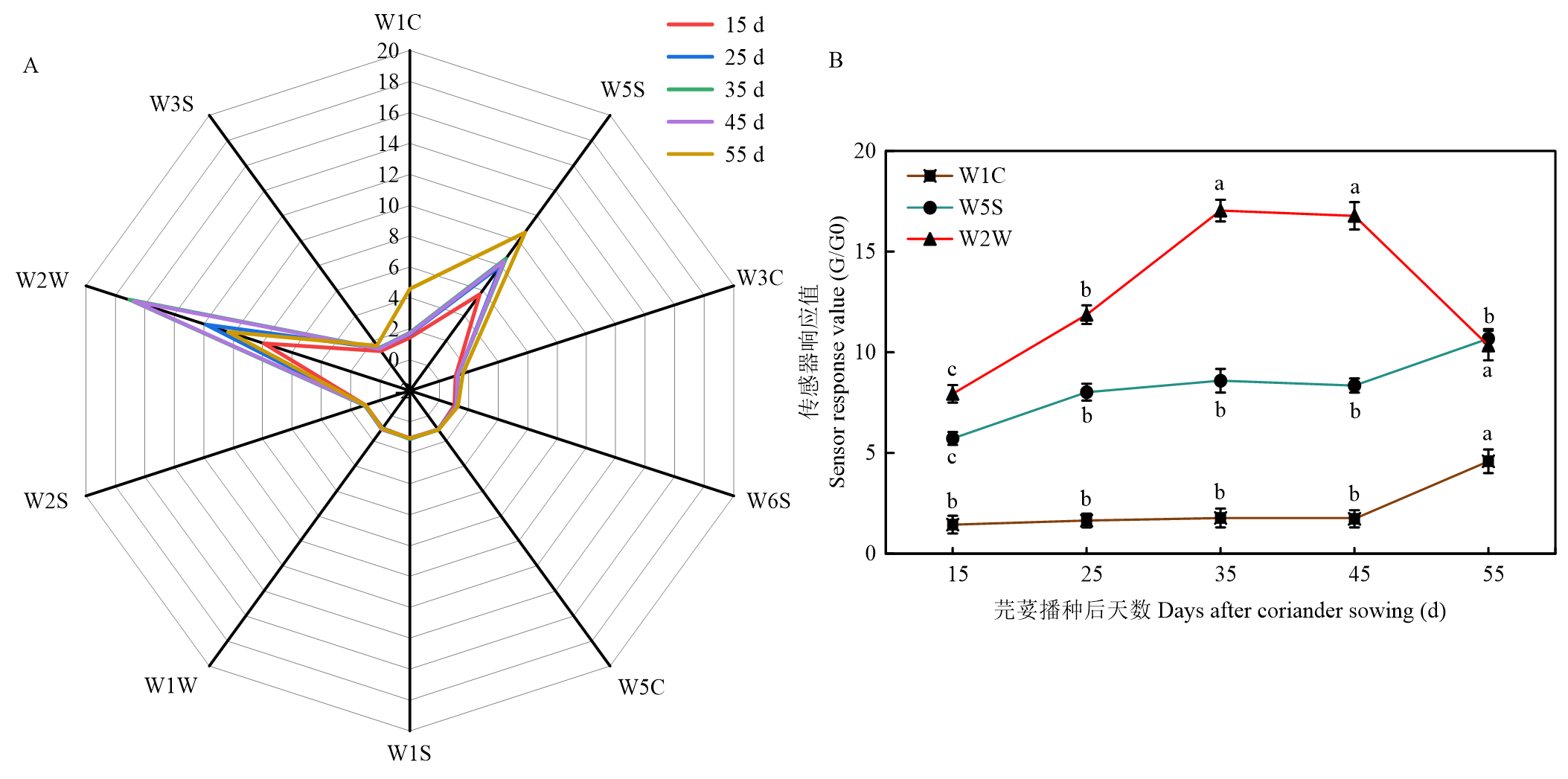
图5
芫荽挥发性物质的电子鼻雷达图(A)和传感器响应值动态图(B)"
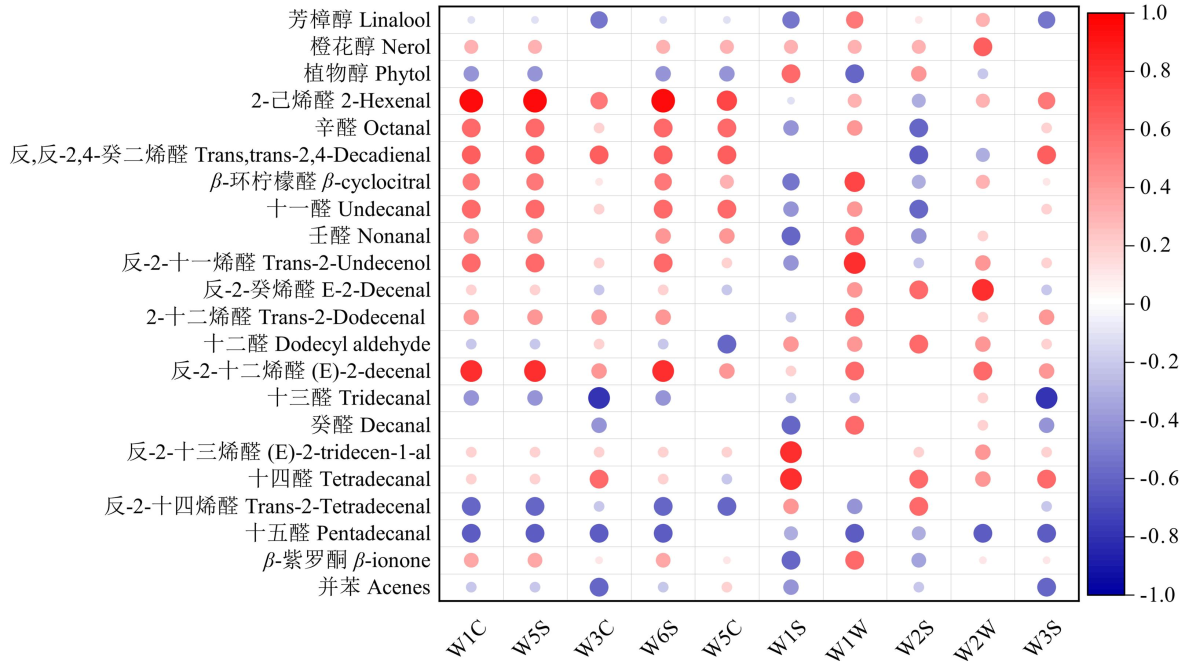
图6
不同生长阶段芫荽挥发性物质挥发性物质和电子鼻传感器的相关性分析"
| [1] |
doi: 10.1016/j.indcrop.2021.113599 |
| [2] |
doi: 10.1080/0972060X.2022.2049892 |
| [3] |
doi: 10.1021/jf60178a018 |
| [4] |
刘信平, 张驰, 谭志伟, 于爱农. 香菜地上部分挥发活性成分研究. 食品科学, 2008, 29(8): 517-519.
|
|
|
|
| [5] |
|
| [6] |
doi: 10.3389/fchem.2024.1369745 |
| [7] |
doi: 10.1016/j.foodchem.2024.140128 |
| [8] |
余亦婷, 赵乙萌, 袁曦, 曹丽娟, 李西文, 陆兔林, 严国俊. Heracles Neo超快速气相电子鼻对不同产地、生长年限及采收期黄芪药材品质评价研究. 中草药, 2022, 53(5): 1328-1337.
|
|
|
|
| [9] |
doi: 10.1016/j.foodres.2024.114964 |
| [10] |
doi: 10.1038/s41598-022-11555-4 |
| [11] |
张一昊, 宗梦婷, 刘艳红, 唐兴莹, 方林江, 马兆成. 基于HS-SPME-GC-MS的临沧普洱生茶与传统绿茶香气差异分析. 生物资源, 2025, 47(5): 456-469.
|
|
|
|
| [12] |
doi: 10.1016/j.fochx.2024.101892 |
| [13] |
doi: 10.1002/fsn3.v8.2 |
| [14] |
doi: 10.1016/j.fochx.2023.101007 |
| [15] |
杜玲玲, 孟晓伟, 胡伊涵, 刘荣华, 张寿文, 钟凌云, 朱卫丰, 梁永强. 不同陈化年份陈皮(樟头红)挥发成分差异的电子鼻与HS-GC-MS对比分析. 食品科学, 2025, 46(11): 253-262.
|
|
|
|
| [16] |
doi: 10.1016/j.ultsonch.2024.106979 |
| [17] |
魏守辉. 芫荽挥发性物质萃取方法优化及外源茉莉酸甲酯对其调控的机理研究[D]. 兰州: 甘肃农业大学, 2023.
|
|
|
|
| [18] |
doi: 10.1016/j.foodres.2024.115363 |
| [19] |
doi: 10.1007/s12161-021-02001-8 |
| [20] |
doi: 10.1016/j.foodres.2025.116442 |
| [21] |
doi: 10.1016/j.lwt.2019.108666 |
| [22] |
doi: 10.3389/fpls.2022.822956 |
| [23] |
doi: 10.1016/j.foodchem.2024.142546 |
| [24] |
doi: 10.3390/horticulturae8060488 |
| [25] |
李威龙, 王顺, 李晓燕, 崔文嘉, 张诗翌, 林文浩, 李梦瑶. 芹菜不同品种生长时期挥发性有机物质成分分析. 四川农业大学学报, 2024, 42(2): 322-329, 338.
|
|
|
|
| [26] |
陈建英, 吕迪瑚, 杨春. 基于HS-SPME-GC-MS和感官评价分析不同时期木枣的挥发性物质. 食品与发酵工业, 2025, 51(1): 330-336.
doi: 10.13995/j.cnki.11-1802/ts.038327 |
|
doi: 10.13995/j.cnki.11-1802/ts.038327 |
|
| [27] |
李大龙, 郭潇雨, 李铁梅, 王泽珉, 宇航, 张鹏, 王佳明, 杨国慧. 利用电子鼻评价树莓果实香气. 东北农业大学学报, 2022, 53(7): 78-87.
|
|
|
|
| [28] |
|
| [29] |
doi: 10.1186/s42269-020-00448-z |
| [30] |
doi: 10.3390/molecules28020696 |
| [31] |
方灵, 孔宝玉, 韦航, 颜孙安, 刘文静, 司瑞茹, 史梦竹, 梁启富, 任丽花, 傅建炜. 不同发育阶段黄金百香果挥发性成分差异性研究. 果树学报, 2022, 39(12): 2376-2389.
|
|
|
|
| [32] |
doi: 10.3390/horticulturae10121361 |
| [33] |
doi: 10.1016/j.fochx.2024.101514 |
| [34] |
doi: 10.1016/j.foodchem.2025.143760 |
| [35] |
doi: 10.1016/j.jfca.2025.107201 |
| [36] |
阳景阳, 陈远权, 梁贤智, 王明释, 骆妍妃, 覃潇敏, 廖春文, 巫虹颖. HS-SPME-GC-MS结合OAV对乌龙茶树品种制花香型红茶的香气评价. 食品工业科技, 2025, 46(6): 315-324.
|
|
|
| [1] | 吴予灿, 张紫涵, 赵桂苹, 魏立民, 黄峰, 张春晖. 椰子汁煮制对文昌鸡食用品质的影响[J]. 中国农业科学, 2023, 56(16): 3199-3212. |
| [2] | 岳盈肖,何近刚,赵江丽,闫子茹,程玉豆,武肖琦,王永霞,关军锋. 窖藏和冷藏条件下鸭梨挥发性物质及其相关基因表达分析[J]. 中国农业科学, 2021, 54(21): 4635-4649. |
| [3] | 张芳,未志胜,王鹏,李凯旋,詹萍,田洪磊. 基于BP神经网络和遗传算法的库尔勒香梨挥发性物质萃取条件的优化[J]. 中国农业科学, 2018, 51(23): 4535-4547. |
| [4] | 宋伟,胡婉君,徐宗季,刘兵,樊艳,倪阳,杨慧萍. 湖南省主要早籼稻品种挥发性物质种类及含量[J]. 中国农业科学, 2017, 50(2): 348-361. |
| [5] | 曹俊,刘欣,陈文若,戴炳业,董文,陈银基. 基于E-NOSE与SPME-GC/MS技术分析温湿度动态变化过程中稻谷的挥发性成分[J]. 中国农业科学, 2017, 50(1): 142-160. |
| [6] | 方 勇,王红盼,裴 斐,马 宁,汤晓智,杨文建,胡秋辉. 挤压膨化对金针菇-发芽糙米复配粉的消化特性及挥发性物质的影响[J]. 中国农业科学, 2016, 49(23): 4606-4618. |
| [7] | 郭亚娟, 邓媛元, 张瑞芬, 张名位, 魏振承, 唐小俊, 张雁. 不同荔枝品种果干挥发性物质种类及其含量比较[J]. 中国农业科学, 2013, 46(13): 2751-2768. |
| [8] | 吴曼, 沈向, 王超, 董彦, 韩甜甜, 王荣. 童期长度不同的海棠叶挥发性物质的差异分析[J]. 中国农业科学, 2012, 45(12): 2438-2446. |
| [9] | 李洪军, 黄业传, 贺稚非, 李凤. 猪肉制品冷藏中感官特性和挥发性物质变化的回归分析[J]. 中国农业科学, 2012, 45(1): 142-152. |
| [10] | 李宝庆,鹿秀云,郭庆港,钱常娣,李社增,马平 . 枯草芽孢杆菌BAB-1产脂肽类及挥发性物质的分离和鉴定 [J]. 中国农业科学, 2010, 43(17): 3547-3554 . |
| [11] | 李晓磊,沈 向,王 磊,王庆菊,孙凡雅,康 鸾. 海棠不同品种果实香气物质分析[J]. 中国农业科学, 2008, 41(6): 1742-1748 . |
| [12] | 乔 宇,谢笔钧,张 妍,范 刚,徐晓云,周海燕,潘思轶. 三种温州蜜柑果实香气成分的研究[J]. 中国农业科学, 2008, 41(5): 1452-1458 . |
| [13] | 乜兰春,孙建设,陈华君,邹祥旺. 苹果不同品种果实香气物质研究[J]. 中国农业科学, 2006, 39(03): 641- . |
|
||
