






中国农业科学 ›› 2026, Vol. 59 ›› Issue (8): 1697-1711.doi: 10.3864/j.issn.0578-1752.2026.08.008
米春晓1,2( ), 张强1,2, 郭佳祺1,2, 樊林染1,2, 李睿颖1,2, 张艳军1,2, 张贵龙1,2, 王慧1,2(), 赵建宁1,2()
收稿日期:2025-12-29
接受日期:2026-02-08
出版日期:2026-04-21
发布日期:2026-04-21
通信作者:
联系方式:
米春晓,E-mail:872604507@qq.com。
基金资助:
MI ChunXiao1,2(), ZHANG Qiang1,2, GUO JiaQi1,2, FAN LinRan1,2, LI RuiYing1,2, ZHANG YanJun1,2, ZHANG GuiLong1,2, WANG Hui1,2(), ZHAO JianNing1,2()
Received:2025-12-29
Accepted:2026-02-08
Published:2026-04-21
Online:2026-04-21
摘要:
【目的】入侵植物根际土壤中可能蕴藏丰富的溶磷微生物资源,本研究旨在从其根际土壤中分离筛选高效溶磷菌株,为土壤改良和农业可持续发展挖掘具有应用潜力的功能菌株。【方法】以不同生境采集的10份入侵植物根际土壤样品为材料,基于溶磷固体培养基平板筛选和钼锑抗比色法获得高效溶磷菌株并进行分子鉴定,对鉴定出的新菌株进行溶磷能力测定及全基因组测序分析,通过序列组装、基因功能注释、挖掘潜在的磷循环相关功能基因簇及作用机制,分析其磷素利用潜能。【结果】从不同入侵植物根际土壤分离得到16株高效溶磷菌株,经16S rDNA鉴定获得两株新菌,分别命名为IPSM-1和IPSM-2。溶磷量测定结果表明,两株菌的溶磷效率差异显著,IPSM-2的溶磷量高达448.82 mg·L-1,显著高于IPSM-1的243.00 mg·L-1。利用MEGA软件邻接法构建系统进化树,证实了菌株IPSM-1与IPSM-2分别隶属于巨大普里斯特氏菌属(Priestia)和假单胞菌属(Pseudomonas)。采用溶磷圈法评估其溶磷能力,培养10 d后,IPSM-1与IPSM-2的溶磷圈直径与菌落直径之比(D/d)分别为2.07和2.41,结合菌株生长曲线测定结果表明,IPSM-1具有更优的生长特性,而IPSM-2显示出更强的溶磷潜力。通过扫描电镜观察发现两株菌在菌落形态、细胞结构及生长特性方面亦呈现明显差异。全基因组分析显示,IPSM-1基因组大小为5 961 332 bp,GC含量为37.48%,其功能基因在碳水化合物代谢、氨基酸转运及信号转导等通路中显著富集,同时富含磷酸化相关功能基因。IPSM-2 基因组大小为8 746 878 bp,GC含量达67.15%,除在上述代谢与信号通路中基因富集程度更高外,其跨膜运输、金属离子结合相关的基因数量也显著多于IPSM-1,并含有较完整的有机酸合成与分泌基因簇。【结论】获得的两株新型溶磷菌株IPSM-1、IPSM-2具有较高的溶磷效率。其中,IPSM-1可能主要通过胞内磷代谢途径实现溶磷作用,更适合长期低磷胁迫环境;IPSM-2通过分泌有机酸、螯合金属离子等多途径协同溶磷,从而表现出更强的溶磷能力,二者可为开发高效微生物菌肥提供优良的菌种资源。
米春晓, 张强, 郭佳祺, 樊林染, 李睿颖, 张艳军, 张贵龙, 王慧, 赵建宁. 入侵植物根际溶磷菌的分离鉴定及全基因组测序分析[J]. 中国农业科学, 2026, 59(8): 1697-1711.
MI ChunXiao, ZHANG Qiang, GUO JiaQi, FAN LinRan, LI RuiYing, ZHANG YanJun, ZHANG GuiLong, WANG Hui, ZHAO JianNing. Isolation, Identification and Whole-Genome Sequencing Analysis of Phosphate-Solubilizing Bacteria in Invasive Plant Rhizosphere[J]. Scientia Agricultura Sinica, 2026, 59(8): 1697-1711.

表1
样品采集信息"
| 植物类别 Plant category | 采样时间 Sampling date | 采样地点 Sampling location | 生境类型 Habitat type | 经纬度 Longitude and latitude |
|---|---|---|---|---|
| 三叶鬼针草Bidens pilosa | 2024-08-12 | 山东省临沂市Linyi City, Shandong Province | 林地Forestland | 35.35° N, 118.31° E |
| 大狼把草Bidens frondosa | 2024-08-12 | 山东省临沂市Linyi City, Shandong Province | 河边Riverside | 35.46° N, 117.83° E |
| 银胶菊Parthenium hysterophorus | 2024-08-12 | 山东省济宁市Jining City, Shandong Province | 路边Roadside | 35.48° N, 116.41° E |
| 垂序商陆Phytolacca americana | 2024-08-12 | 山东省临沂市Linyi City, Shandong Province | 林地Forestland | 35.62° N, 118.11° E |
| 一年蓬Erigeron annuus | 2024-08-12 | 山东省临沂市Linyi City, Shandong Province | 沟渠Ditch | 35.42° N, 118.27° E |
| 苏门白酒草Conyza sumatrensis | 2024-08-11 | 山东省东营市Dongying City, Shandong Province | 农田Farmland | 38.01° N, 118.09° E |
| 豚草Ambrosia artemisiifolia | 2024-08-08 | 山东省青岛市Qingdao City, Shandong Province | 农田Farmland | 36.22° N, 120.18°E |
| 三叶鬼针草Bidens pilosa | 2024-08-10 | 山东省莱西市Laixi City, Shandong Province | 苹果园Apple orchard | 36.68° N, 120.44° E |
| 大狼把草Bidens frondosa | 2024-08-12 | 山东省临沂市Linyi City, Shandong Province | 路边Roadside | 35.52° N, 117.58° E |
| 银胶菊Parthenium hysterophorus | 2024-08-12 | 山东省济宁市Jining City, Shandong Province | 农田Farmland | 35.48° N, 116.41° E |
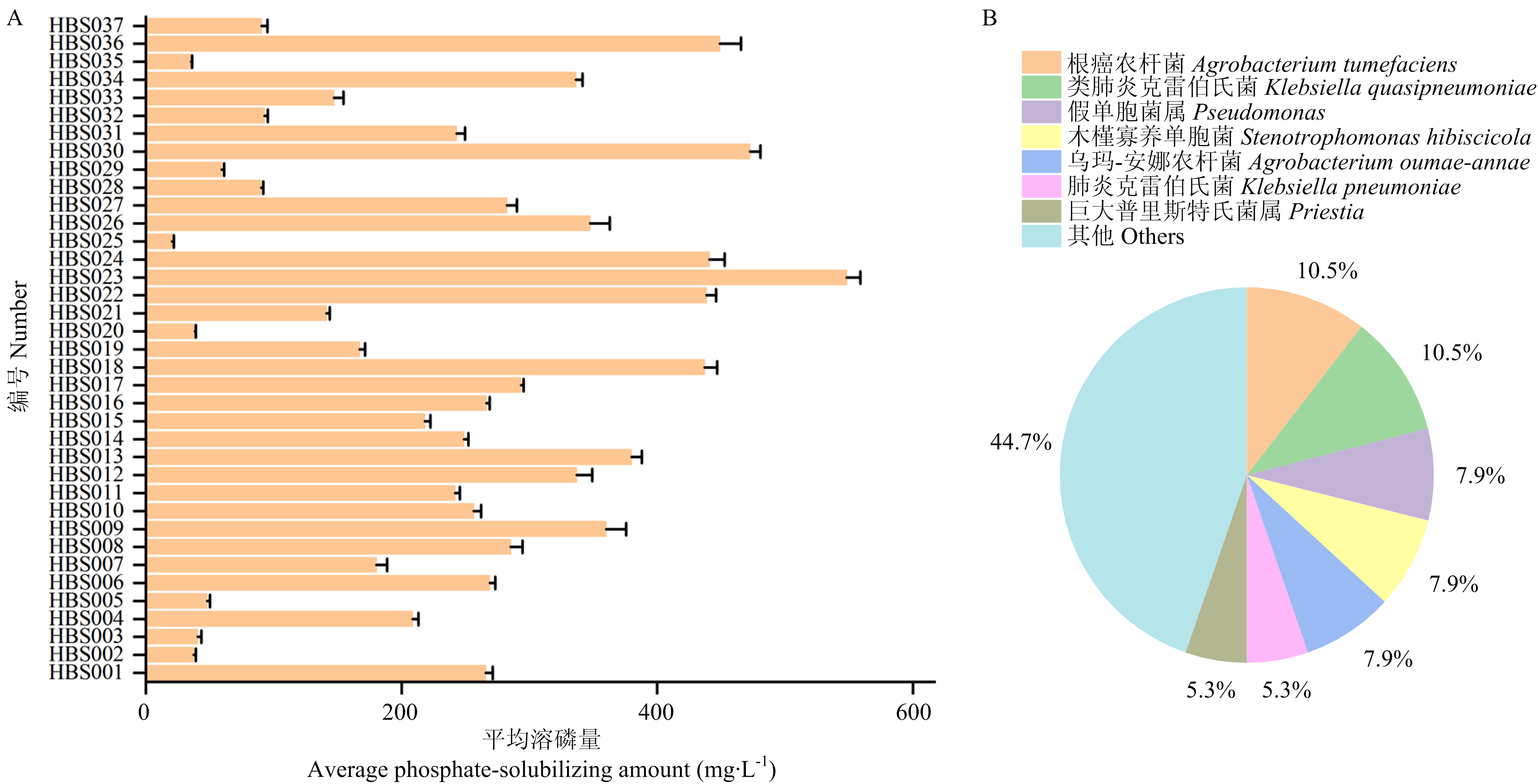
图1
菌株的溶磷能力(A)和种属类别(B)"
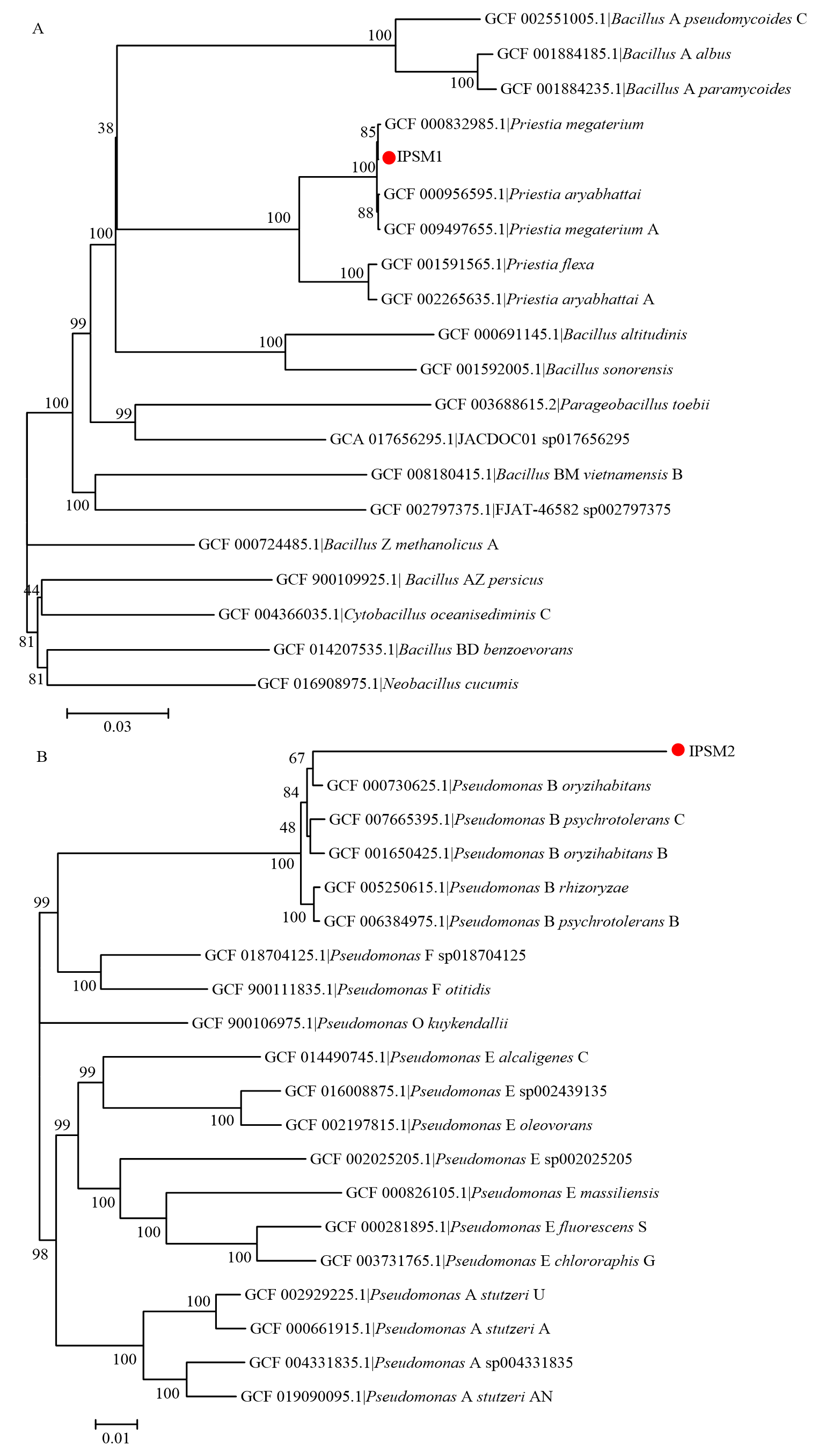
图2
IPSM-1(A)和IPSM-2(B)的系统发育进化树"

图3
菌株在固体培养基上产生的溶磷圈(A)及生长曲线(B)"
表2
溶磷圈与菌落直径比值"
| 菌株编号Strain number | 时间 Time (d) | 菌落直径 Colony diameter (d, mm) | 平均值 Average (mm) | 溶磷圈直径 Phosphate-solubilizing zone diameter (D, mm) | 平均值 Average (mm) | D/d | ||||||
|---|---|---|---|---|---|---|---|---|---|---|---|---|
| IPSM-1 | 2 | 8.0 | 7.8 | 8.9 | 8.23 | 9.5 | 9.8 | 10.7 | 10.00 | 1.23±0.03 | ||
| 4 | 10.1 | 10.5 | 10.3 | 10.30 | 15.9 | 16.8 | 16.1 | 16.27 | 1.58±0.02 | |||
| 6 | 10.6 | 10.5 | 10.6 | 10.57 | 18.8 | 19.1 | 18.5 | 18.80 | 1.78±0.03 | |||
| 8 | 10.4 | 10.7 | 10.3 | 10.47 | 20.8 | 21.8 | 21.1 | 21.23 | 2.04±0.01 | |||
| 10 | 10.5 | 10.7 | 10.1 | 10.43 | 21.0 | 21.1 | 22.0 | 21.37 | 2.07±0.11 | |||
| IPSM-2 | 2 | 5.9 | 6.3 | 5.7 | 5.97 | 10.4 | 8.4 | 10.0 | 9.60 | 1.57±0.21 | ||
| 4 | 6.8 | 7.3 | 7.6 | 7.23 | 15.8 | 16.0 | 15.6 | 15.80 | 2.14±0.08 | |||
| 6 | 7.6 | 7.2 | 7.1 | 7.30 | 17.1 | 16.1 | 16.5 | 16.57 | 2.28±0.04 | |||
| 8 | 7.7 | 7.5 | 7.4 | 7.53 | 17.5 | 17.4 | 18.3 | 17.73 | 2.38±0.08 | |||
| 10 | 7.5 | 7.4 | 7.6 | 7.50 | 17.5 | 17.8 | 18.5 | 17.93 | 2.41±0.02 | |||

图4
IPSM-1(A—C)和IPSM-2(D—F)菌株的生长状态及细胞形态"
表3
菌株IPSM-1和IPSM-2基因组基本特征"
| 基因组特征Genomic characteristics | IPSM-1 | IPSM-2 |
|---|---|---|
| 基因组大小Genome size (bp) | 5961332 | 8746878 |
| Scaffold数量Number of scaffolds | 30 | 48 |
| GC含量GC content (%) | 37.48 | 67.15 |
| 编码基因数量Number of protein-coding genes | 6084 | 8131 |
| 重复序列数量Number of repetitive sequences | 85 | 268 |
| tRNA基因数量Number of tRNA genes | 100 | 92 |
| rRNA基因数量 Number of rRNA genes (5S/16S/23S) | 11/1/1 | 2/2/2 |

图5
菌株IPSM-1和IPSM-2的全基因组框架图"
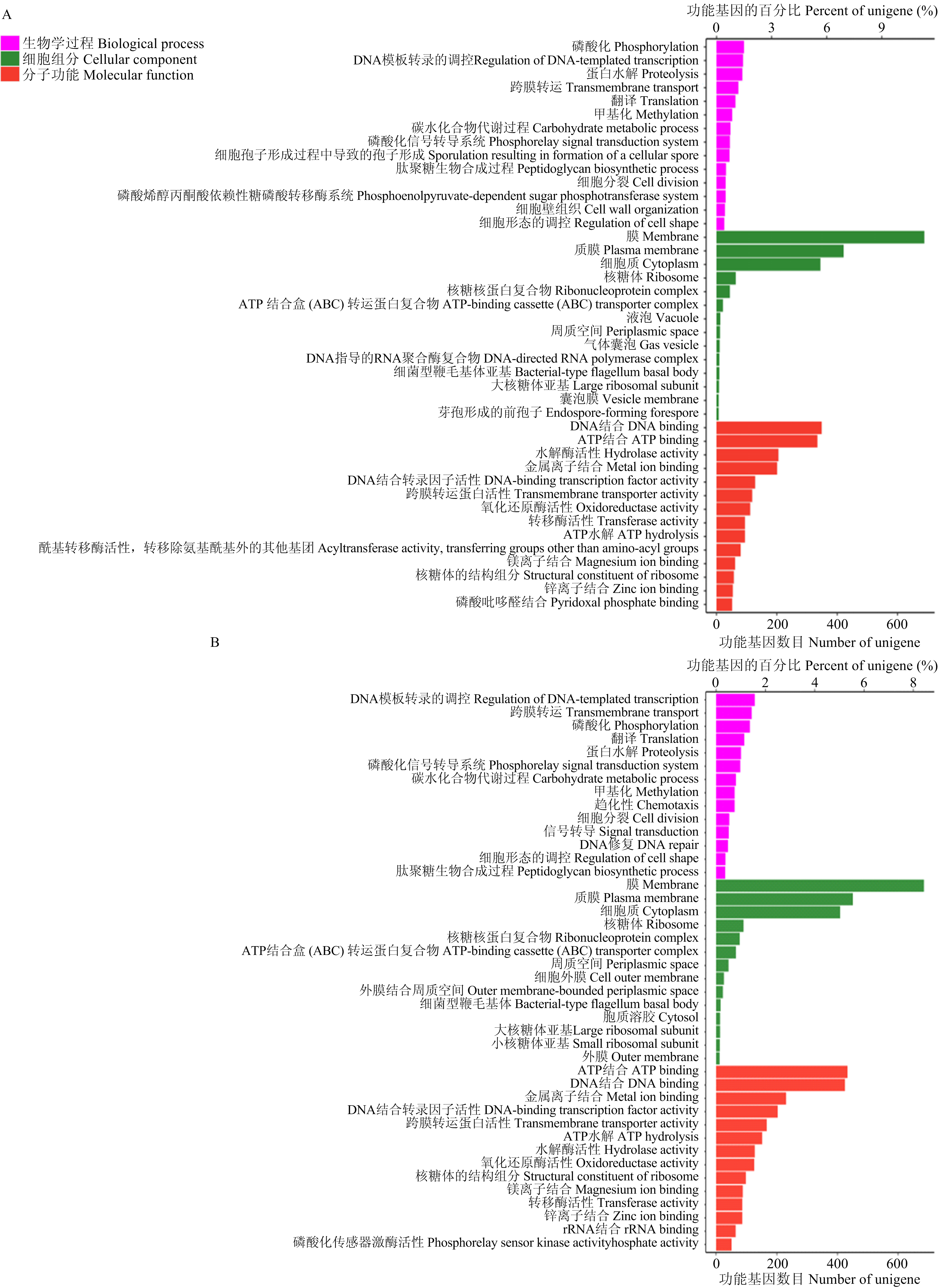
图6
IPSM-1(A)和IPSM-2(B)的GO数据库功能注释比较分析"
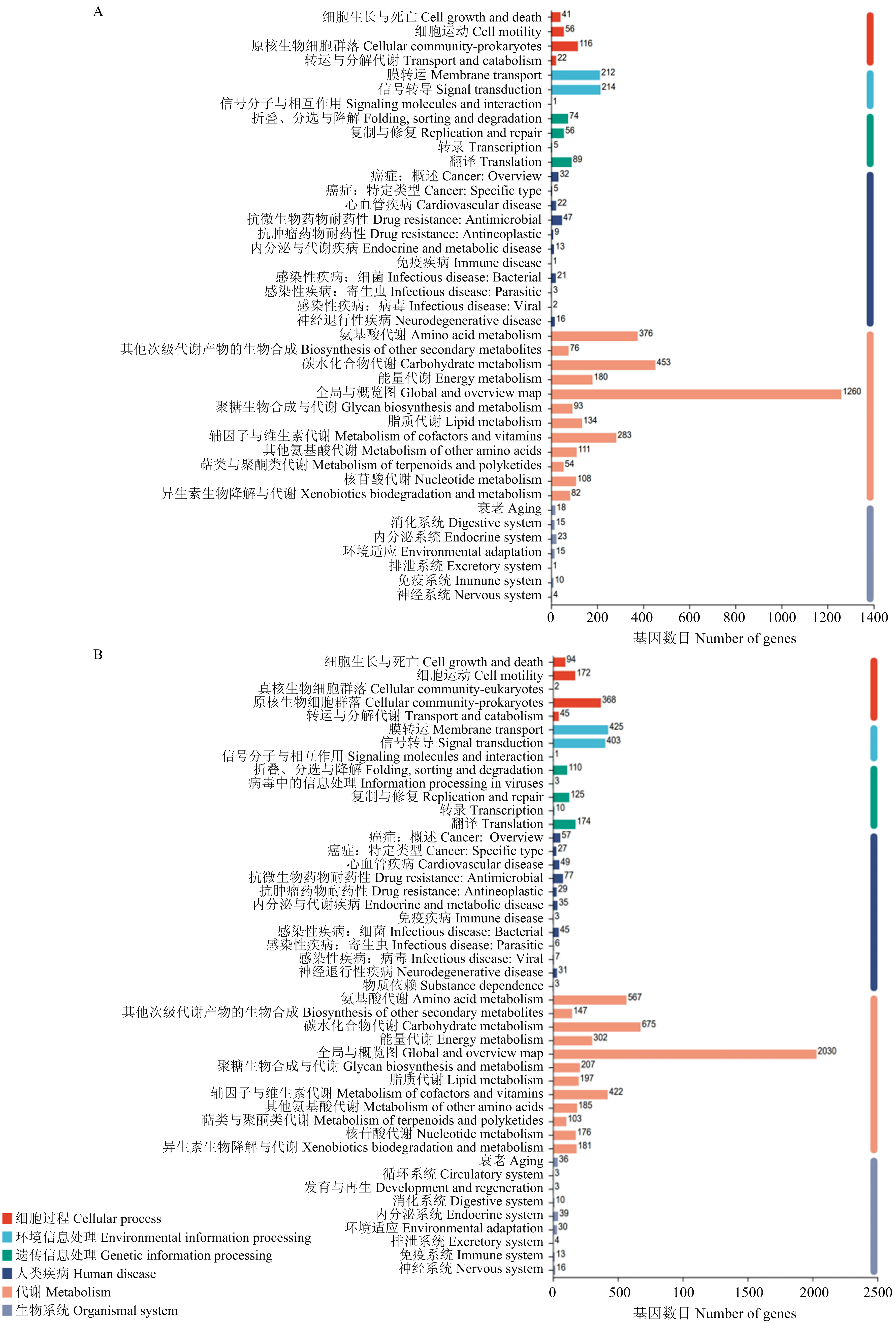
图7
IPSM-1(A)和IPSM-2(B)的KEGG数据库功能注释比较分析"
| [1] |
吕俊, 王晓娅. 溶磷微生物及其对植物促生作用的研究进展. 中国土壤与肥料, 2023(1): 231-239.
|
|
|
|
| [2] |
doi: 10.1016/j.plantsci.2010.06.007 |
| [3] |
孙艳, 洪婉婷, 韩阳, 徐梓楷, 程凌云. 植物内部磷循环利用提高磷效率的研究进展. 植物营养与肥料学报, 2021, 27(12): 2216-2228.
|
|
|
|
| [4] |
温佳旭, 陈雪丽, 肖洋, 万书明, 孙磊, 方海瑞. 土壤中主要溶磷菌种类及其作用机制. 北方园艺, 2023(14): 139-145.
|
|
|
|
| [5] |
|
| [6] |
李娟, 王文丽, 卢秉林. 解磷微生物菌剂对油菜生长及产量的影响. 中国土壤与肥料, 2010(3): 67-69.
|
|
|
|
| [7] |
蒋欣梅, 夏秀华, 于锡宏, 倪淑君, 张树春. 微生物解磷菌肥对大棚茄子生长及土壤有效磷利用的影响. 浙江大学学报(理学版), 2012, 39(6): 685-688.
|
|
|
|
| [8] |
韩凯鑫. 耐盐解磷菌筛选及对土壤细菌群落结构的影响[D]. 哈尔滨: 东北农业大学, 2023.
|
|
|
|
| [9] |
孙健, 张鑫鹏, 李松龄, 王亚艺. 高寒冷凉环境中解磷微生物的效果初探. 中国土壤与肥料, 2023(1): 217-223.
|
|
|
|
| [10] |
江红梅, 殷中伟, 史发超, 刘彩月, 程明芳, 范丙全. 一株耐盐溶磷真菌的筛选、鉴定及其生物肥料的应用效果. 植物营养与肥料学报, 2018, 24(3): 728-742.
|
|
|
|
| [11] |
宫安东, 朱梓钰, 路亚南, 万海燕, 吴楠楠,
|
|
|
|
| [12] |
doi: 10.1080/00103624.2022.2070632 |
| [13] |
doi: 10.1007/s11756-022-01105-8 |
| [14] |
doi: 10.1016/j.scib.2023.09.002 pmid: 37739845 |
| [15] |
|
| [16] |
doi: 10.1111/geb.v30.8 |
| [17] |
doi: 10.1111/ele.13181 pmid: 30460738 |
| [18] |
doi: 10.1016/j.ejsobi.2013.11.007 |
| [19] |
王利民, 邱珊莲, 林新坚, 黄东风, 李卫华, 邱孝煊. 不同培肥茶园土壤微生物量碳氮及相关参数的变化与敏感性分析. 生态学报, 2012, 32(18): 5930-5936.
|
|
doi: 10.5846/stxb |
|
| [20] |
陈华. 外来植物与土壤微生物的关系研究[D]. 济南: 山东大学, 2011.
|
|
|
|
| [21] |
陈亮, 李会娜, 杨民和, 万方浩. 入侵植物薇甘菊和三叶鬼针草对土壤细菌群落的影响. 中国农学通报, 2011, 27(8): 63-68.
|
|
|
|
| [22] |
贾伟. 入侵菊科植物对根际土壤微生物群落结构的影响[D]. 福州: 福建农林大学, 2010.
|
|
|
|
| [23] |
doi: 10.1007/s00374-005-0039-4 |
| [24] |
陆雪天, 赵菁, 程丹丹. 入侵植物欧洲千里光内生固氮菌和溶磷菌多样性. 微生物学通报, 2023, 50(2): 454-470.
|
|
|
|
| [25] |
doi: 10.5897/AJB |
| [26] |
doi: 10.1002/jssc.v38.11 |
| [27] |
纪巧凤. 黄顶菊入侵对根际土壤主要功能细菌多样性的影响[D]. 北京: 中国农业科学院, 2014.
|
|
|
|
| [28] |
宋振, 纪巧凤, 付卫东, 张瑞海, 张婷, 晏静, 张国良. 黄顶菊入侵对土壤中主要功能细菌的影响. 应用生态学报, 2016, 27(8): 2636-2644.
doi: 10.13287/j.1001-9332.201608.013 |
|
|
|
| [29] |
胡传旺, 李巧玉, 周朝晖, 李铁桥, 陈坚, 堵国成, 方芳. 酱醪细菌菌株的分离及功能分析. 微生物学通报, 2017, 44(8): 1899-1907.
|
|
|
|
| [30] |
夏枫峰, 油九菊, 洪志翔, 傅荣兵, 何映雪, 余靖雯, 张晓林. 一株耐盐微生物的分离鉴定及其对养殖尾水降解效果研究. 浙江海洋大学学报(自然科学版), 2021, 40(2): 134-138, 147.
|
|
|
|
| [31] |
蔺宝珺, 杨文权, 赵帅, 柴港宁, 鱼杨华, 武燕茹, 韩显忠, 李希来, 寇建村. 高寒草甸植物根际溶磷菌的筛选鉴定及其溶磷与促生效果. 草地学报, 2022, 30(11): 3132-3139.
doi: 10.11733/j.issn.1007-0435.2022.11.031 |
|
|
|
| [32] |
宋雅荣, 常单娜, 周国朋, 高嵩涓, 段廷玉, 曹卫东. 解磷细菌活化水稻土中低品位磷矿粉的效果与机制. 中国农业科学, 2024, 57(6): 1102-1116. doi: 10.3864/j.issn.0578-1752.2024.06.007.
|
|
|
|
| [33] |
倪晋仁, 吴东姣, 陈倩. 兼具脱氮除磷功能的根癌土壤杆菌及其应用: CN102586154A[P]. (2012-07-18) [2025-12-29].
|
|
|
|
| [34] |
doi: 10.1128/spectrum.00422-24 |
| [35] |
刘诚, 张钲, 佘梦林, 唐梦君, 倪红. 多功能菌株假单胞菌的溶磷和解磷效果及其应用. 湖北大学学报(自然科学版), 2018, 40(5): 457-461, 469.
|
|
|
|
| [36] |
介晓磊, 李有田, 庞荣丽, 刘世亮, 化党领. 低分子量有机酸对石灰性土壤磷素形态转化及有效性的影响. 土壤通报, 2005, 36(6): 856-860.
|
|
|
|
| [37] |
廖新荣, 梁嘉伟, 梁善, 王荣萍, 詹振寿. 不同种类小分子有机酸对砖红壤磷素形态转化的影响. 华南农业大学学报, 2017, 38(5): 30-35.
|
|
|
|
| [38] |
doi: 10.1007/s00284-024-03946-9 |
| [1] | 陈娟妮, 陈品璐, 李珏, 谢蒙潇, 李欣蓓, 丁伟. 纳米氧化镁诱导烟草抗青枯病的作用机理[J]. 中国农业科学, 2025, 58(16): 3327-3344. |
| [2] | 宣泽鹏, 冯慧瑶, 陈美淇, 徐基胜, 刘梦璇, 赵炳梓, 张佳宝. 秸秆还田配施化肥对土壤生态系统多功能性的影响[J]. 中国农业科学, 2025, 58(14): 2821-2837. |
| [3] | 赵勇, 张仲富, 王禹童, 艾静, 刘家勇, 吴建明, 邓军, 张跃彬. 施钾对根际土壤微生物群落和甘蔗生长的影响[J]. 中国农业科学, 2025, 58(13): 2630-2644. |
| [4] | 姜亚楠, 亓方剑, 李维维, 陈巨莲, 谭晓玲. 温度升高通过小麦根际微生物加快禾谷缢管蚜和麦长管蚜的种群增长[J]. 中国农业科学, 2024, 57(20): 4045-4056. |
| [5] | 彭治鑫, 张希芬, 韩小斌, 司国栋, 徐康文, 张成省. 脂肪酸类天然产物2E,4E-癸二烯酸对烟草根际微生物群落的影响[J]. 中国农业科学, 2024, 57(18): 3601-3611. |
| [6] | 赵卫松, 郭庆港, 崔钠淇, 鹿秀云, 李社增, 马平. 外源添加L-脯氨酸对棉花黄萎病发生及其根际土壤微生物群落的影响[J]. 中国农业科学, 2024, 57(11): 2143-2160. |
| [7] | 郭晗玥, 王东升, 阮杨, 乔亦铸, 张芸滔, 李玲, 黄启为, 郭世伟, 凌宁, 沈其荣. 西瓜连作根际土壤微生物群落演替特征[J]. 中国农业科学, 2023, 56(21): 4245-4258. |
| [8] | 赵卫松, 郭庆港, 李社增, 鹿秀云, 勾建军, 马平. 土壤添加西兰花残体对棉花根际土壤酶活性的影响及其与碳代谢特征的关系[J]. 中国农业科学, 2023, 56(11): 2092-2105. |
| [9] | 李天来,杨丽娟. 专题导读:作物连作障碍的克服——难解的问题[J]. 中国农业科学, 2016, 49(5): 916-918. |
| [10] | 李会娜,刘万学,万方浩 . 杀真菌剂对入侵植物紫茎泽兰与伴生植物生长的反馈作用[J]. 中国农业科学, 2011, 44(11): 2269-2275 . |
| [11] | 李潮海,王小星,王 群,郝四平. 不同质地土壤玉米根际生物活性研究[J]. 中国农业科学, 2007, 40(2): 412-418 . |
| [12] | 胡元森,吴 坤,李翠香,贾新成. 黄瓜连作对土壤微生物区系影响Ⅱ——基于DGGE方法对微生物种群的变化分析[J]. 中国农业科学, 2007, 40(10): 2267-2273 . |
| [13] | 庄敬华,陈捷,杨长成,高增贵,刘 限,牟连晓,郑雅楠. 生防木霉菌生物安全性评价[J]. 中国农业科学, 2006, 39(04): 715-720 . |
| [14] | 胡元森,吴坤. 黄瓜不同生育期根际微生物区系变化研究[J]. 中国农业科学, 2004, 37(10): 1521-1526 . |
|
||
