






中国农业科学 ›› 2026, Vol. 59 ›› Issue (19): 4301-4317.doi: 10.3864/j.issn.0578-1752.2026.19.009
陈柯烨1( ), 蒋硕匀2, 王先哲1,3, 梁新强1, 汤小天4, 姜培坤5, 岳春雷6(), 张志剑1()
收稿日期:2026-02-02
接受日期:2026-06-30
出版日期:2026-10-01
发布日期:2026-10-10
通信作者:
联系方式:
陈柯烨,E-mail:3220102634@zju.edu.cn。
基金资助:
CHEN KeYe1(), JIANG ShuoYun2, WANG XianZhe1,3, LIANG XinQiang1, TANG XiaoTian4, JIANG PeiKun5, YUE ChunLei6(), ZHANG ZhiJian1()
Received:2026-02-02
Accepted:2026-06-30
Published:2026-10-01
Online:2026-10-10
摘要:
针对当前全球农业发展中生态退化、资源约束与品质需求间的失衡问题以及有机农业的局限性,本文提出了“自然养育农业”这一农业发展新范式,即通过优先培育土壤、生物群落、物质循环等生态载体,发挥“生物质矿产”核心资源优势,在有机农业禁化学品投入的基础上实现优质农产品增产、生态载体健康及其生态资产增效的进阶形态。本研究采用理论分析与案例研究相结合的方法。首先,梳理并讨论当前各类可持续农业模式与自然养育农业的联系与区别,再结合生态学整体论、循环经济理论和生态资产理论,构建自然养育农业的分析框架。其次,选取具有代表性的植物界、动物界和菌物界3类实践案例,通过整理多种生态指标分析自然养育农业在资源循环、系统韧性提升和生态资产增值方面的作用机制,并阐述其“先养育、后生产、再增值”的可行性。具体包括:(1)在植物界案例中,通过采取生物有机肥、绿肥还田、生态水体和缓冲带建设等措施,农场在2年多养育后土壤有机质含量显著提升,蔬菜地蚯蚓密度明显增加,化肥和农药使用大幅减量,主要土传病害发生率显著下降,并形成一定碳汇收益和农旅附加收益。(2)在动物界案例中,经生态塘改造与2年多养育后,养殖水体生物多样性显著恢复,鱼塘食物链趋于完整,配合中草药、菌酶制剂和昆虫蛋白替代技术,实现全年禁用抗生素与常规渔药,鲈鱼产量和品质同步提升,并增加了副产渔获和水生植物收益。(3)在菌物界案例中,利用闲耕期开展稻草赤松茸栽培,并配施虻粪促进秸秆降解和土壤培育,实现了秸秆高值化利用、土壤固碳增强、菌群多样性提高和菌渣还田二次养育,体现生产过程与生态养育耦合的特点。自然养育农业是在有机农业的基础上进一步强调生态载体培育、系统内循环和生态资产增值的农业发展路径,其本质是以生态健康支撑稳定生产和多元价值实现。未来应围绕区域适配、技术体系构建、长期定位监测、生态资产核算和标准认证等方面开展深入研究,以推动自然养育农业由概念探索走向规范化应用。
陈柯烨, 蒋硕匀, 王先哲, 梁新强, 汤小天, 姜培坤, 岳春雷, 张志剑. 自然养育农业:基于多界协同的新农业态思考[J]. 中国农业科学, 2026, 59(19): 4301-4317.
CHEN KeYe, JIANG ShuoYun, WANG XianZhe, LIANG XinQiang, TANG XiaoTian, JIANG PeiKun, YUE ChunLei, ZHANG ZhiJian. Nature-Nurturing Agriculture: Investigation on a New Agricultural Paradigm Based on Cross-Kingdom Synergy[J]. Scientia Agricultura Sinica, 2026, 59(19): 4301-4317.

表1
当前多种可持续农业模式的核心要素的差异化分析"
| 农业类型 Agricultural model | 核心理念 Core concept | 技术手段 Technology means | 生态视角 Ecological perspective | 监管认证 Regulatory certification |
|---|---|---|---|---|
| 有机农业 Organic farming | 禁用人工合成化学品,产出符合认证要求的有机产品 Ban synthetic chemicals and produce organic products that meet certification requirements | 允许使用认证有机投入品,部分可实现集约化 The use of certified organic inputs is permitted, and some intensification can be achieved | 侧重“禁止清单” Focus on the “prohibited list” | 高度标准化 Highly standardized |
| 自然农法 Natural farming | 以遵循自然规律、维护土壤与作物健康为核心 With adhering to natural laws and maintaining soil and crop health as the core | 采用生物刺激剂技术,强调本地种子的应用 Employing biostimulant technology, with an emphasis on the application of local seeds | 整体哲学观 Overall philosophical perspective | 自我监管 Self-regulation |
| 再生农业 Regenerative agriculture | 修复并提升生态系统的健康水平 Restore and enhance the health of ecosystems | 免耕、覆盖作物、多样化轮作及农牧整合等策略 Strategies such as no-till farming, cover crops, diversified crop rotation, and the integration of agriculture and animal husbandry | 强调恢复力 Emphasize resilience | 易被“漂绿” Prone to “greenwashing” |
| 自然正向农业 Natural positive agriculture | 重点关注“土地-水-食物”的互联 Focus on the interconnection of "land-water- food" | 因地制宜,同时融合传统与先进技术 Adjust measures to local conditions, while integrating traditional and advanced technologies | 重视景观和系统运作 Attach importance to landscape and system operation | 发展中 Developing |
| 自然养育农业 Nature-nurturing agriculture | 先养育、后生产、再增值,强调整体生态功能最大化与生态资产增值增效 First nurture, then produce, and finally enhance value, emphasizing the maximization of overall ecological functions and the increase in value and efficiency of ecological assets | 废弃物生物转化、生物生态防控、物种协同共生等技术 Technologies such as waste biotransformation, bio-ecological prevention and control, and species co-symbiosis | 生态载体的培育作为基础和前提 The cultivation of ecological carriers serves as the foundation and prerequisite | 尚未发展 Not yet developed |

图1
基于“三农”易腐有机废弃物的“生物质矿产”技术模式图"

图2
基于自然养育的农业范式"

图3
植物界-自然养育农业模式图"

图4
动物界-自然养育农业模式图"
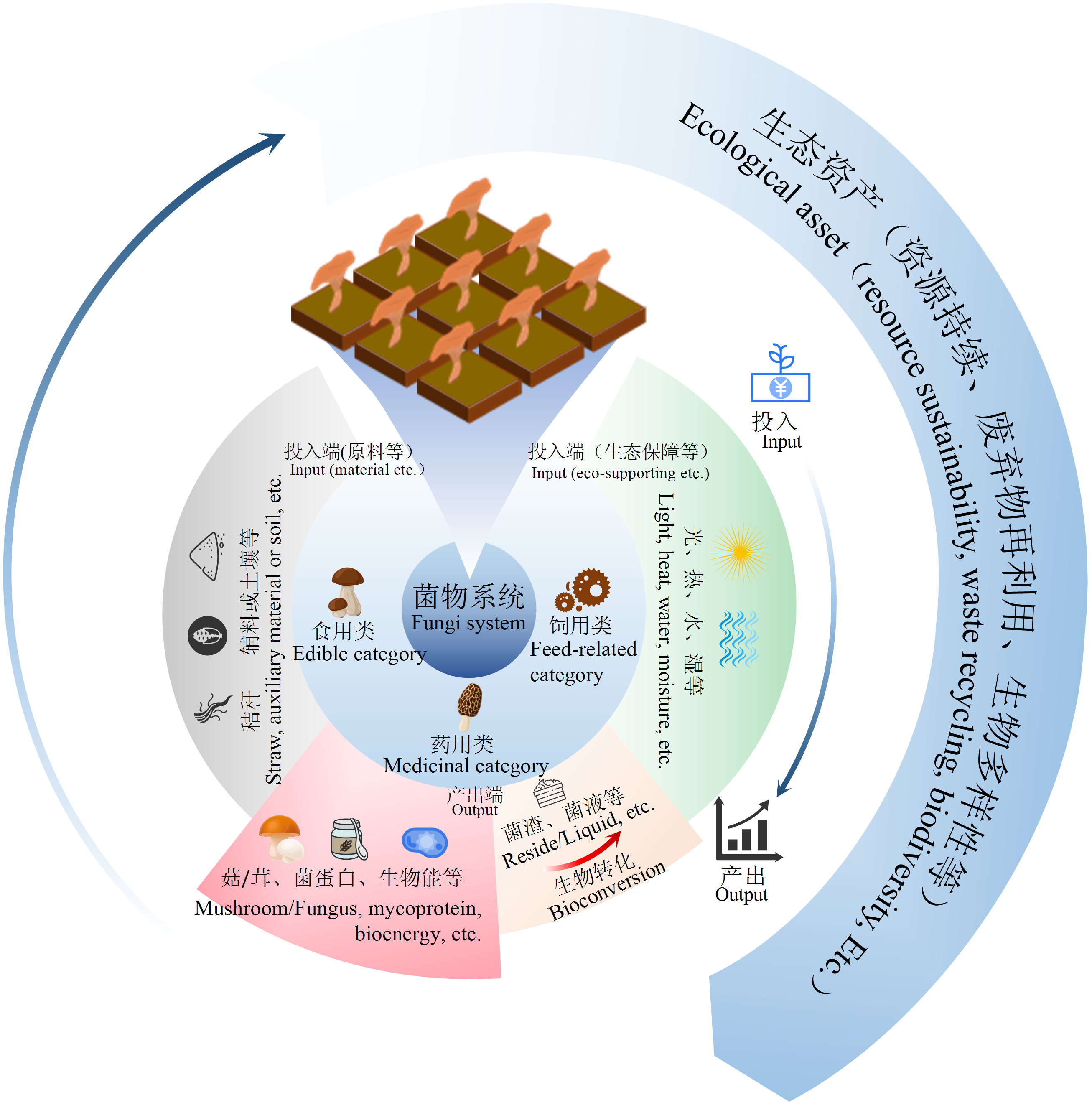
图5
菌物界-自然养育农业模式图"
| [1] |
孙燕, 袁一心, 葛恒军, 蒋非非, 邹铭, 陈浮. 2010—2022年中国农业温室设施空间格局及变化趋势[J]. 农业工程学报, 2025, 41(18): 291-299.
|
|
|
|
| [2] |
冯在文, 许多, 田芳, 张红雨, 李万理, 彭辉, 刘善梅, 刘汉尊, 金慧东, 黄远, 吴颖丹, 龙浩, 韩怡然. 设施农业智能决策大模型关键技术与发展方向[J]. 农业工程学报, 2025, 41(13): 50-61.
|
|
|
|
| [3] |
doi: 10.1038/s41586-025-09201-w |
| [4] |
于滢, 姬广兴, 陈轶楠, 翁倩文, 陈伟强. 北方集约化农区农业氮素面源污染模拟及动因分析[J]. 环境科学, 2025, 46(5): 2783-2792.
|
|
|
|
| [5] |
刘晶, 徐伟义, 金晓斌, 应苏辰, 王世磊. 可持续集约导向下的耕地利用转型: 理论逻辑与调控路径[J]. 地理研究, 2025, 44(7): 1861-1876.
doi: 10.11821/dlyj020240595 |
|
|
|
| [6] |
周连昊, 曾全超, 梅唐英泽, 汪明霞, 谭文峰. 集约化柑橘种植抑制土壤磷循环微生物活性[J]. 环境科学, 2024, 45(5): 2881-2890.
|
|
|
|
| [7] |
蔡继明, 李艺铭. 培育发展农业领域新质生产力的路径选择[J]. 人民论坛, 2024(24): 75-77.
|
|
|
|
| [8] |
耿立, 魏莉丽, 俞洋, 吴一平, 申进文. 食用菌规模化快速发展背景下菇农生产意愿的分析: 基于泌阳、西峡两县的调查[J]. 中国农业资源与区划, 2020, 41(6): 120-129.
|
|
|
|
| [9] |
刘俊彩, 范博文, 赵立琴, 孙欣莹, 董子铭, 王萌萌, 孙宁, 杨凤军. 玉米浆添加对堆肥过程中磷组分转化及微生物群落的影响[J]. 微生物学通报, 2025, 52(1): 249-262.
|
|
|
|
| [10] |
李王成, 黄亚浩, 马东祥, 贾振江, 吴洋洋, 徐昊文, 张一帆, 李旭. 砂田退化机制及其修复改良措施: 研究进展及展望[J]. 江西农业大学学报, 2025, 47(2): 277-290.
|
|
doi: 10.3724/aauj.2025025 |
|
| [11] |
刘洋, 胡钰, 郭芯蕊, 丁斐. 我国农业新污染物治理的现状与展望[J]. 环境保护, 2025, 53(13): 64-68.
|
|
|
|
| [12] |
李开轩, 李富根, 钟耀辉, 付鑫羽. 关于农药中有关危险化学品管理问题的思考[J]. 农药科学与管理, 2025, 46(10): 56-60.
|
|
|
|
| [13] |
刘丰茂, 刘东晖. 农药残留与安全专题序言[J]. 农药学学报, 2025, 27(3): I0001-I0002.
|
|
|
|
| [14] |
吴思敏, 王春蕊, 汤涛, 季晨阳, 赵美蓉. 农药助剂的毒性效应研究进展[J]. 农药学学报, 2025, 27(4): 606-617.
|
|
|
|
| [15] |
贾亚楠, 唐忠. 中国和欧美国家养殖业抗生素使用负面问题及管理政策比较[J]. 农业环境科学学报, 2024, 43(6): 1205-1219.
|
|
|
|
| [16] |
赵方凯, 沈琳钧, 杨恺丰, 刘鸿林, 杨磊, 陈利顶. 中国农田土壤抗生素污染格局及其对施肥和灌溉的响应[J]. 科技导报, 2025, 43(12): 171-178.
doi: 10.3981/j.issn.1000-7857.2025.02.00228 |
|
|
|
| [17] |
李业芳, 苏艳芳, 王晶, 魏新华, 赵文轩, 余大为, 孙研研, 贾亚雄, 马月辉, 侯水生, 蒋琳. 我国畜禽种质资源保护现状与展望[J]. 中国工程科学, 2025, 27(5): 165-179.
doi: 10.15302/J-SSCAE-2025.05.014 |
|
doi: 10.15302/J-SSCAE-2025.05.014 |
|
| [18] |
doi: 10.1016/j.tree.2021.06.010 |
| [19] |
doi: 10.1038/s41586-019-1684-3 |
| [20] |
doi: 10.1016/S0169-5347(03)00011-9 |
| [21] |
姜小三, 卢梦凡, 刘岩, 李晗泚, 袁诗睿, 林伯正. 江苏省4类主要秸秆和畜禽粪便空间分布及综合利用潜力研究[J]. 农业环境科学学报, 2024, 43(3): 675-687.
|
|
|
|
| [22] |
龚世飞, 翟自建, 丁武汉, 张振, 望甜, 李虎. 南水北调中线工程水源地畜禽粪便面源污染特征及替代化肥潜力[J]. 中国生态农业学报(中英文), 2025, 33(2): 324-337.
|
|
|
|
| [23] |
马悦, 赵若男, 陈朱淑怡, 童文彬, 王美. 畜禽粪便中抗生素耐药基因的污染现状及其防控研究进展[J]. 中国畜牧杂志, 2025, 61(5): 117-121.
|
|
|
|
| [24] |
doi: 10.1007/s13165-024-00458-5 |
| [25] |
doi: 10.1016/j.jobab.2025.01.002 |
| [26] |
doi: 10.1016/j.oneear.2025.101416 |
| [27] |
doi: 10.1126/science.abh0840 pmid: 33766879 |
| [28] |
|
| [29] |
doi: 10.1016/j.rser.2025.115713 |
| [30] |
宣泽鹏, 冯慧瑶, 陈美淇, 徐基胜, 刘梦璇, 赵炳梓, 张佳宝. 秸秆还田配施化肥对土壤生态系统多功能性的影响[J]. 中国农业科学, 2025, 58(14): 2821-2837. doi: 10.3864/j.issn.0578-1752.2025.14.009.
|
|
|
|
| [31] |
doi: 10.1038/s41467-024-54602-6 |
| [32] |
|
| [33] |
王二平. 我国有机农业的发展与有机产品认证及监管[J]. 中国农业资源与区划, 2014, 35(6): 70-74.
|
|
|
|
| [34] |
胡晓兵, 陈凡. 从自然农法看循环农业技术的哲学基础[J]. 自然辩证法研究, 2006, 22(9): 41-44, 68.
|
|
|
|
| [35] |
朱士超, 李健, 王欢, 夏兵. 溯源技术对供应商漂绿的影响及其采纳决策研究[J/OL]. 系统工程理论与实践. https://link.cnki.net/urlid/11.2267.N.20251112.1450.002.
|
|
|
|
| [36] |
doi: 10.3390/su17031151 |
| [37] |
doi: 10.1016/j.scitotenv.2025.178600 |
| [38] |
doi: 10.1126/science.adj1914 |
| [39] |
刘广伟. 食学定位: 隐性“食事知识体系”的显性确立[J]. 山西农业大学学报(社会科学版), 2025, 24(5): 26-36.
|
|
|
|
| [40] |
王晓红. 符号学框架下的饮食文化文本解析与意义构建[J]. 食品与机械, 2025, 41(2): 254-255.
|
|
|
|
| [41] |
肖显静, 何进. 生态系统生态学研究的关键问题及趋势: 从“整体论与还原论的争论”看[J]. 生态学报, 2018, 38(1): 31-40.
|
|
|
|
| [42] |
doi: 10.1007/BF00046547 |
| [43] |
doi: 10.1038/s41467-018-05056-0 pmid: 29973596 |
| [44] |
doi: 10.2307/1930070 |
| [45] |
doi: 10.1016/j.tree.2025.04.013 |
| [46] |
doi: 10.1038/s41467-024-53169-6 pmid: 39389978 |
| [47] |
|
| [48] |
doi: 10.1007/s40656-021-00440-4 |
| [49] |
doi: 10.1126/science.abm7841 pmid: 36201585 |
| [50] |
刘万才, 张政兵, 贺平均, 宋一林, 陈学新. 植保无人机释放赤眼蜂球防治二化螟的效果[J]. 中国植保导刊, 2022, 42(4): 44-47.
|
|
|
|
| [51] |
doi: 10.1146/ento.2025.70.issue-1 |
| [52] |
doi: 10.1127/entomologia/2024/2241 |
| [53] |
doi: 10.3390/insects13100937 |
| [54] |
时敏, 唐璞, 王知知, 黄健华, 陈学新. 中国寄生蜂研究及其在害虫生物防治中的应用[J]. 应用昆虫学报, 2020, 57(3): 491-548.
|
|
|
|
| [55] |
doi: 10.1007/s44297-023-00011-y |
| [56] |
doi: 10.1016/j.resconrec.2017.09.005 |
| [57] |
doi: 10.1111/jiec.v29.2 |
| [58] |
黄仁辉, 高明. 基于链间竞争的“城市矿产”资源化共生网络竞合关系研究[J]. 系统工程理论与实践, 2025, 45(3): 886-906.
doi: 10.12011/SETP2023-2248 |
|
|
|
| [59] |
陈丽强, 高明, 梁开荣. 基于ANP-BPNN的“城市矿产”开发利用多主体协同影响因素识别[J]. 管理评论, 2023, 35(2): 16-27.
|
|
|
|
| [60] |
唐燕, 孟繁癑. “城市矿产”产业生态效率动态演变特征与影响因素[J]. 中国人口·资源与环境, 2021, 31(6): 67-77.
|
|
|
|
| [61] |
孙佳杰, 范诗琳, 项方铭, 韩璐滢, 沈珂薇, 张志剑. 鸡粪协同易腐垃圾的黑水虻幼虫转化增效及肠道菌群响应机理分析[J]. 环境污染与防治, 2025, 47(7): 26-35.
|
|
|
|
| [62] |
陶兴华, 王先哲, 马景津, 黄恩, 沈建林, 金维正, 张志剑. 黑水虻转化厨余垃圾过程中物料理化性质及溶解性有机质光谱学特征[J]. 应用与环境生物学报, 2023, 29(4): 860-866.
|
|
|
|
| [63] |
doi: 10.1016/j.biortech.2025.133408 |
| [64] |
doi: 10.1016/j.biortech.2025.132701 |
| [65] |
doi: 10.1016/j.jenvman.2024.122373 |
| [66] |
doi: 10.1016/j.envpol.2023.122676 |
| [67] |
doi: 10.1007/s11356-024-33308-8 |
| [68] |
吴孔阳, 马佳音, 杨同香, 唐琳, 陈雪冬, 韩新宽, 韩建明. 农业废弃物堆肥技术研究进展[J]. 江苏农业科学, 2025, 53(11): 1-8.
|
|
|
|
| [69] |
彭瑞雪, 程艳, 宋娜, 杨利, 周维, 杨俊, 杨青, 吴启侠, 段小丽. 水稻-大球盖菇模式对土壤微生物量碳氮磷的影响[J]. 中国土壤与肥料, 2024(7): 49-59.
|
|
|
|
| [70] |
doi: 10.1016/j.agee.2023.108560 |
| [71] |
doi: 10.1016/j.eja.2025.127521 |
| [72] |
刘苏捷, 王剑, 贺腾飞, 刘汉锁, 龙沈飞, 臧建军, 朴香淑, 王春林. 不同蛋白质原料对断奶仔猪生长性能、养分表观消化率、血清免疫和抗氧化指标及肠道形态的影响[J]. 动物营养学报, 2022, 34(4): 2238-2248.
doi: 10.3969/j.issn.1006-267x.2022.04.020 |
|
|
|
| [73] |
祝婕, 刘桂荣. 蝇蛆粉对仔猪生长性能、血清免疫指标及经济效益的影响[J]. 饲料研究, 2023, 46(1): 33-37.
|
|
|
|
| [74] |
蔡赐美, 马崇, 朱剑锋, 庞旭, 祁姣姣, 李雪玲, 杨美艳, 胡文锋, 胡斌. 黑水虻幼虫作为饲料原料在生猪养殖中的应用研究进展[J]. 中国畜牧兽医, 2024, 51(4): 1500-1510.
doi: 10.16431/j.cnki.1671-7236.2024.04.018 |
|
|
|
| [75] |
李志强, 蒋硕匀, 江承亮, 沈珂薇, 杨柱理, 岳春雷, 张志剑. 饲粮中添加发酵虻浆对仔猪生长性能及肠道菌群的影响[J]. 养殖与饲料, 2026, 25(5): 1-8.
|
|
|
|
| [76] |
doi: 10.1016/S0921-8009(98)00020-2 |
| [77] |
高嵩涓, 吴翠霞, 周国朋, 常单娜, 曹卫东. “绿肥+”产业机制及其实践[J]. 中国农业科学, 2025, 58(10): 1982-1993. DOI: 10.3864/j.issn.0578-1752.2025.10.010.
|
|
|
|
| [78] |
蒙培元. 人与自然: 中国哲学生态观[M]. 北京: 人民出版社, 2004.
|
|
|
|
| [79] |
Sven Erik Jϕrgensen. 系统生态学导论[M]. 陆健健, 译. 北京: 高等教育出版社, 2013.
|
|
|
|
| [80] |
doi: 10.1007/s42773-025-00510-x |
| [81] |
doi: 10.1016/j.rser.2025.116676 |
| [82] |
doi: 10.1016/j.jclepro.2024.142332 |
| [83] |
doi: 10.1021/acs.est.4c12517 |
| [84] |
吴信, 张会会, 杨旭东, 梁晓晓, 高乐. 新型单细胞蛋白饲料资源开发利用进展[J]. 饲料工业, 2024, 45(20): 1-8.
|
|
|
|
| [85] |
韩振强, 梁浩, 鹿富俊, 李柏浩, 瞿子惠, 赵晓东, 闫晓刚, 耿春银. 肉牛粗饲料玉米秸秆高效利用的研究进展[J]. 饲料研究, 2023, 46(7): 133-137.
|
|
|
|
| [86] |
吕亮雨, 施建军, 蔡宗程, 高佩, 李发毅. 菌剂配施有机肥对高海拔地区燕麦生长及土壤特性影响[J]. 草地学报, 2025, 33(12): 4172-4182.
doi: 10.11733/j.issn.1007-0435.2025.12.029 |
|
|
|
| [87] |
俞孔见, 胡加付, 柴一秋, 蔡瑞杭. 白僵菌素产量对蝉花虫草侵染斜纹夜蛾的致病性影响[J]. 菌物学报, 2025, 44(6): 108-119.
|
|
|
|
| [88] |
陈欣, 叶俊龙, 唐建军. 现代集约化农业如何利用物种多样性: 源自对重要农业文化遗产“稻鱼共生系统”研究的思考[J]. 中国生态农业学报(中英文), 2026, 34(1): 1-5.
|
|
|
|
| [89] |
梁新强, 杨姣, 何霜, 刘博弈, 李建业, 徐向阳, 傅伯杰. 关于长江三角洲地区推进稻田退水零直排工程建设的建议[J]. 中国科学院院刊, 2021, 36(7): 814-822.
|
|
|
|
| [90] |
吴小沔, 贺聪志. 从反思到实践: 有机农业的发展历程与话语变迁回顾[J]. 中国农业大学学报(社会科学版), 2019, 36(2): 116-128.
|
|
|
|
| [91] |
doi: 10.1016/j.jclepro.2024.144479 |
| [92] |
党莹超, 李莎, 苏巍, 胡凡旭, 姜伟. 基于环境DNA技术的宜宾江段秋季鱼类多样性研究[J]. 水产科学, 2024, 43(6): 894-905.
|
|
|
|
| [93] |
苏文英, 王一璞, 刘晓梅, 纪伟, 孙潇潇, 胡曙鋆, 任立凯. 大球盖菇-大豆-豆丹种养循环模式对土壤细菌群落结构和多样性的影响[J]. 江西农业学报, 2025, 37(3): 47-53, 62.
|
|
|
| [1] | 王维, 陈秧分. 全球农业农村现代化的演变趋势与影响因素[J]. 中国农业科学, 2025, 58(24): 5299-5314. |
| [2] | 张维理,KOLBEH,张认连,冀宏杰. 农田土壤有机碳管理与有机质平衡算法[J]. 中国农业科学, 2020, 53(2): 332-345. |
| [3] | 胡志全,朱殿霄,辛岭,侯丽薇,王东阳. 基于产业要素年代差距分析的农业现代化水平国际比较研究[J]. 中国农业科学, 2018, 51(7): 1412-1420. |
| [4] | 马世铭. 世界有机农业发展的历史回顾与发展动态[J]. 中国农业科学, 2004, 37(10): 1510-1516 . |
|
||
