






中国农业科学 ›› 2025, Vol. 58 ›› Issue (24): 5299-5314.doi: 10.3864/j.issn.0578-1752.2025.24.015
• 农业经济与农村发展 • 上一篇
王维( ), 陈秧分*()
收稿日期:2025-03-25
接受日期:2025-07-11
出版日期:2025-12-16
发布日期:2025-12-22
通信作者:
联系方式:
王维,E-mail:ww_20001231@163.com。
基金资助:
WANG Wei(), CHEN YangFen*()
Received:2025-03-25
Accepted:2025-07-11
Published:2025-12-16
Online:2025-12-22
摘要:
【目的】农业农村现代化需要立足世界一般规律与中国特色,从全球视角探究其演变趋势与影响因素对于中国推进乡村全面振兴具有重要意义。【方法】本研究构建了包含农业现代化和农村现代化两个维度的评价指标体系,在测度2000—2022年152个国家农业农村发展水平的基础上,运用三维核密度估计和空间基尼系数揭示全球农业农村现代化的演变趋势,并借助最优参数地理探测器对社会经济因素和农业因素的作用强度及交互作用影响力进行识别。【结果】在过去20多年间,全球农业农村现代化水平呈现稳步提升态势,低收入国家与中等收入国家的差距逐年收敛,但与高收入国家的差距依然巨大。中国农业农村现代化建设成效斐然,国际排名由第78名跃升至第57名。从一般规律看,经济发展水平始终是农业农村现代化发展的关键驱动力;产业结构和农产品贸易开放的作用日益凸显;农业技术进步的贡献依然重要,但呈边际递减趋势;而农地利用结构的影响则具有长期性与复杂性。从差异性情况看,信息化水平是低收入和中低收入国家实现追赶的首要驱动力,对中高收入和高收入国家的影响则逐渐减弱;人口老龄化水平成为阻碍中等收入国家农业农村现代化发展的主导制约因素,而对高收入国家的影响相对较小;环境保护力度在不同收入国家组别之间呈明显分化效应。低收入国家组中两两因素产生负向交互作用的比例显著下降,中低收入国家组的各因素间交互作用已全部转变为正向协同效应,中高收入和高收入国家组的各因素间则普遍存在协同增强效应,意味着全球农业农村现代化时空分异是社会经济因素与农业因素共同作用的结果。【结论】中国在推进乡村全面振兴过程中,应坚持农业现代化与农村现代化“双轮驱动”,统筹经济发展、社会进步和环境保护三者之间的关系,最终实现城乡融合发展。
王维, 陈秧分. 全球农业农村现代化的演变趋势与影响因素[J]. 中国农业科学, 2025, 58(24): 5299-5314.
WANG Wei, CHEN YangFen. Evolutionary Trends and Influencing Factors of Global Agricultural and Rural Modernization[J]. Scientia Agricultura Sinica, 2025, 58(24): 5299-5314.
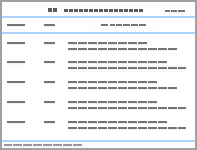
表1
农业农村现代化评价指标体系"
| 维度层 Dimension layer | 指标层 Indicator layer | 指标释义 Indicator definition | 属性 Attribute | 权重 Weight |
|---|---|---|---|---|
| 农业现代化 Agricultural modernization (0.5) | 农业劳动生产率 Agricultural labor productivity | 农林牧渔业增加值/农业就业人员(万美元/人) Added value of agriculture, forestry, animal husbandry, and fishery/Agricultural employment (104 USD/person) | 正 Positive | 0.3312 |
| 粮食单产 Grain yield per unit area | 粮食产量/粮食播种面积(吨/公顷) Grain output/Grain sown area (tons/hectare) | 正 Positive | 0.1723 | |
| 农业资本投入强度 Agricultural capital input intensity | 农林牧渔业资本存量/农业用地面积(万美元/公顷) Capital stock of agriculture, forestry, animal husbandry, and fishery/Agricultural land area (104 USD/hm2) | 正 Positive | 0.0569 | |
| 农产品国际市场占有率 International market share of agricultural products | 农产品出口额/世界农产品出口额(%) Agricultural export value/World agricultural export value (%) | 正 Positive | 0.2884 | |
| 谷物自给率 Cereal self-sufficiency rate | 谷物产量/(谷物产量+谷物进口量-谷物出口量)(%) Cereal production/ (Cereal production+Cereal imports-Cereal exports) (%) | 正 Positive | 0.0718 | |
| 食物供应量 Food supply | 食物供应总量/总人口/当年天数(千卡/人/天) Total food supply/Total population/Days in the year (kcal/person/day) | 正 Positive | 0.0643 | |
| 农用化学品使用强度 Agrochemical use intensity | 化肥农药使用量/耕地面积(千克/公顷) Fertilizer and pesticide use/Cultivated land area (kg·hm2) | 负 Negative | 0.0087 | |
| 农业碳排放强度 Agricultural carbon intensity | 农业碳排放量/农林牧渔业增加值(吨/万美元) Agricultural carbon emissions/Added value of agriculture, forestry, animal husbandry, and fishery (tons/104 USD) | 负 Negative | 0.0064 | |
| 农村现代化 Rural modernization (0.5) | 乡村人口比重 Rural population proportion | 农村人口/总人口(%) Rural population/Total population (%) | 负 Negative | 0.1045 |
| 非农就业占比 Non-agricultural employment share | 非农就业人员/就业人员(%) Non-agricultural employment/Total employment (%) | 正 Positive | 0.0792 | |
| 农业相对劳动生产率 Agricultural relative labor productivity | 农林牧渔业增加值份额/农业就业人员份额(—) Share of added value in agriculture, forestry, animal husbandry, and fishery/Share of agricultural employment (—) | 正 Positive | 0.0852 | |
| 农村通电率 Rural electrification rate | 获得电力供应的农村人口/农村总人口(%) Rural population with access to electricity/Total rural population (%) | 正 Positive | 0.1956 | |
| 农村供水率 Rural water supply rate | 至少使用基本饮用水服务的农村人口/农村总人口(%) Rural population using at least basic drinking water services/Total rural population (%) | 正 Positive | 0.0700 | |
| 农村清洁能源使用率 Rural clean energy usage rate | 获得清洁燃料和烹饪技术的农村人口/农村总人口(%) Rural population with access to clean fuels and technologies for cooking/Total rural population (%) | 正 Positive | 0.3508 | |
| 农村卫生设施普及率 Rural sanitation facility coverage rate | 至少使用基本卫生服务的农村人口/农村总人口(%) Rural population using at least basic sanitation services/Total rural population (%) | 正 Positive | 0.0913 | |
| 营养不良发生率 Malnutrition incidence rate | 营养不良人口/总人口(%) Undernourished population/Total population (%) | 负 Negative | 0.0234 |

图1
全球农业农村发展水平的箱型图"

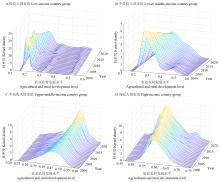
图2
全球农业农村发展水平的三维核密度图"
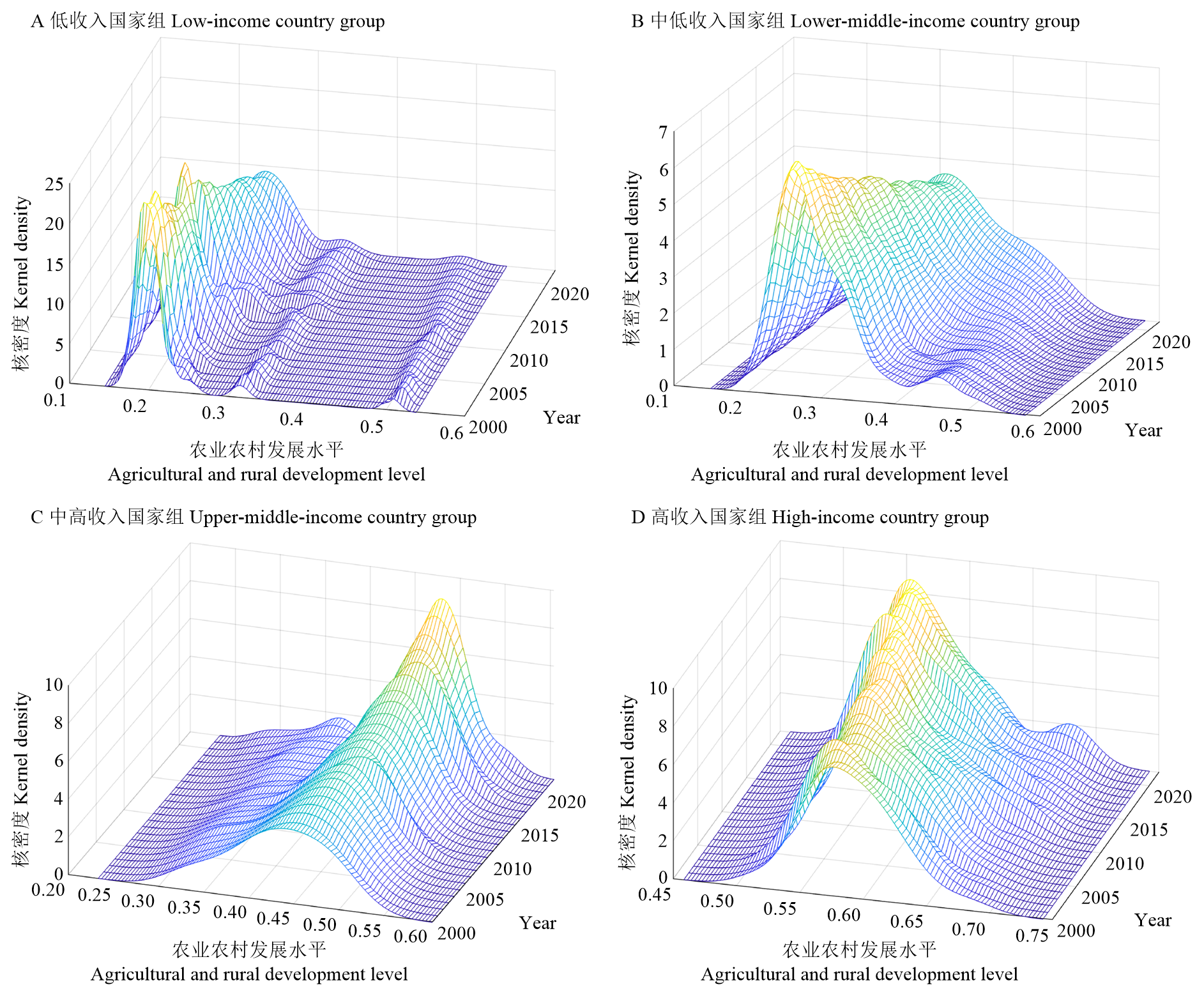
表2
全球农业农村发展水平的空间差异"
| 年份 Year | 总体基尼系数 Overall Gini coefficient | 各部分贡献度Contribution of each part (%) | ||
|---|---|---|---|---|
| 组内差异 Within-group differences | 组间差异 Between-group differences | 超变密度 Super-variate density | ||
| 2000 | 0.2444 | 11.25 | 85.01 | 3.74 |
| 2002 | 0.2414 | 11.20 | 85.15 | 3.64 |
| 2004 | 0.2380 | 11.38 | 84.86 | 3.75 |
| 2006 | 0.2315 | 11.47 | 84.57 | 3.96 |
| 2008 | 0.2275 | 11.62 | 84.59 | 3.79 |
| 2010 | 0.2223 | 11.82 | 84.39 | 3.79 |
| 2012 | 0.2182 | 11.97 | 84.35 | 3.68 |
| 2014 | 0.2141 | 12.06 | 84.41 | 3.53 |
| 2016 | 0.2085 | 12.05 | 84.50 | 3.45 |
| 2018 | 0.2024 | 12.01 | 84.76 | 3.24 |
| 2020 | 0.1994 | 12.00 | 84.80 | 3.20 |
| 2022 | 0.1967 | 12.17 | 84.71 | 3.12 |
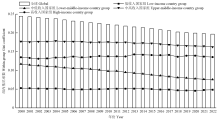
图3
全球农业农村发展水平的组内差异"
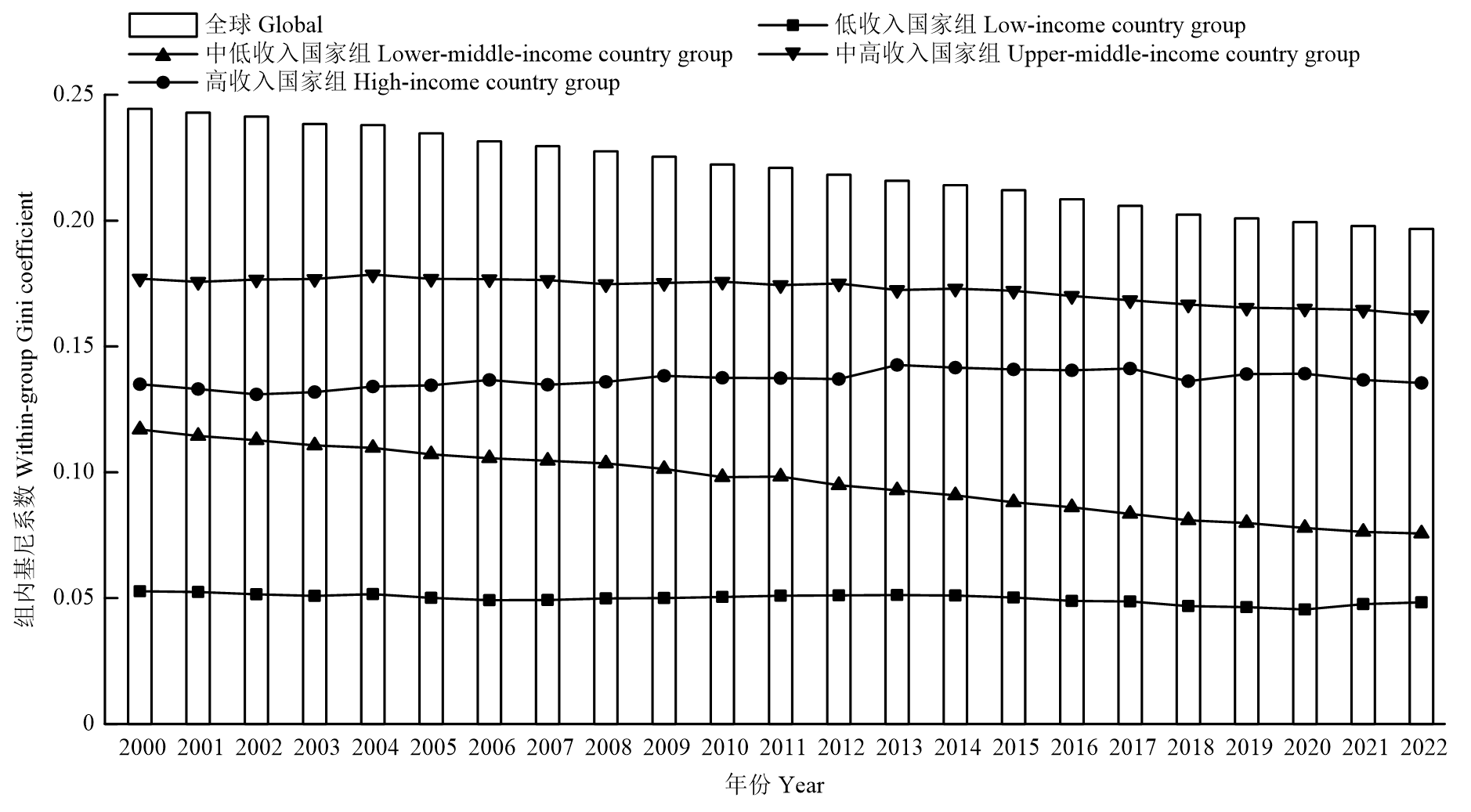
图4
全球农业农村发展水平的组间差异"
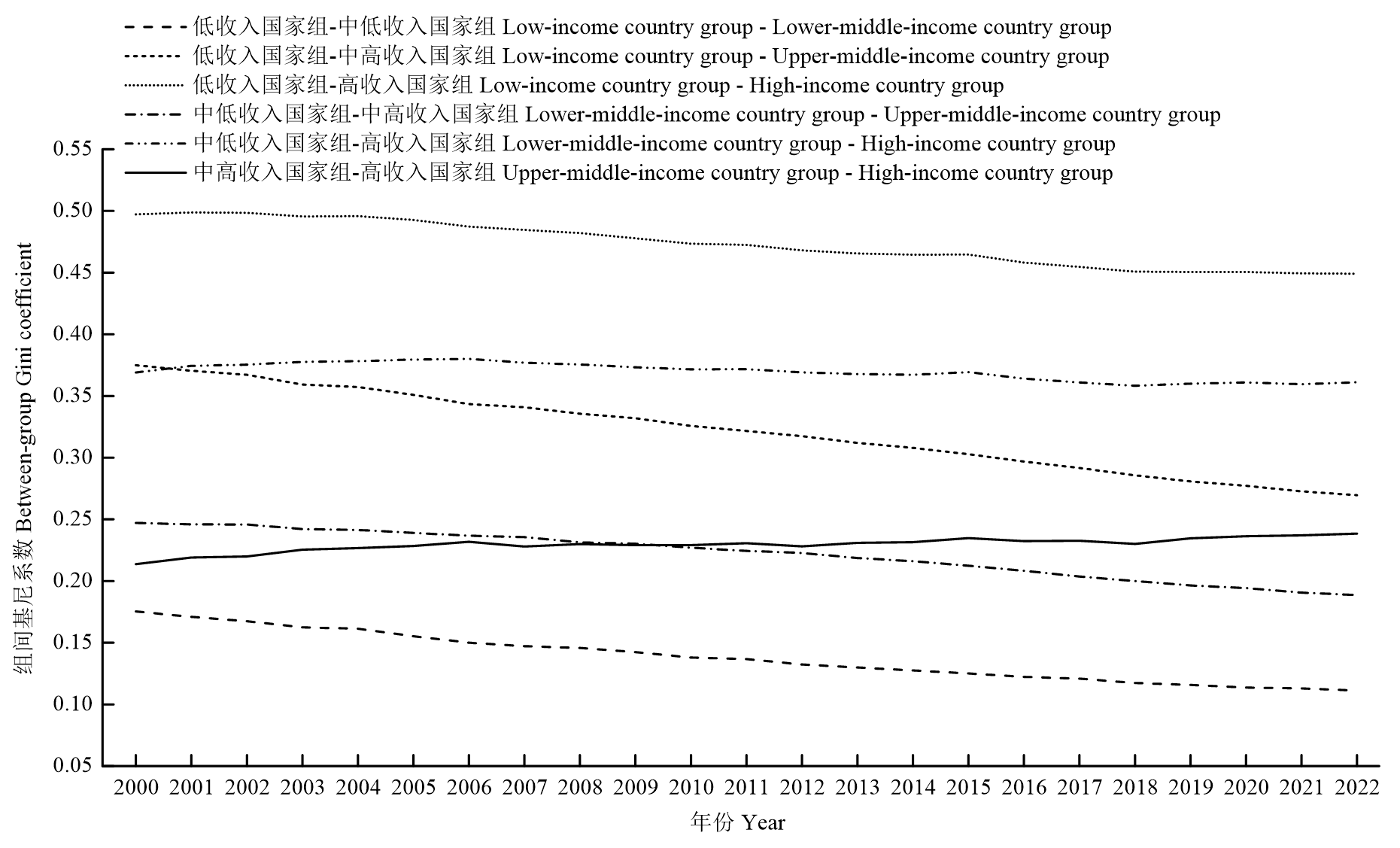
表3
2000年农业农村发展水平空间分异的因子探测结果"
| 影响因素 Influencing factor | 低收入国家组 Low-income country group | 中低收入国家组 Lower-middle-income country group | 中高收入国家组 Upper-middle-income country group | 高收入国家组 High-income country group | ||||
|---|---|---|---|---|---|---|---|---|
| q值 q-value | 排序 Rank | q值 q-value | 排序 Rank | q值 q-value | 排序 Rank | q值 q-value | 排序 Rank | |
| 经济发展水平(X1) Economic development level (X1) | 0.7683 | 1 | 0.5486 | 1 | 0.2150 | 4 | 0.6942 | 1 |
| 信息化水平(X2) Informatization level (X2) | 0.1847 | 8 | 0.4026 | 3 | 0.2943 | 2 | 0.5191 | 2 |
| 产业结构(X3) Industrial structure (X3) | 0.5163 | 2 | 0.1541 | 7 | 0.1557 | 6 | 0.1391 | 8 |
| 人口老龄化水平(X4) Population aging level (X4) | 0.3024 | 4 | 0.2673 | 5 | 0.2896 | 3 | 0.1845 | 7 |
| 农产品贸易开放(X5) Agricultural trade openness (X5) | 0.2306 | 7 | 0.1714 | 6 | 0.1766 | 5 | 0.1917 | 6 |
| 农业技术进步(X6) Agricultural technological progress (X6) | 0.2732 | 5 | 0.3131 | 4 | 0.3347 | 1 | 0.3544 | 3 |
| 环境保护力度(X7) Environmental protection intensity (X7) | 0.3682 | 3 | 0.4768 | 2 | 0.0878 | 7 | 0.2113 | 5 |
| 农地利用结构(X8) Agricultural land use structure (X8) | 0.2564 | 6 | 0.1386 | 8 | 0.0623 | 8 | 0.2502 | 4 |
表4
2022年农业农村发展水平空间分异的因子探测结果"
| 影响因素 Influencing factor | 低收入国家组 Low-income country group | 中低收入国家组 Lower-middle-income country group | 中高收入国家组 Upper-middle-income country group | 高收入国家组 High-income country group | ||||
|---|---|---|---|---|---|---|---|---|
| q值 q-value | 排序 Rank | q值 q-value | 排序 Rank | q值 q-value | 排序 Rank | q值 q-value | 排序 Rank | |
| 经济发展水平(X1) Economic development level (X1) | 0.2253 | 7 | 0.5707 | 2 | 0.2599 | 2 | 0.6212 | 1 |
| 信息化水平(X2) Informatization level (X2) | 0.4710 | 1 | 0.6074 | 1 | 0.2313 | 4 | 0.4186 | 2 |
| 产业结构(X3) Industrial structure (X3) | 0.2551 | 6 | 0.3590 | 4 | 0.1657 | 6 | 0.2463 | 4 |
| 人口老龄化水平(X4) Population aging level (X4) | 0.3025 | 5 | 0.4561 | 3 | 0.7159 | 1 | 0.1128 | 8 |
| 农产品贸易开放(X5) Agricultural trade openness (X5) | 0.4378 | 3 | 0.1309 | 8 | 0.2516 | 3 | 0.2469 | 3 |
| 农业技术进步(X6) Agricultural technological progress (X6) | 0.3285 | 4 | 0.2700 | 5 | 0.2154 | 5 | 0.1935 | 6 |
| 环境保护力度(X7) Environmental protection intensity (X7) | 0.4601 | 2 | 0.1758 | 7 | 0.1085 | 8 | 0.2385 | 5 |
| 农地利用结构(X8) Agricultural land use structure (X8) | 0.1907 | 8 | 0.2244 | 6 | 0.1445 | 7 | 0.1621 | 7 |
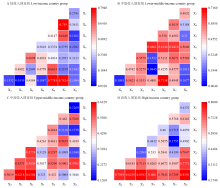
图5
2000年农业农村发展水平影响因素的交互探测结果"

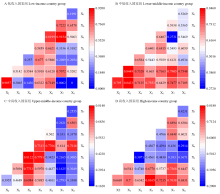
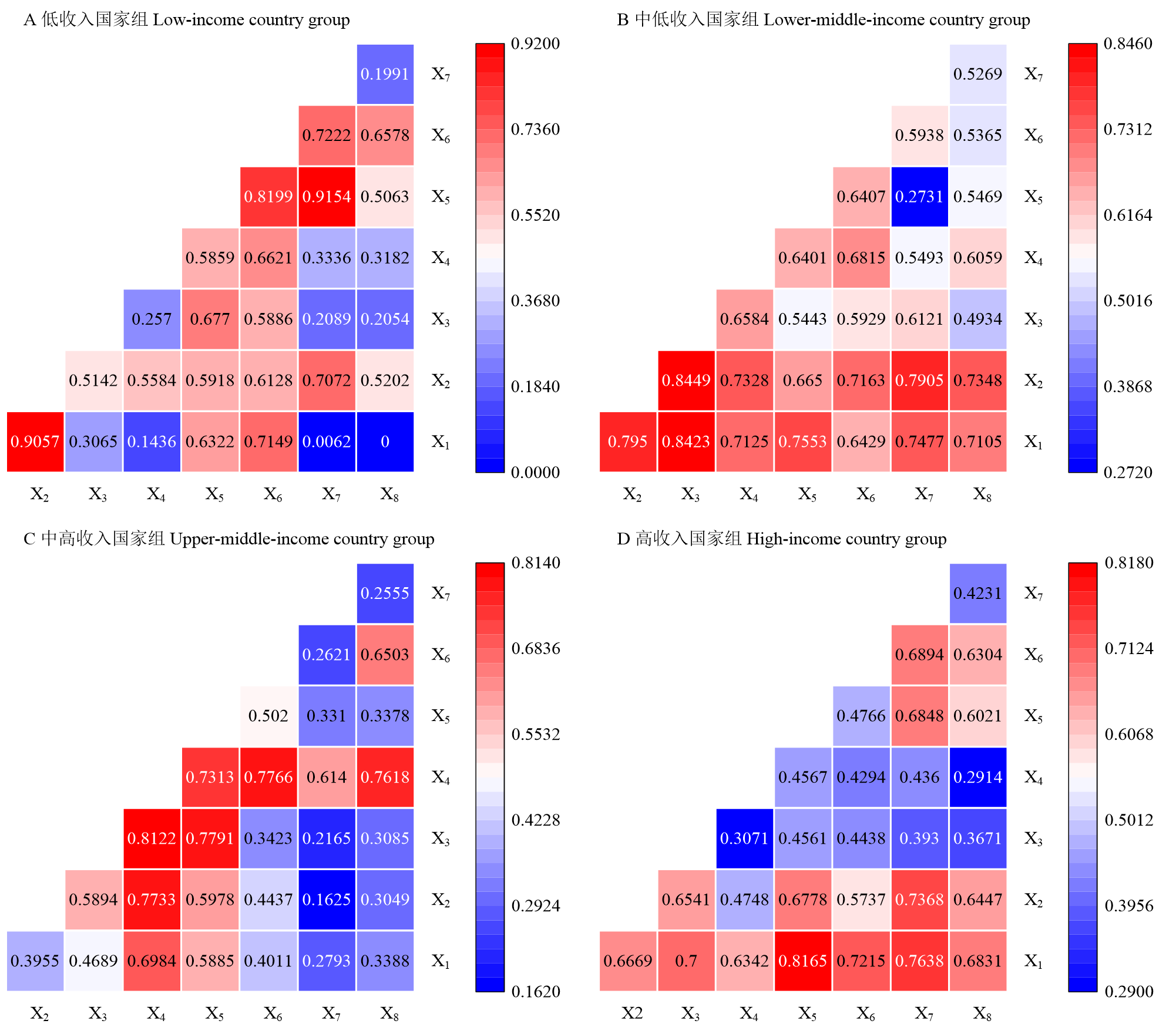
图6
2022年农业农村发展水平影响因素的交互探测结果"
| [1] |
匡远配, 彭云, 李姗姗. 新时代中国农业农村现代化的多重逻辑、基本特征及实现路径. 中国农村经济, 2024(12): 2-22.
|
|
|
|
| [2] |
李思梦, 杨忍, 龙花楼. 全球乡村发展理论演化及其对中国乡村现代化的启示. 地理学报, 2024, 79(4): 854-872.
|
|
|
|
| [3] |
陈秧分, 卢昱嘉. 面向远景目标的农业强国建设: 国际比较与中国对策. 现代经济探讨, 2023(3): 1-11.
|
|
|
|
| [4] |
黄季焜, 胡瑞法, 易红梅, 盛誉, 王金霞, 宝明涛, 刘旭. 面向2050年我国农业发展愿景与对策研究. 中国工程科学, 2022, 24(1): 11-19.
|
|
|
|
| [5] |
蒋黎, 蒋和平, 郝汉. 中国式农业农村现代化: 科学内涵、条件分析及实现途径. 经济学家, 2024(11): 119-128.
|
|
|
|
| [6] |
魏后凯. “十四五”时期中国农村发展若干重大问题. 中国农村经济, 2020(1): 2-16.
|
|
|
|
| [7] |
吕新业, 万广华, 刘景琦, 汪晨. 中国式农业农村现代化: 内涵特征、现实挑战与策略选择. 改革, 2024(9): 125-137.
|
|
|
|
| [8] |
陈慧卿, 曾福生. 湖南省农业农村现代化发展水平测度及其区域差异. 经济地理, 2022, 42(11): 185-194.
|
|
|
|
| [9] |
覃朝晖, 范振楠, 余思明. 数字经济与农业农村现代化: 基于地级市层面的研究. 中南财经政法大学学报, 2024(4): 108-119.
|
|
|
|
| [10] |
姬志恒. 中国农业农村高质量发展的空间差异及驱动机制. 数量经济技术经济研究, 2021, 38(12): 25-44.
|
|
|
|
| [11] |
张务伟, 王辰飞, 呼静茹. 山东省农业农村现代化动态演进及空间溢出效应研究. 农业现代化研究, 2024, 45(4): 577-590.
|
|
|
|
| [12] |
谢会强, 王涵, 谭宇航. 中国农业农村现代化发展水平的时空演变特征及区域差异研究. 世界农业, 2023(3): 85-96.
|
|
|
|
| [13] |
陈先兵. 数字经济、基本公共服务均等化与中国式农业农村现代化. 西南民族大学学报(人文社会科学版), 2023, 44(10): 95-109.
|
|
|
|
| [14] |
王力, 刘小凤, 李兴锋, 王一峰. 中国式农业农村现代化的时空特征及影响因素分析. 管理学刊, 2024, 37(6): 1-17.
|
|
|
|
| [15] |
程美秀, 陈秧分. 国际比较视角下中国农业现代化成效评估与影响因素分析. 资源科学, 2022, 44(10): 1994-2005.
|
|
|
|
| [16] |
张俊婕. 中国农业农村现代化发展水平的时空特征及障碍因子分析. 经济体制改革, 2022(2): 87-94.
|
|
|
|
| [17] |
赵丹玉, 崔建军. 中国农业农村高质量发展的时空特征、区域差异及影响因素. 华中农业大学学报(社会科学版), 2024(3): 10-24.
|
|
|
|
| [18] |
李媛, 阮连杰. 数字经济赋能中国式农业农村现代化: 理论逻辑与经验证据. 经济问题, 2023(8): 25-32.
|
|
|
|
| [19] |
张梦飞, 吴琳玥. 数字普惠金融、双元创新与中国式农业农村现代化. 华东经济管理, 2024, 38(11): 41-52.
|
|
|
|
| [20] |
孙贺, 傅孝天. 农业农村现代化一体推进的政治经济学逻辑. 求是学刊, 2021, 48(1): 81-89.
|
|
|
|
| [21] |
李周, 温铁军, 魏后凯, 杜志雄, 李成贵, 金文成. 加快推进农业农村现代化: “三农”专家深度解读中共中央一号文件精神. 中国农村经济, 2021(4): 2-20.
|
|
|
|
| [22] |
胡志全, 朱殿霄, 辛岭, 侯丽薇, 王东阳. 基于产业要素年代差距分析的农业现代化水平国际比较研究. 中国农业科学, 2018, 51(7): 1412-1420. doi: 10.3864/j.issn.0578-1752.2018.07.018.
|
|
|
|
| [23] |
|
| [24] |
陈明. 农业农村现代化的世界进程与国际比较. 经济体制改革, 2022(4): 151-159.
|
|
|
|
| [25] |
张应禄, 陈志钢. 城乡二元经济结构: 测定、变动趋势及政策选择. 农业经济问题, 2011, 32(11): 84-93, 112.
|
|
|
|
| [26] |
陈准, 刘云朋, 陈太政, 周志民, 王伟. 中国省际农业高质量发展空间关联网络结构演化及其驱动因素. 经济地理, 2024, 44(11): 151-160, 172.
|
|
|
|
| [27] |
|
| [28] |
杨忍, 刘芮彤. 珠三角城市群地区都市农业功能演变及其协同-权衡关系. 地理研究, 2022, 41(7): 1995-2015.
|
|
|
|
| [29] |
|
| [30] |
郭强, 杨湘君. 中国省域发展软环境评价及其区域差异. 经济地理, 2023, 43(9): 10-19.
|
|
|
|
| [31] |
陈实, 黄银兰, 金云翔, 徐成林, 邹金秋. 中国北部冬小麦安全种植的农业气候因子及其阈值. 中国农业科学, 2024, 57(16): 3142-3153. doi: 10.3864/j.issn.0578-1752.2024.16.004.
|
|
|
|
| [32] |
刘同山, 陈斯懿. 农业强国的测度指标、国际比较与中国选择. 东岳论丛, 2023, 44(7): 5-14.
|
|
|
|
| [33] |
孙运宏. 财政支农与农业现代化: 基于全球视野的分析. 世界经济与政治论坛, 2024(2): 146-165.
|
|
|
|
| [34] |
|
| [1] | 胡志全,朱殿霄,辛岭,侯丽薇,王东阳. 基于产业要素年代差距分析的农业现代化水平国际比较研究[J]. 中国农业科学, 2018, 51(7): 1412-1420. |
|
||
