






中国农业科学 ›› 2026, Vol. 59 ›› Issue (18): 4056-4075.doi: 10.3864/j.issn.0578-1752.2026.18.009
• 专题:面向农业害虫精准防控的机制解析、技术优化与决策支撑 • 上一篇 下一篇
李灏元1( ), 杨采青1(), 陈丹1, 许振邦2, 门雅惠1, 高菲1, 张爱兵1()
收稿日期:2026-04-03
接受日期:2026-06-18
出版日期:2026-09-16
发布日期:2026-09-20
通信作者:
联系方式:
李灏元,E-mail:captain_if@163.com。
基金资助:
LI HaoYuan1(), YANG CaiQing1(), CHEN Dan1, XU ZhenBang2, MEN YaHui1, GAO Fei1, ZHANG AiBing1()
Received:2026-04-03
Accepted:2026-06-18
Published:2026-09-16
Online:2026-09-20
摘要:
【目的】天蛾幼虫取食寄主植物叶片致使植株受损甚至死亡,对区域农林业发展造成严重威胁。论文旨在揭示北京地区不同类型的经济作物对天蛾害虫的潜在重要性,从而识别各类型作物对应的主要天蛾害虫物种并提出防控意见。【方法】构建北京地区的天蛾-寄主植物互作网络,基于连接度、嵌套性和模块性等指标分析网络的结构;使用模块间连通性(c值)和模块内度(z值)量化各节点在网络模块结构中的属性,采用次生灭绝曲线量化节点对于网络稳健性的影响,并使用Kruskal-Wallis检验比较不同类型作物对网络稳健性和模块结构的作用是否具有显著差异;对于网络中连接较多的天蛾,分析其食谱占比并依据不同作物类型给出防控建议。【结果】天蛾-寄主植物互作网络的连接度C=0.043,嵌套性N=3.67,模块性Q=0.668。农业作物类包含2个模块枢纽,林业作物类包含2个模块枢纽,药用作物类包含2个模块枢纽和3个连接者节点,观赏作物类包含2个模块枢纽和2个连接者节点,乡土树木类包含3个模块枢纽和1个连接者节点,其他作物类包含4个模块枢纽和2个连接者节点,非经济作物类中的植物均属于边缘节点。各类别的寄主植物对网络稳健性的影响无显著差异,而各类型作物的模块内度均显著高于非经济作物(农业作物:P=0.0015;林业作物:P=0.0030;药用作物:P=0.0010;观赏作物:P=0.0069;乡土树木:P=0.0006;其他作物:P=0.0011)。【结论】北京地区的天蛾-寄主植物互作网络呈现出连接稀疏、分散的互作格局,不同天蛾害虫对各类作物均具有较高的潜在危害风险。在北京地区开展防控工作时,对全部寄主植物而言,应优先防治在网络中具有较高中心性的物种,如丁香天蛾(Psilogramma increta)、白薯天蛾(Agrius convolvuli)等;对全部类别作物而言,除重点保护农林业作物外,还需将其他经济作物和乡土树木纳入保护范围;对单一类型的作物而言,要对以其为主要取食对象的天蛾物种进行特异性防治;此外,对于在北京地区有分布记录、潜在寄主植物但目前种群规模较小的天蛾物种,应警惕其暴发风险。
李灏元, 杨采青, 陈丹, 许振邦, 门雅惠, 高菲, 张爱兵. 不同类型作物对北京地区天蛾-寄主植物互作网络的重要性研究[J]. 中国农业科学, 2026, 59(18): 4056-4075.
LI HaoYuan, YANG CaiQing, CHEN Dan, XU ZhenBang, MEN YaHui, GAO Fei, ZHANG AiBing. The Importance of Different Crop Types to the Hawkmoth-Host Plant Interaction Network in Beijing Area[J]. Scientia Agricultura Sinica, 2026, 59(18): 4056-4075.

图1
北京地区的天蛾-寄主植物互作网络"
表1
寄主植物的作物类别和在互作网络中的节点属性"
| 科名 Family name | 属名 Genus name | 农业作物 Agricultural crop | 林业作物 Forestry crop | 药用作物 Medicinal crop | 观赏作物 Ornamental crop | 乡土树木 Indigenous tree | 其他作物 Other crop | 非经济作物 Non-econo-mic crop | 节点属性 Network role |
|---|---|---|---|---|---|---|---|---|---|
| 菊科Asteraceae | 莴苣属Lactuca | √ | √ | 边缘节点Peripheral node | |||||
| 五加科Araliaceae | 常春藤属Hedera | √ | √ | ||||||
| 忍冬科Caprifoliaceae | 忍冬属Lonicera | √ | √ | √ | √ | 连接者节点Connector node | |||
| 败酱属Patrinia | √ | √ | √ | 边缘节点Peripheral node | |||||
| 锦带花属Weigela | √ | ||||||||
| 荚蒾科Viburnaceae | 荚蒾属Viburnum | √ | √ | ||||||
| 冬青科Aquifoliaceae | 冬青属Ilex | √ | |||||||
| 唇形科 Lamiaceae | 紫珠属Callicarpa | √ | |||||||
| 大青属Clerodendrum | √ | √ | √ | 模块枢纽 Module hub | |||||
| 鞘蕊花属Coleus | √ | 边缘节点Peripheral node | |||||||
| 紫苏属Perilla | √ | ||||||||
| 牡荆属Vitex | √ | √ | √ | 模块枢纽Module hub | |||||
| 泡桐科 Paulowniaceae | 泡桐属Paulownia | √ | 边缘节点Peripheral node | ||||||
| 紫葳科Bignoniaceae | 梓属Catalpa | √ | |||||||
| 芝麻科Pedaliaceae | 芝麻属Sesamum | √ | |||||||
| 马鞭草科Verbenaceae | 假连翘属Duranta | √ | |||||||
| 车前科 Plantaginaceae | 金鱼草属Antirrhinum | √ | |||||||
| 柳穿鱼属Linaria | √ | ||||||||
| 车前属Plantago | √ | ||||||||
| 木樨科 Oleaceae | 流苏树属Chionanthus | √ | |||||||
| 连翘属Forsythia | √ | ||||||||
| 梣属Fraxinus | √ | √ | √ | √ | |||||
| 素馨属Jasminum | √ | ||||||||
| 女贞属Ligustrum | √ | ||||||||
| 木樨榄属Olea | √ | ||||||||
| 木樨属Osmanthus | √ | ||||||||
| 丁香属Syringa | √ | √ | |||||||
| 茜草科 Rubiaceae | 拉拉藤属Galium | √ | √ | 连接者节点Connector node | |||||
| 栀子属Gardenia | √ | 边缘节点Peripheral node | |||||||
| 野丁香属Leptodermis | √ | √ | |||||||
| 水线草属Oldenlandia | √ | ||||||||
| 鸡屎藤属Paederia | √ | ||||||||
| 茜草属Rubia | √ | ||||||||
| 白马骨属Serissa | √ | ||||||||
| 茄科 Solanaceae | 辣椒属Capsicum | √ | √ | ||||||
| 烟草属Nicotiana | √ | √ | |||||||
| 茄属Solanum | √ | √ | √ | ||||||
| 旋花科 Convolvulaceae | 打碗花属Calystegia | √ | |||||||
| 旋花属Convolvulus | √ | √ | |||||||
| 番薯属Ipomoea | √ | √ | √ | √ | |||||
| 鱼黄草属Merremia | √ | ||||||||
| 猕猴桃科Actinidiaceae | 猕猴桃属Actinidia | √ | |||||||
| 凤仙花科Balsaminaceae | 凤仙花属Impatiens | √ | √ | ||||||
| 绣球花科Hydrangeaceae | 绣球属Hydrangea | √ | √ | ||||||
| 山梅花属Philadelphus | √ | √ | |||||||
| 马齿苋科Portulacaceae | 马齿苋属Portulaca | √ | √ | √ | |||||
| 石竹科Caryophyllaceae | 繁缕属Stellaria | √ | |||||||
| 蓼科 Polygonaceae | 萹蓄属Polygonum | √ | √ | √ | √ | ||||
| 酸模属Rumex | √ | √ | |||||||
| 豆科 Fabaceae | 落花生属Arachis | √ | |||||||
| 刀豆属Canavalia | √ | ||||||||
| 大豆属Glycine | √ | ||||||||
| 扁豆属Lablab | √ | √ | |||||||
| 胡枝子属Lespedeza | √ | √ | √ | √ | √ | ||||
| 菜豆属Phaseolus | √ | √ | √ | √ | |||||
| 豌豆属Pisum | √ | ||||||||
| 葛属Pueraria | √ | √ | |||||||
| 刺槐属Robinia | √ | √ | √ | √ | |||||
| 豇豆属Vigna | √ | √ | |||||||
| 紫藤属Wisteria | √ | ||||||||
| 蔷薇科 Rosaceae | 山楂属Crataegus | √ | √ | √ | |||||
| 枇杷属Eriobotrya | √ | ||||||||
| 棣棠属Kerria | √ | ||||||||
| 苹果属Malus | √ | √ | √ | √ | |||||
| 石楠属Photinia | √ | ||||||||
| 李属Prunus | √ | √ | √ | √ | |||||
| 梨属Pyrus | √ | √ | √ | ||||||
| 蔷薇属Rosa | √ | √ | √ | √ | √ | ||||
| 绣线菊属Spiraea | √ | √ | |||||||
| 桑科 Moraceae | 构属Broussonetia | √ | √ | ||||||
| 榕属Ficus | √ | ||||||||
| 橙桑属Maclura | √ | ||||||||
| 桑属Morus | √ | √ | √ | ||||||
| 榆科 Ulmaceae | 榆属Ulmus | √ | √ | √ | |||||
| 榉属Zelkova | √ | ||||||||
| 鼠李科 Rhamnaceae | 鼠李属Rhamnus | √ | |||||||
| 枣属Ziziphus | √ | √ | √ | √ | √ | ||||
| 胡颓子科Elaeagnaceae | 胡颓子属Elaeagnus | √ | √ | √ | |||||
| 桦木科 Betulaceae | 桦木属Betula | √ | |||||||
| 鹅耳枥属Carpinus | √ | √ | |||||||
| 榛属Corylus | √ | ||||||||
| 胡桃科 Juglandaceae | 山核桃属Carya | √ | |||||||
| 胡桃属Juglans | √ | √ | √ | √ | √ | 模块枢纽 Module hub | |||
| 枫杨属Pterocarya | √ | 边缘节点Peripheral node | |||||||
| 壳斗科 Fagaceae | 栗属Castanea | √ | |||||||
| 栎属Quercus | √ | √ | √ | √ | √ | √ | |||
| 杨柳科 Salicaceae | 杨属Populus | √ | √ | √ | √ | ||||
| 柳属Salix | √ | √ | √ | ||||||
| 大戟科 Euphorbiaceae | 铁苋菜属Acalypha | √ | |||||||
| 大戟属Euphorbia | √ | √ | √ | 连接者节点Connector node | |||||
| 酢浆草科Oxalidaceae | 酢浆草属Oxalis | √ | √ | 边缘节点Peripheral node | |||||
| 卫矛科Celastraceae | 卫矛属Euonymus | √ | √ | √ | |||||
| 锦葵科 Malvaceae | 黄麻属Corchorus | √ | |||||||
| 梧桐属Firmiana | √ | ||||||||
| 棉属Gossypium | √ | ||||||||
| 锦葵属Malva | √ | √ | √ | ||||||
| 椴属Tilia | √ | √ | √ | ||||||
| 楝科Meliaceae | 楝属Melia | √ | |||||||
| 无患子科Sapindaceae | 槭属Acer | √ | √ | √ | √ | ||||
| 漆树科 Anacardiaceae | 黄连木属Pistacia | √ | √ | √ | √ | ||||
| 盐麸木属Rhus | √ | √ | √ | ||||||
| 柳叶菜科 Onagraceae | 柳兰属Chamerion | √ | |||||||
| 露珠草属Circaea | √ | ||||||||
| 柳叶菜属Epilobium | √ | 连接者节点Connector node | |||||||
| 倒挂金钟属Fuchsia | √ | 边缘节点Peripheral node | |||||||
| 丁香蓼属Ludwigia | √ | ||||||||
| 月见草属Oenothera | √ | √ | |||||||
| 千屈菜科Lythraceae | 千屈菜属Lythrum | √ | |||||||
| 牻牛儿苗科Geraniaceae | 老鹳草属Geranium | √ | √ | √ | |||||
| 葡萄科 Vitaceae | 蛇葡萄属Ampelopsis | √ | √ | √ | |||||
| 乌蔹莓属Causonis | √ | ||||||||
| 地锦属Parthenocissus | √ | √ | √ | ||||||
| 葡萄属Vitis | √ | √ | 模块枢纽 Module hub | ||||||
| 虎耳草科Saxifragaceae | 虎耳草属Saxifraga | √ | 边缘节点Peripheral node | ||||||
| 悬铃木科Platanaceae | 悬铃木属Platanus | √ | √ | ||||||
| 小檗科Berberidaceae | 小檗属Berberis | √ | √ | ||||||
| 禾本科 Poaceae | 白茅属Imperata | √ | |||||||
| 玉蜀黍属Zea | √ | ||||||||
| 薯蓣科Dioscoreaceae | 薯蓣属Dioscorea | √ | √ | √ | |||||
| 天南星科 Araceae | 魔芋属Amorphophallus | √ | |||||||
| 天南星属Arisaema | √ | √ | |||||||
| 五彩芋属Caladium | √ | ||||||||
| 芋属Colocasia | √ | ||||||||
| 半夏属Pinellia | √ | √ | |||||||
| 犁头尖属Typhonium | √ | ||||||||
| 马蹄莲属Zantedeschia | √ | ||||||||
| 松科 Pinaceae | 落叶松属Larix | √ | √ | ||||||
| 云杉属Picea | √ | √ | √ | ||||||
| 松属Pinus | √ | √ | √ | √ | √ |
表2
天蛾科昆虫在互作网络中的度和节点属性"
| 亚科名Subfamily name | 种名Species name | 度(连接数)Degree (number of links) | 节点属性Network role |
|---|---|---|---|
| 天蛾亚科Sphinginae | 丁香天蛾Psilogramma increta | 20 | 边缘节点 Peripheral node |
| 长喙天蛾亚科Macroglossinae | 芋双线天蛾Theretra oldenlandiae | 19 | |
| 天蛾亚科Sphinginae | 白薯天蛾Agrius convolvuli | 18 | |
| 长喙天蛾亚科Macroglossinae | 深色白眉天蛾Hyles gallii | 17 | 连接者节点 Connector node |
| 红天蛾Deilephila elpenor | 16 | ||
| 天蛾亚科Sphinginae | 芝麻鬼脸天蛾Acherontia styx | 15 | 边缘节点 Peripheral node |
| 长喙天蛾亚科Macroglossinae | 八字白眉天蛾Hyles livornica | 12 | |
| 雀纹天蛾Theretra japonica | 12 | ||
| 蒙古白肩天蛾Rhagastis mongoliana | 10 | ||
| 目天蛾亚科Smerinthinae | 红六点天蛾Marumba gaschkewitschii | 9 | |
| 天蛾亚科Sphinginae | 红节天蛾Sphinx ligustri | 9 | |
| 目天蛾亚科Smerinthinae | 榆绿天蛾Callambulyx tatarinovii | 8 | |
| 长喙天蛾亚科Macroglossinae | 白环红天蛾Deilephila askoldensis | 8 | |
| 目天蛾亚科Smerinthinae | 钩翅天蛾Mimas christophi | 7 | |
| 蓝目天蛾Smerinthus planus | 7 | ||
| 豆天蛾Clanis bilineata | 6 | ||
| 黄脉天蛾Laothoe amurensis | 6 | ||
| 栗六点天蛾Marumba sperchius | 5 | ||
| 锯翅天蛾亚科Langiinae | 锯翅天蛾Langia zenzeroides | 5 | |
| 长喙天蛾亚科Macroglossinae | 缺角天蛾Acosmeryx castanea | 5 | |
| 葡萄缺角天蛾Acosmeryx naga | 5 | ||
| 葡萄天蛾Ampelophaga rubiginosa | 5 | ||
| 目天蛾亚科Smerinthinae | 裂斑鹰翅天蛾Ambulyx ochracea | 4 | |
| 核桃鹰翅天蛾Ambulyx schauffelbergeri | 4 | ||
| 天蛾亚科Sphinginae | 绒星天蛾Dolbina tancrei | 4 | |
| 长喙天蛾亚科Macroglossinae | 条背线天蛾Cechetra lineosa | 4 | |
| 黑长喙天蛾Macroglossum pyrrhosticta | 4 | ||
| 目天蛾亚科Smerinthinae | 日本鹰翅天蛾Ambulyx japonica | 3 | |
| 构月天蛾Parum colligata | 3 | ||
| 盾天蛾Phyllosphingia dissimilis | 3 | ||
| 杨目天蛾Smerinthus caecus | 3 | ||
| 天蛾亚科Sphinginae | 晦暗松天蛾Hyloicus caligineus | 3 | |
| 绒天蛾Kentrochrysalis streckeri | 3 | ||
| 长喙天蛾亚科Macroglossinae | 纹背线天蛾Cechetra striata | 3 | |
| 咖啡透翅天蛾Cephonodes hylas | 3 | ||
| 黑边天蛾Hemaris affinis | 3 | ||
| 黄胫黑边天蛾Hemaris ottonis | 3 | ||
| 后黄黑边天蛾Hemaris radians | 3 | ||
| 青背长喙天蛾Macroglossum bombylans | 3 | ||
| 小豆长喙天蛾Macroglossum stellatarum | 3 | ||
| 葡萄昼天蛾Sphecodina caudata | 3 | ||
| 目天蛾亚科Smerinthinae | 托比鹰翅天蛾Ambulyx tobii | 2 | |
| 灰斑豆天蛾Clanis undulosa | 2 | ||
| 甘蔗天蛾Leucophlebia lineata | 2 | ||
| 黄边六点天蛾Marumba maackii | 2 | ||
| 天蛾亚科Sphinginae | 白须绒天蛾Kentrochrysalis sieversi | 2 | |
| 鼠天蛾Sphingulus mus | 2 | ||
| 长喙天蛾亚科Macroglossinae | 凸缘长喙天蛾Macroglossum nycteris | 2 | |
| 山锤天蛾Neogurelca montana | 2 | ||
| 目天蛾亚科Smerinthinae | 华南鹰翅天蛾Ambulyx kuangtungensis | 1 | |
| 晋陕六点天蛾Marumba fenzelii | 1 | ||
| 小目天蛾Smerinthus minor | 1 | ||
| 长喙天蛾亚科Macroglossinae | 浅纹白眉天蛾Hyles exilis | 1 | |
| 长喙天蛾Macroglossum corythus | 1 | ||
| 波斑长喙天蛾Macroglossum saga | 1 |
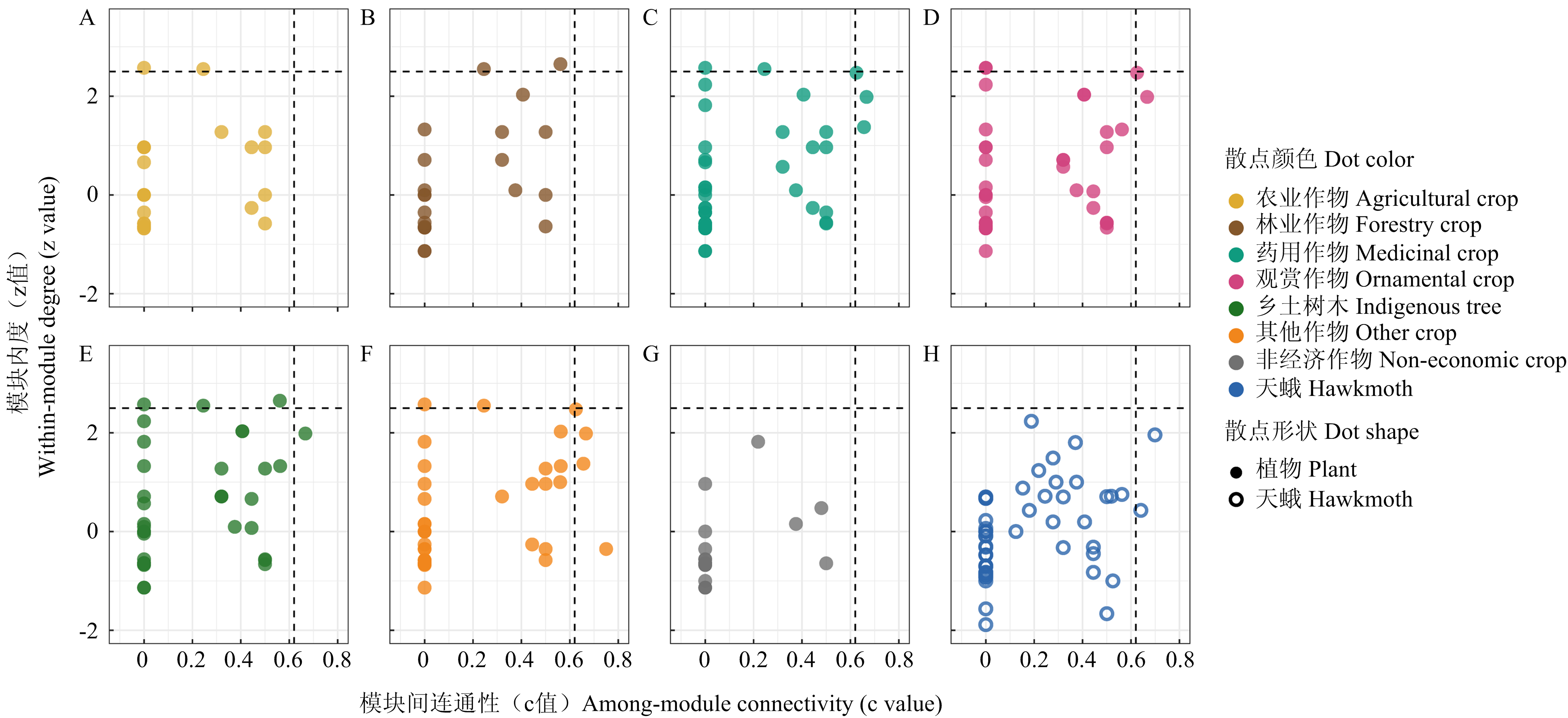
图2
互作网络中寄主植物和天蛾节点的c-z值"
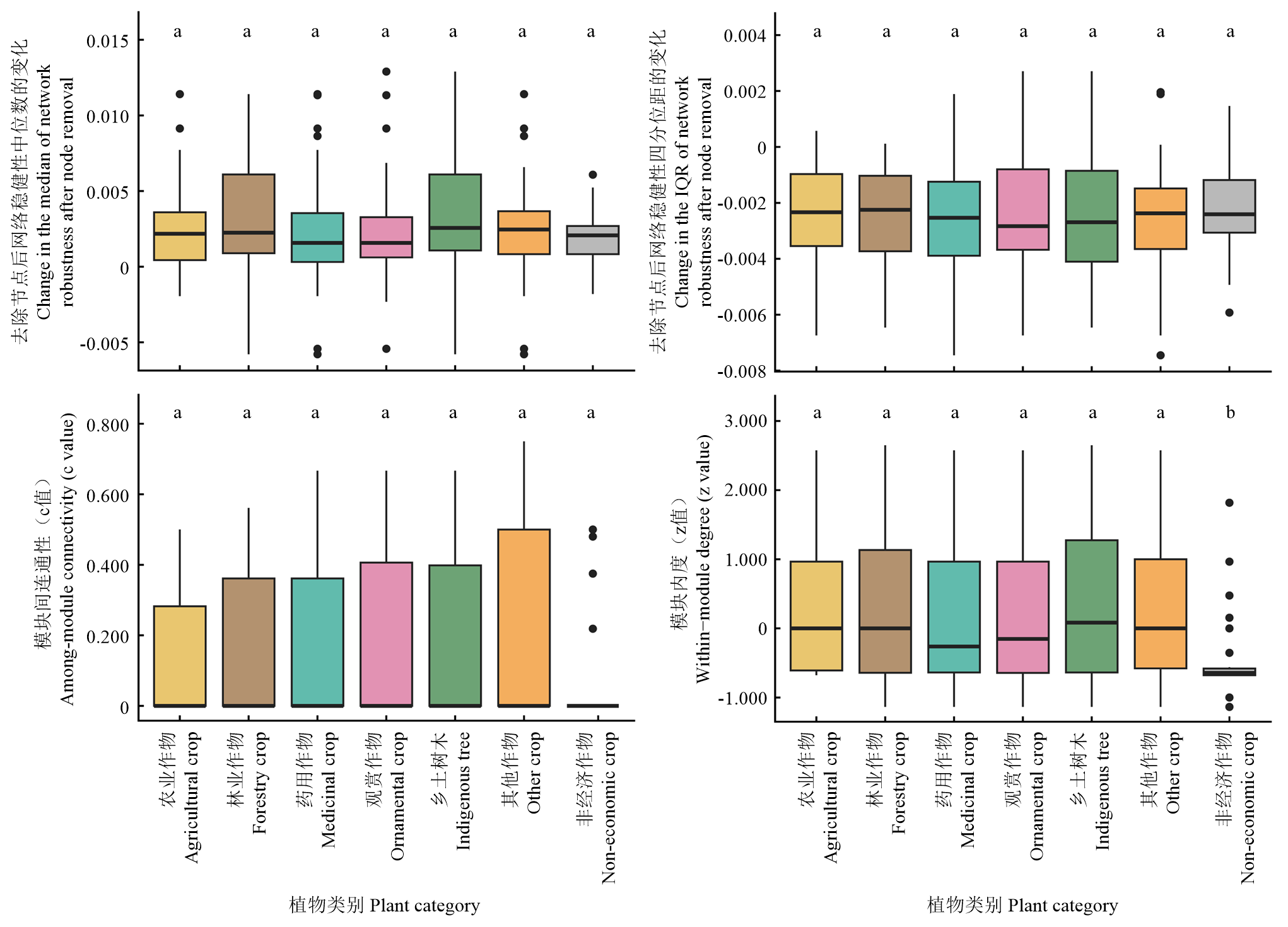
图3
不同类型作物对网络稳健性、稳健性变异程度的影响及c-z值的差异比较"
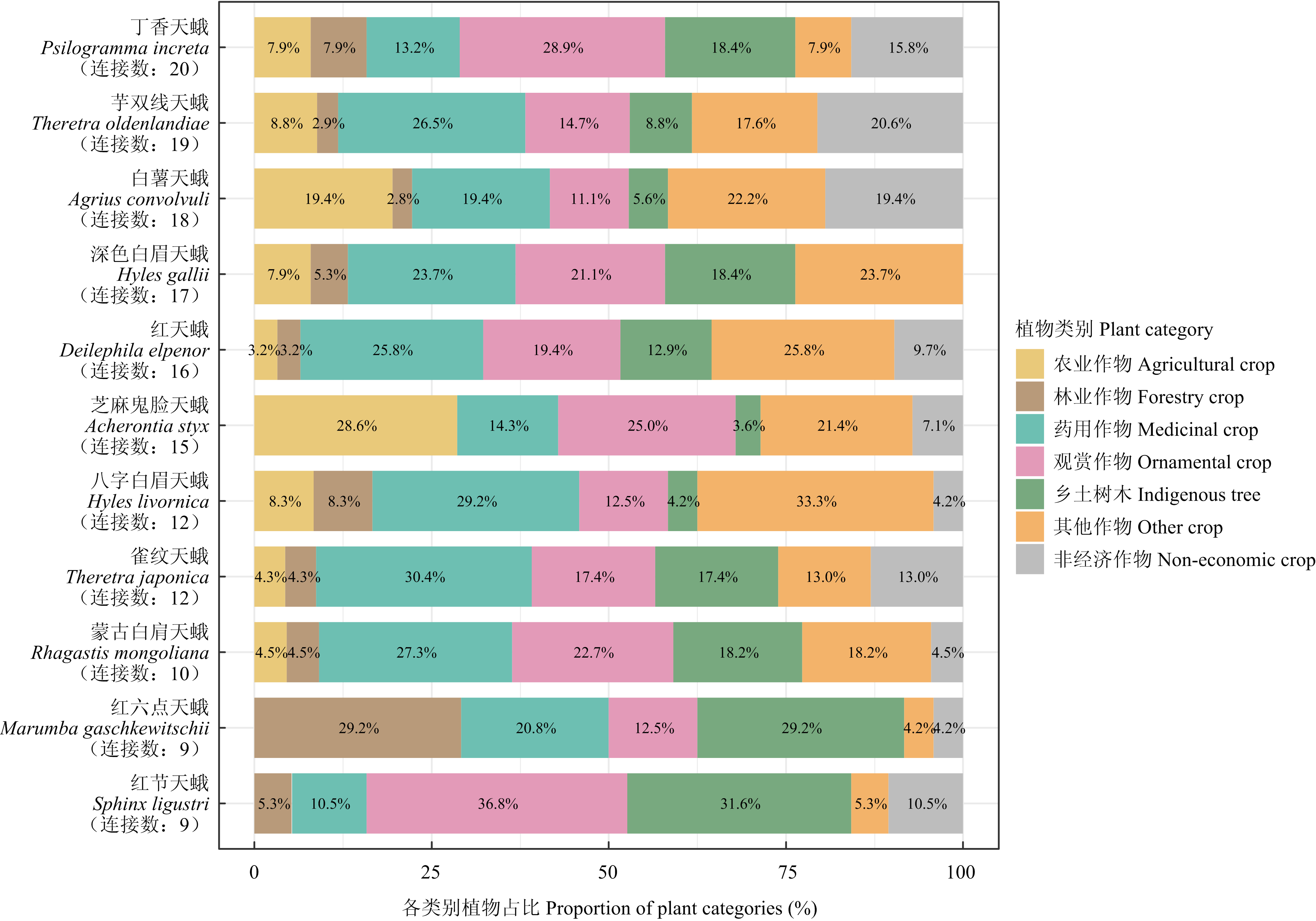
图4
连接数排名前10的天蛾物种取食的寄主植物"
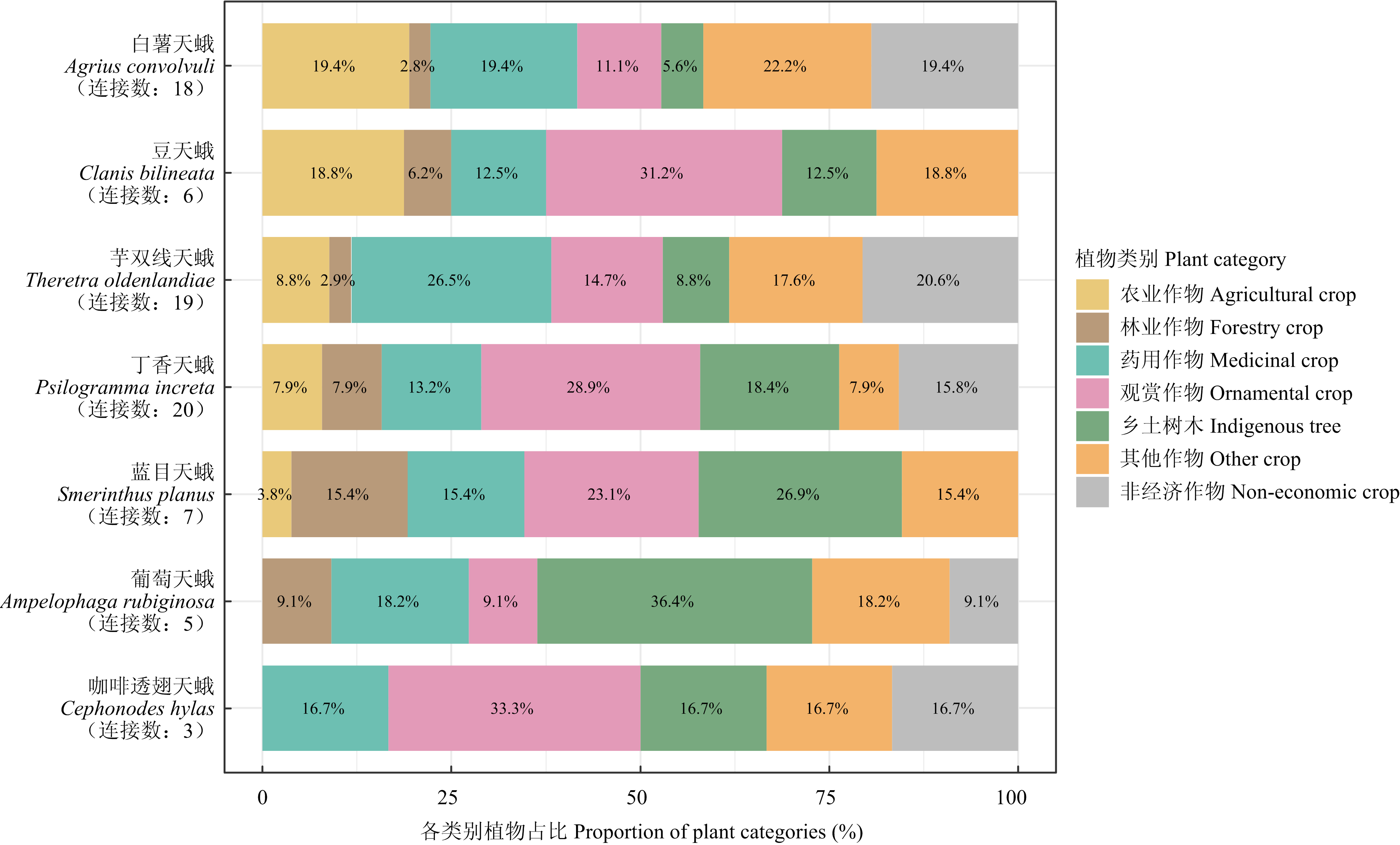
图5
重大天蛾害虫物种取食的寄主植物(按取食各类别植物的占比排列)"
表3
天蛾对不同类型寄主植物的偏好性"
| 寄主植物类别 Host plant category | 类别内占比最高的天蛾 Hawkmoth species with the highest proportion within each plant category | 类别内食谱最宽的天蛾 Hawkmoth species with the broadest diet breadth within each plant category |
|---|---|---|
| 农业作物Agricultural crop | 芝麻鬼脸天蛾Acherontia styx | 芝麻鬼脸天蛾Acherontia styx |
| 林业作物Forestry crop | 红六点天蛾Marumba gaschkewitschii | 红六点天蛾Marumba gaschkewitschii |
| 药用作物Medicinal crop | 雀纹天蛾Theretra japonica | 深色白眉天蛾Hyles gallii; 芋双线天蛾Theretra oldenlandiae |
| 观赏作物Ornamental crop | 红节天蛾Sphinx ligustri | 丁香天蛾Psilogramma increta |
| 乡土树木Indigenous tree | 红节天蛾Sphinx ligustri | 榆绿天蛾Callambulyx tatarinovii; 红六点天蛾Marumba gaschkewitschii; 钩翅天蛾Mimas christophi; 蓝目天蛾Smerinthus planus; 丁香天蛾Psilogramma increta; 深色白眉天蛾Hyles gallii |
| 其他作物Other crop | 八字白眉天蛾Hyles livornica | 深色白眉天蛾Hyles gallii |
| 非经济作物Non-economic crop | 芋双线天蛾Theretra oldenlandiae | 白薯天蛾Agrius convolvuli; 芋双线天蛾Theretra oldenlandiae |
| [1] |
doi: 10.1038/ncomms12462 pmid: 27511722 |
| [2] |
doi: 10.1016/j.tree.2005.04.004 |
| [3] |
doi: 10.1073/pnas.1633576100 pmid: 12881488 |
| [4] |
doi: 10.1073/pnas.0706375104 pmid: 18056808 |
| [5] |
doi: 10.1126/science.1188321 pmid: 20705861 |
| [6] |
doi: 10.1098/rspb.2004.2909 |
| [7] |
pmid: 17897679 |
| [8] |
doi: 10.1126/science.1214915 pmid: 22363009 |
| [9] |
张梦迪, 闫俊杰, 高玉林. 马铃薯块茎蛾对不同品种马铃薯块茎的适应性分析[J]. 中国农业科学, 2021, 54(3): 536-546. DOI: 10.3864/j.issn.0578-1752.2021.03.008.
|
|
|
|
| [10] |
吴明月, 甫秋梅, 黄圣琳, 罗丰, 刘勇, 史彩华, 张友军, 孔祥义, 谢文. 2020—2025年海南冬春季豇豆害虫种类调查及其发生危害规律[J]. 中国农业科学, 2025, 58(21): 4451-4466. DOI: 10.3864/j.issn.0578-1752.2025.21.014.
|
|
|
|
| [11] |
doi: 10.1002/ecs2.2017.8.issue-10 |
| [12] |
|
| [13] |
doi: 10.1007/s11829-024-10079-0 |
| [14] |
doi: 10.1016/j.scitotenv.2024.173949 |
| [15] |
doi: 10.1111/1365-2656.12509 pmid: 26931495 |
| [16] |
doi: 10.1111/jse.v57.1 |
| [17] |
doi: 10.1093/botlinnean/boab074 |
| [18] |
魏鸿钧. 黄淮地区的“三蛾”问题[J]. 植物保护, 1965(2): 64-65.
|
|
|
|
| [19] |
王贺军. 豆天蛾在河北省发生严重[J]. 植物保护, 1988(1): 55.
|
|
|
|
| [20] |
刘珍, 张世举. 豆天蛾1990年在新乡市暴发[J]. 植物保护, 1991(4): 53.
|
|
|
|
| [21] |
张广义, 王登甲, 惠祥海, 詹召芳, 孙明海. 1994年甘薯天蛾大暴发原因及防治对策[J]. 山东农业科学, 1995, 27(2): 31-32.
|
|
|
|
| [22] |
杨辉, 蔡娟, 姜道威, 吕丽萍, 孙宗明. 洛宁县2005年豆天蛾局部暴发成因及监控意见[J]. 中国植保导刊, 2006, 26(9): 18.
|
|
|
|
| [23] |
doi: 10.1111/jbi.v51.4 |
| [24] |
doi: 10.1111/1749-4877.12745 |
| [25] |
刘爱萍, 王建锋. 恶性杂草乳浆大戟天敌—大戟天蛾寄主专一性测定[J]. 中国草地, 1996(2): 33-34.
|
|
|
|
| [26] |
|
| [27] |
虞国跃. 北京蛾类图谱[M]. 北京: 科学出版社, 2014.
|
|
|
|
| [28] |
杜连海, 史宏亮, 吴记贵, 潘彥平, 田呈明, 刘博. 北京松山自然保护区昆虫图谱[M]. 杨凌: 西北农林科技大学出版社, 2015.
|
|
|
|
| [29] |
丁建云, 张建华. 北京灯下蛾类图谱[M]. 北京: 中国农业出版社, 2016.
|
|
|
|
| [30] |
虞国跃, 王合, 冯术快. 王家园昆虫[M]. 北京: 科学出版社, 2016.
|
|
|
|
| [31] |
虞国跃, 王合. 北京林业昆虫图谱(I)[M]. 北京: 科学出版社, 2018.
|
|
|
|
| [32] |
虞国跃. 北京访花昆虫图谱[M]. 北京: 电子工业出版社, 2019.
|
|
|
|
| [33] |
蒋卓衡, 黄嘉龙. 中国天蛾科图鉴[M]. 福州: 海峡书局, 2023.
|
|
|
|
| [34] |
|
| [35] |
肖翠, 刘冰, 吴超然, 马金双, 叶建飞, 夏晓飞, 林秦文. 北京维管植物编目和分布数据集[J]. 生物多样性, 2022, 30(6): 22064.
doi: 10.17520/biods.2022064 |
|
doi: 10.17520/biods.2022064 |
|
| [36] |
|
| [37] |
|
| [38] |
doi: 10.1016/j.pld.2022.05.005 |
| [39] |
doi: 10.1098/rsos.251697 |
| [40] |
刘旭, 杨庆文. 中国作物及其野生近缘植物名录卷[M]. 北京: 中国农业出版社, 2013.
|
|
|
|
| [41] |
冯志荣, 陈有城, 彭艳琼, 李莉, 王波. 生态网络分析: 从集合群落到集合网络[J]. 生物多样性, 2023, 31(8): 23171.
doi: 10.17520/biods.2023171 |
|
doi: 10.17520/biods.2023171 |
|
| [42] |
doi: 10.1111/oik.2008.117.issue-8 |
| [43] |
doi: 10.1098/rsos.140536 |
| [44] |
|
| [45] |
doi: 10.1016/j.ecolmodel.2007.02.032 |
| [46] |
doi: 10.1098/rsbl.2011.1167 |
| [47] |
|
| [48] |
doi: 10.1111/jec.2019.107.issue-4 |
| [49] |
李曾三, 郑新民. 消灭柳天蛾保护堤柳的几种办法[J]. 黄河建设, 1964(12): 31.
|
|
|
|
| [50] |
冯建国. 繁殖赤眼蜂的新寄主—柳天蛾的研究[J]. 山东农业科学, 1979(1): 29-31.
|
|
|
|
| [51] |
陈崇祯. 襄北地区甘薯天蛾(Herse convolvuli C.)的初步观察[J]. 昆虫知识, 1964(3): 124.
|
|
|
|
| [52] |
刘汉舒, 尤桂爱, 迟新之, 张广义, 孙明海, 詹召芳. 鲁西南甘薯天蛾发生规律及防治研究[J]. 华东昆虫学报, 1998(1): 42-46.
|
|
|
|
| [53] |
黄广泰. 伏牛山区甘薯天蛾的发生与防治[J]. 河南农业科学, 1998(7): 25.
|
|
|
|
| [54] |
陈森. 霜天蛾生活习性初步观察[J]. 江苏林业科技, 1982(2): 27-28.
|
|
|
|
| [55] |
程红, 严善春. 危害丁香属植物的昆虫种类[J]. 东北林业大学学报, 2011, 39(3): 113-116.
|
|
|
|
| [56] |
庞震, 龙淑文. 葡萄天蛾的观察简报[J]. 昆虫知识, 1975(4): 24-25.
|
|
|
|
| [57] |
张东光, 付晓颖. 葡萄天蛾在吉林松原地区的发生与防治[J]. 北方园艺, 2013(1): 200.
|
|
|
|
| [58] |
鄢春发, 吴文智, 唐征辉, 杨勤根, 李龙根. 咖啡透翅天蛾的初步研究[J]. 昆虫知识, 1988(2): 98-100.
|
|
|
|
| [59] |
廖寿南, 谢保令. 山枝子咖啡透翅天蛾的生活习性及防治[J]. 广西农业科学, 1995(3): 128-129.
|
|
|
|
| [60] |
许思学. 黄栀子咖啡透翅天蛾发生规律及防治技术初探[J]. 植保技术与推广, 2003, 23(12): 22-23.
|
|
|
|
| [61] |
李国元, 邓青云, 华光安, 胡波, 雷朝亮. 红栀子主要害虫与天敌种类及田间种群动态研究[J]. 昆虫天敌, 2005, 27(1): 21-26.
|
|
|
|
| [62] |
李国元, 邓青云, 华光安, 胡波, 雷朝亮. 红栀子园两种主要害虫咖啡透翅天蛾和茶长卷叶蛾的生物学特性及防治[J]. 昆虫知识, 2005, 42(4): 400-403.
|
|
|
|
| [63] |
何家庆, 施忠辉. 双线雀天蛾生物学及其对磨芋为害的观察研究[J]. 武汉植物学研究, 1995, 13(4): 369-372.
|
|
|
|
| [64] |
只佳增, 钱云, 陈鸿洁, 周劲松. 芋双线天蛾的生物学特性[J]. 热带农业科学, 2018, 38(5): 66-70.
|
|
|
|
| [65] |
王帅宇, 张子腾, 谢爱婷, 董杰, 杨建国, 张爱环. 我国草地贪夜蛾种群杀虫剂靶标基因突变分析[J]. 中国农业科学, 2022, 55(20): 3948-3959. DOI: 10.3864/j.issn.0578-1752.2022.20.007.
|
|
|
|
| [66] |
张桂芬, 万坤, 潘梦妮, 王龙, 黄聪, 王玉生, 张毅波, 冼晓青, 杨念婉, 桂富荣, 刘万学, 万方浩. 番茄潜叶蛾种群定殖与种群重建及延续能力研究[J]. 中国农业科学, 2024, 57(3): 514-524. DOI: 10.3864/j.issn.0578-1752.2024.03.007.
|
|
|
|
| [67] |
刘浩凯, 丰友娜, 李靖, 梁倩. 八角和莪术挥发油对小菜蛾杀虫活性成分及其作用机制[J]. 中国农业科学, 2025, 58(19): 3905-3918. DOI: 10.3864/j.issn.0578-1752.2025.19.008.
|
|
|
|
| [68] |
陆庆轩. 关于乡土植物定义的辨析[J]. 中国城市林业, 2016, 14(4): 12-14.
|
|
|
|
| [69] |
卢成仁. 有机、生态食物与中国的第三次农业革命[J]. 原生态民族文化学刊, 2022, 14(1): 69-76, 154.
|
|
|
|
| [70] |
王琛柱, 闫凤鸣. 信息化学物质及其在害虫防治中的应用[J]. 应用昆虫学报, 2023, 60(2): 313-314.
|
|
|
|
| [71] |
陈学新, 杜永均, 黄健华, 李姝, 姜道宏, 莫明和, 庞虹, 孙修炼, 王琦, 王甦, 夏玉先, 徐学农, 臧连生, 张杰, 张礼生, 张文庆, 尹恒. 我国作物病虫害生物防治研究与应用最新进展[J]. 植物保护, 2023, 49(5): 340-370.
|
|
|
|
| [72] |
向云菊, 张旺和, 徐进, 叶辉. CRISPR/Cas9基因编辑技术在害虫基因功能及害虫防治研究中的应用进展[J]. 农业生物技术学报, 2024, 32(6): 1415-1431.
|
|
|
|
| [73] |
海露, 张梦君, 杨斌. RNA农药: 重塑农业生态与害虫防治范式的创新蓝图[J]. 植物保护, 2025, 51(5): 178-189, 196.
|
|
|
|
| [74] |
doi: 10.1093/sysbio/syab076 |
| [75] |
张壮, 傅慧, 王殿轩, 荆世华, 李志信, 王泽, 刘曼. 基于AI多模型技术对储粮害虫防治应用的研究[J]. 中国粮油学报, 2024, 39(11): 17-25.
|
|
|
| [1] | 黄圣琳, 许怡博, 孔祥义, 史彩华, 焦晓国, 张友军, 吴明月, 谢文. 海南豇豆豆大蓟马周年种群动态分析[J]. 中国农业科学, 2025, 58(21): 4439-4450. |
| [2] | 王欢廷, 黄立飞, 曹雪梅, 龚芮, 苏国连, 郑霞林, 吴明月, 杨朗. 不同寄主植物对豆大蓟马体内消化酶活性及营养物质含量的影响[J]. 中国农业科学, 2025, 58(21): 4429-4438. |
| [3] | 年和粉, 张钰析, 李伯辽, 陈秀琳, 罗坤, 李广伟. 李小食心虫GfunOBP2的原核表达及气味配体结合特性[J]. 中国农业科学, 2023, 56(12): 2302-2316. |
| [4] | 宋博文,杨龙,潘云飞,李海强,李浩,冯宏祖,陆宴辉. 农田景观格局对南疆苹果园梨小食心虫成虫种群动态的影响[J]. 中国农业科学, 2022, 55(1): 85-95. |
| [5] | 郑许松,田俊策,杨亚军,朱平阳,李宽,徐红星,吕仲贤. 禾本科杂草作为防治稻纵卷叶螟的功能性植物的可行性[J]. 中国农业科学, 2017, 50(21): 4129-4137. |
| [6] | 王洁,田国忠,徐启聪,刘永光,高瑞,李向东,竺晓平 . 泡桐丛枝病病树周围几种植物上植原体的分子检测[J]. 中国农业科学, 2010, 43(2): 304-312 . |
| [7] | 徐广,郭予元,吴孔明. 棉铃虫成虫携带花粉的分析[J]. 中国农业科学, 1999, 32(06): 63-70 . |
|
||
