






中国农业科学 ›› 2026, Vol. 59 ›› Issue (18): 4163-4182.doi: 10.3864/j.issn.0578-1752.2026.18.016
徐浩楠1( ), 姚蕾1, 彭城1, 靳琳宇1, 曹果清1,2, 路畅1,2(), 李步高1,2()
收稿日期:2025-12-29
接受日期:2026-07-05
出版日期:2026-09-16
发布日期:2026-09-20
通信作者:
联系方式:
徐浩楠,E-mail:xuhaonanaa@163.com。
基金资助:
XU HaoNan1(), YAO Lei1, PENG Cheng1, JIN LinYu1, CAO GuoQing1,2, LU Chang1,2(), LI BuGao1,2()
Received:2025-12-29
Accepted:2026-07-05
Published:2026-09-16
Online:2026-09-20
摘要:
【目的】长链非编码RNA(long non-coding RNA,lncRNA)是一类长度超过200 nt且基本不编码蛋白质的RNA分子,在冷应激诱导的脂肪产热过程中具有重要调控功能。通过对藏猪和巴马猪皮下脂肪组织的转录组数据进行分析,挖掘冷应激条件下调控脂肪代谢的lncRNA,为进一步解析冷应激下脂肪产热机制奠定基础。【方法】选取5周龄藏猪和巴马猪各8只,每个品种分为室温组和低温(4 ℃)组,每组4个生物学重复。处理4 h后采集皮下脂肪组织进行转录组测序。基于测序数据,鉴定lncRNA,并对lncRNA及mRNA进行差异表达分析,比较两个品种在冷应激响应上的差异;通过顺式调控预测差异表达lncRNA的靶基因,利用DAVID在线工具进行GO(gene ontology)和KEGG(kyoto encyclopedia of genes and genomes)富集分析预测其参与的生物学过程;通过加权基因共表达网络分析(weighted correlation network analysis,WGCNA)筛选与冷应激最相关的模块,构建lncRNA和编码蛋白基因的共表达网络图。最后通过实时荧光定量PCR(RT-qPCR)技术对差异表达的lncRNA转录组数据进行验证。【结果】在藏猪和巴马猪皮下脂肪组织中共鉴定出2 988个lncRNA,其中1 939个lncRNA至少在一个样品中有表达。冷应激处理后,在藏猪与巴马猪的皮下脂肪组织中分别鉴定出88个和10个差异表达lncRNA,以及360个和88个差异表达mRNA,富集分析表明,差异mRNA主要富集到脂肪酸代谢和抗病毒感染生物学过程以及磷脂酰肌醇3-激酶-蛋白激酶B信号通路(PI3K-Akt)、过氧化物酶体增殖物激活受体信号通路(PPAR)以及Ras相关蛋白1信号通路(Rap1)等信号通路。此外,筛选了顺式调控的lncRNA和编码蛋白基因对,其中108个lncRNA位于83个编码蛋白基因上下游10 kb范围内,216个差异表达lncRNA位于289个差异表达基因上下游100 kb范围内。最后,通过WGCNA构建lncRNA和编码蛋白基因共表达网络,鉴定出18个模块,其中黄色模块与冷应激表型相关,模块内MSTRG.8042.2、MSTRG.8043.2等关键lncRNA分别与脂代谢核心基因显著关联,推测这些lncRNA可能是冷应激下的关键调控分子,协同参与宿主寒冷防御及脂质代谢调控过程。RT-qPCR结果证实了转录组数据的可靠性。【结论】研究筛选出MSTRG.8042.2、MSTRG.8043.2等影响冷应激下宿主御寒的关键lncRNA,为解析冷应激下调控脂肪代谢的分子机制提供了参考,并为地方猪种冷适应机制解析提供了新视角。
徐浩楠, 姚蕾, 彭城, 靳琳宇, 曹果清, 路畅, 李步高. 猪冷应激脂肪相关长链非编码RNA的鉴定及功能分析[J]. 中国农业科学, 2026, 59(18): 4163-4182.
XU HaoNan, YAO Lei, PENG Cheng, JIN LinYu, CAO GuoQing, LU Chang, LI BuGao. Identification and Functional Analysis of Adipose Tissue Related Long Noncoding RNAs in Response to Cold Stress in Pigs[J]. Scientia Agricultura Sinica, 2026, 59(18): 4163-4182.
表1
RT-qPCR 引物信息"
| 引物名称 Name | 正向序列(5′→3′) Forward sequence (5′→3′) | 反向序列(5′→3′) Reverse sequence (5′→3′) |
|---|---|---|
| MSTRG.8042.2 | CTCAGAACCGTGACAAGCAC | AAAAGGCAACCCAAACTATG |
| MSTRG.11528.4 | TGACAGTTTTCATTTTTGCACAGG | GATTGAGAGGGAGGCATGGT |
| MSTRG.18052.2 | ACCCTTAGCAATTCCCCAGAAA | TTGTGCCTAGTCCCATCCCA |
| MSTRG.17619.1 | GTCTTCCGAGTTGACTTGCG | GGTGGTAAACCTCCTGTCCTT |
| MSTRG.21051.1 | GTGCTAGGGACTACGCTAAA | TACTGACACTGCCTGGTTTT |
| MSTRG.29467.1 | TGATGCGTCCTGTTGTTGTTA | AAGGTCCTTCCTGGCGGTAT |
| MSTRG.13108.1 | GACACAACTTTGAACGGCTGCTG | TGTCTAGTGCCCACTGCCTCTG |
| MSTRG.16773.1 | GCTGGTTGCCGTGGTATTAGGAG | CTGGGGTTGCACACTGTGACTG |
| MSTRG.30235.1 | AGCAGAAGGGACAGCAGTTC | GGCATTTGGGTCCTGAGTCA |
| MSTRG.28076.1 | GGCAGAACCGTCCTGTGTAA | GAGCCCACAGAGAAGCAGTT |
| MSTRG.5773.1 | CCCGCTGCCTGTCAGAACTTAAC | CTGAGCCACAGCAGTGCCAAC |
| MSTRG.16446.1 | AAGATGCTGGGCTTGCGTTCG | GCTTATCCTGGGAGTGGGTGAAAC |
| 18S | ATAAACGATGCCGACTGGCGAT | CAATCTGTCAATCCTGTCCGTGT |
表2
冷应激和室温处理下藏猪和巴马猪的测序数据质量统计及比对率"
| 样本 Sample | 原始序列 Raw reads | 过滤后序列 Clean reads | Q20 (%) | Q30 (%) | GC含量 GC content (%) | 总比对读段数 Total mapped reads | 比对率 Mapping rate (%) |
|---|---|---|---|---|---|---|---|
| RT-BP1 | 30185424 | 28999302 | 96.40 | 91.99 | 50.30 | 56438442 | 97.31 |
| RT-BP2 | 35519152 | 34202834 | 96.74 | 92.66 | 53.18 | 66688686 | 97.49 |
| RT-BP3 | 28269765 | 27186784 | 96.34 | 91.85 | 50.84 | 52758673 | 97.03 |
| RT-BP4 | 76021644 | 73196894 | 96.44 | 92.07 | 50.88 | 142206926 | 97.14 |
| CE-BP1 | 30999664 | 30110740 | 96.97 | 92.57 | 49.82 | 58324503 | 96.85 |
| CE-BP2 | 52997869 | 51281880 | 97.18 | 93.66 | 50.48 | 99804795 | 97.31 |
| CE-BP3 | 38625198 | 37216482 | 96.58 | 92.38 | 49.03 | 72229748 | 97.04 |
| CE-BP4 | 37319742 | 36246998 | 96.83 | 92.29 | 48.78 | 70079946 | 96.67 |
| RT-TP1 | 33101118 | 32221914 | 97.10 | 92.86 | 50.09 | 62284960 | 96.65 |
| RT-TP2 | 33578474 | 32502744 | 96.95 | 92.54 | 50.20 | 62814803 | 96.63 |
| RT-TP3 | 31672459 | 30623374 | 96.98 | 92.59 | 49.52 | 59390972 | 96.97 |
| RT-TP4 | 39844729 | 38634408 | 96.90 | 92.42 | 49.93 | 75198012 | 97.32 |
| CE-TP1 | 33560307 | 32569774 | 96.92 | 92.47 | 48.63 | 63276557 | 97.14 |
| CE-TP2 | 39952519 | 38745691 | 97.13 | 92.91 | 49.76 | 74903170 | 96.66 |
| CE-TP3 | 33682639 | 32838333 | 97.07 | 92.80 | 49.17 | 63666960 | 96.94 |
| CE-TP4 | 36206426 | 35228347 | 97.16 | 92.97 | 50.03 | 68180943 | 96.77 |

图1
藏猪和巴马猪脂肪组织lncRNA的鉴定、表达及分类 A:藏猪和巴马猪脂肪组织lncRNA的鉴定;B:lncRNA的表达量;C:3种类型的lncRNA分布"
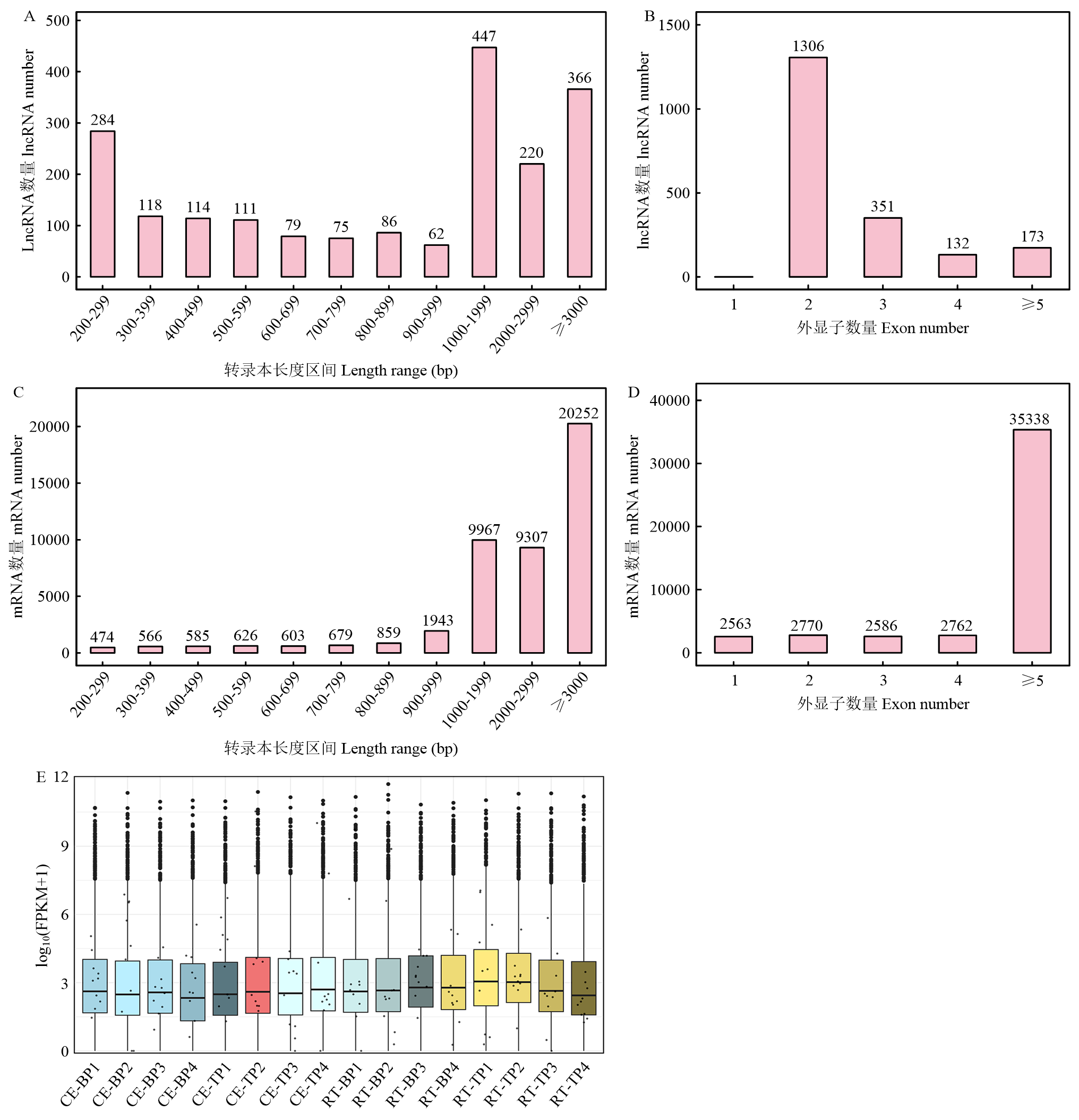
图2
lncRNA的特征分析 A:lncRNA长度分布;B:lncRNA外显子数目及其分布情况;C:mRNA 长度分布;D:mRNA外显子数目及其分布情况;E:冷处理与室温处理下藏猪和巴马猪lncRNA 表达丰度分布"

图3
冷处理和室温处理下两个猪种lncRNA和基因表达量的变化 A:藏猪和巴马猪脂肪组织相关lncRNA的表达量及其显著性分布;B:藏猪和巴马猪脂肪组织相关基因的表达量及其显著性分布"

图4
4个分组的差异表达基因的GO富集分析"

图5
4个分组的差异表达基因的KEGG富集分析"
表3
lncRNA在10 kb和100 kb范围内顺式调控预测"
| 长链非编码RNA lncRNAs | 编码基因 Coding genes | 差异表达的长链非编码RNA DElncRNAs | 差异表达 基因 DEGs | 长链非编码RNA- 编码基因对 lncRNA-coding gene pairs | 差异表达的长链非编码RNA- 差异表达基因对 DElncRNA-DEGs pairs | |
|---|---|---|---|---|---|---|
| 100 kb | 1 756 | 5 608 | 216 | 289 | 7 610 | 120 |
| 10 kb | 822 | 1014 | 108 | 83 | 1 142 | 43 |

图6
不同顺式调控距离下差异基因的 GO 和 KEGG 富集分析 A:100 kb 范围内靶基因的 GO 功能富集;B:100 kb 范围内靶基因的 KEGG 通路富集;C:10 kb 范围内靶基因的 GO 功能富集;D:10 kb 范围内靶基因的 KEGG 通路富集"
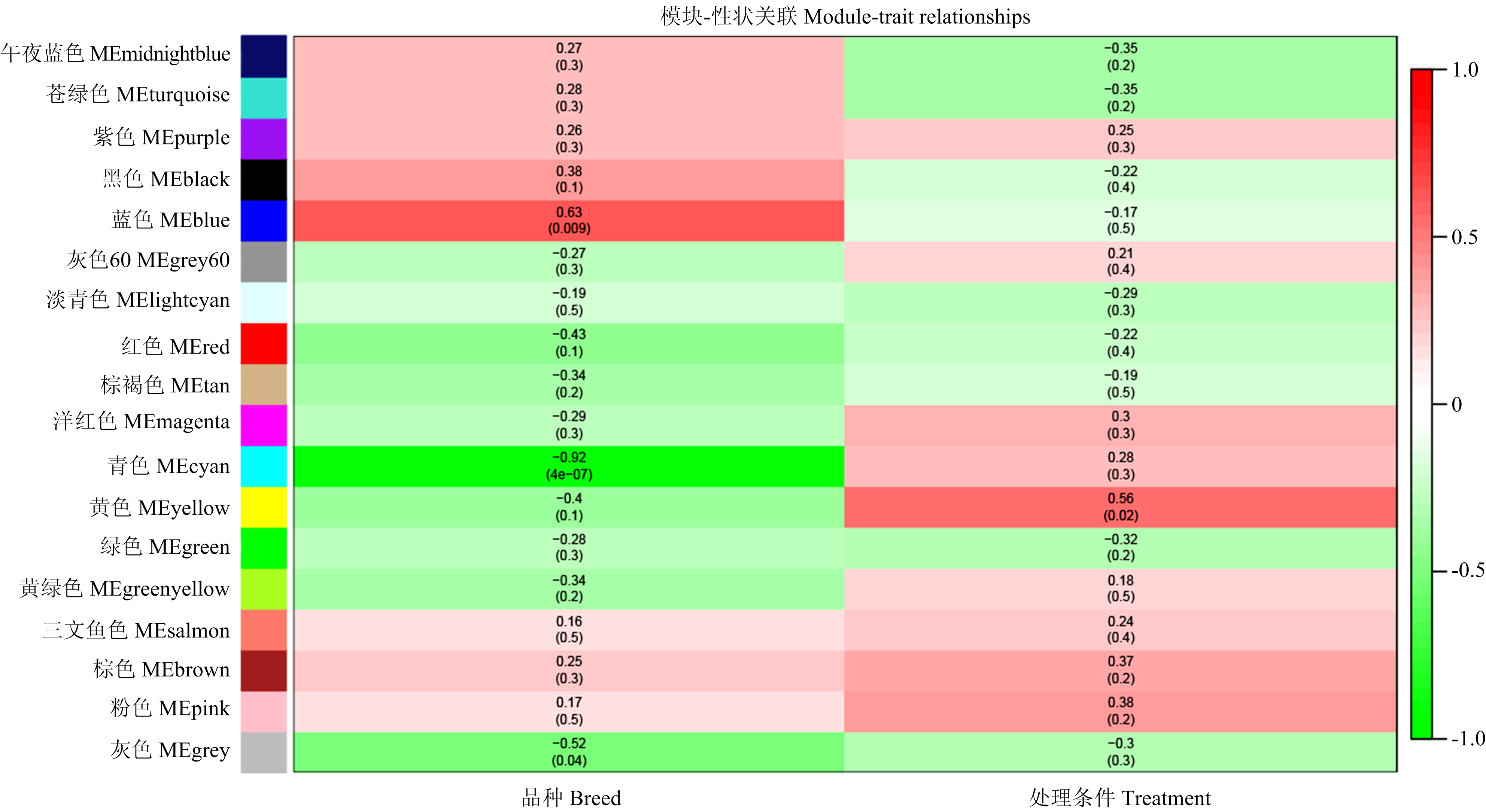
图7
WGCNA 共表达模块与猪种及处理条件的关联热图"

图8
冷应激相关模块内的核心lncRNA与基因共表达网络"
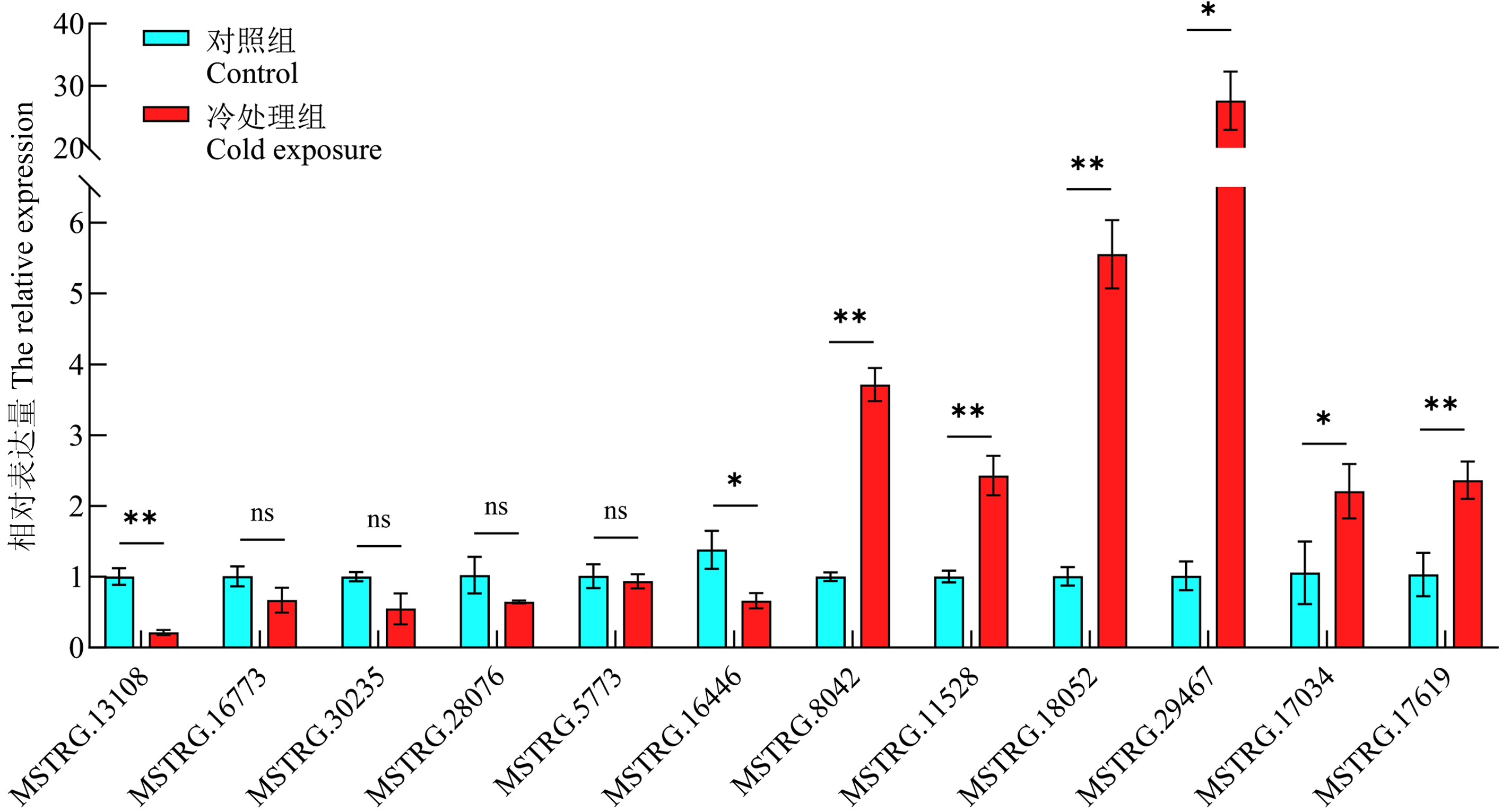
图9
LncRNA荧光定量结果"
表4
脂肪组织中差异表达的lncRNA"
| lncRNA | P value | log2 FC | Regulated | 长度Length (bp) |
|---|---|---|---|---|
| MSTRG.8042 | 1.95E-03 | 3.502042800 | up | 1433 |
| MSTRG.11528 | 5.32E-07 | 1.372503374 | up | 2364 |
| MSTRG.18052 | 4.02E-09 | 1.940246198 | up | 8424 |
| MSTRG.29467 | 1.80E-06 | 2.766504025 | up | 804 |
| MSTRG.17304 | 3.80E-05 | 2.104264713 | up | 613 |
| MSTRG.17619 | 9.56E-27 | 5.166865949 | up | 552 |
| MSTRG.13108 | 7.63E-04 | -1.882138759 | down | 571 |
| MSTRG.16773 | 2.29E-03 | -2.687542429 | down | 767 |
| MSTRG.30235 | 2.04E-03 | -6.41432807 | down | 299 |
| MSTRG.28076 | 3.97E-06 | -1.759364017 | down | 1335 |
| MSTRG.5773 | 1.27E-03 | -1.331161095 | down | 447 |
| MSTRG.16446 | 2.56E-03 | -1.046772722 | down | 767 |
| [1] |
doi: 10.1111/j.1420-9101.2005.00962.x pmid: 16033544 |
| [2] |
doi: 10.1637/10763-010814-Reg.1 |
| [3] |
doi: 10.1038/s41598-019-47506-9 |
| [4] |
doi: 10.1038/s41580-020-00315-9 pmid: 33353982 |
| [5] |
|
| [6] |
|
| [7] |
张冬杰, 马守正, 汪亮, 李忠秋, 刘娣. 民猪骨骼肌对低温环境的应答反应[J]. 中国畜牧杂志, 2024, 60(4): 161-167.
|
|
|
|
| [8] |
doi: 10.1080/21655979.2022.2051841 pmid: 35293286 |
| [9] |
王晋鹏, 罗仍卓么, 李彦霞, 冯芬, 王正兴, 潘传英, 蓝贤勇, 王兴平. lncRNA RRAS2-AS1在LPS诱导奶牛乳腺上皮细胞炎症中的功能[J]. 中国农业科学, 2024, 57(14): 2874-2888. DOI: 10.3864/j.issn.0578-1752.2024.14.014.
|
|
|
|
| [10] |
孟朝轶, 王运路, 姚一龙, 席广银, 牛家强, 索朗斯珠, 郭敏, 徐业芬. lncRNA-MSTRG.7889.1竞争性结合bta-miR-146a靶向Smad4调控牦牛颗粒细胞的凋亡[J]. 中国农业科学, 2024, 57(4): 797-809. DOI: 10.3864/j.issn.0578-1752.2024.04.013.
|
|
|
|
| [11] |
doi: 10.1186/s40101-025-00391-w pmid: 40259336 |
| [12] |
doi: 10.3390/ijms26189045 |
| [13] |
pmid: 17978562 |
| [14] |
doi: 10.3389/fendo.2022.827523 |
| [15] |
陈浩, 敖日格乐, 王纯洁, 斯木吉德, 阿日查, 张剑, 郭雪梅, 刘波, 超克. 慢性冷热应激对蒙古牛血清内分泌激素及抗氧化指标的影响[J]. 黑龙江畜牧兽医, 2018(23): 87-89.
|
|
|
|
| [16] |
pmid: 15971419 |
| [17] |
doi: 10.1016/j.jep.2019.112271 |
| [18] |
|
| [19] |
|
| [20] |
doi: 10.1186/s12864-022-08622-5 pmid: 35590244 |
| [21] |
doi: 10.1038/s41598-020-57451-7 pmid: 31949263 |
| [22] |
|
| [23] |
doi: 10.1016/j.gene.2024.148921 |
| [24] |
doi: 10.1080/10495398.2023.2176319 |
| [25] |
doi: 10.1093/jmcb/mjx018 pmid: 28486585 |
| [26] |
doi: 10.1016/j.plaphy.2024.108908 |
| [27] |
doi: 10.1038/s41597-026-07024-6 |
| [28] |
doi: 10.3390/v12090951 |
| [29] |
doi: 10.3389/fgene.2021.784811 |
| [30] |
doi: 10.1038/s41580-023-00694-9 pmid: 38242953 |
| [31] |
doi: 10.18699/vjgb-25-36 |
| [32] |
doi: 10.1038/s41580-022-00566-8 pmid: 36596869 |
| [33] |
王晓阳, 彭振, 邢爱双, 赵盈睿, 马欣丽, 刘方, 杜雄明, 何守朴. 亚洲棉短纤维发育相关长链非编码RNA的鉴定及表达[J]. 中国农业科学, 2023, 56(23): 4565-4584. DOI: 10.3864/j.issn.0578-1752.2023.23.002.
|
|
|
|
| [34] |
doi: 10.1111/mec.13548 pmid: 26821170 |
| [35] |
|
| [36] |
doi: 10.3390/ijms24087431 |
| [37] |
doi: 10.1038/ng.2811 pmid: 24162736 |
| [38] |
doi: 10.1016/j.bbrc.2022.02.069 pmid: 35231655 |
| [39] |
doi: 10.1194/jlr.M038992 pmid: 23606724 |
| [40] |
doi: 10.1111/jcmm.2018.22.issue-10 |
| [1] | 王继英, 李菁璇, 王彦平, 郭建凤, 蔺海朝, 赵雪艳. 通过加权基因共表达网络分析揭示影响猪脂肪沉积的候选基因[J]. 中国农业科学, 2025, 58(9): 1845-1855. |
| [2] | 姜超, 张久盘, 宋雅萍, 焦若普, 杨东梅, 龚红芳, 马艺伦, 马云, 魏大为. FoxO1通过TGF-β/SMAD-TGFBI途径抑制牛成肌细胞和前体脂肪细胞的增殖与分化[J]. 中国农业科学, 2025, 58(24): 5274-5284. |
| [3] | 张化鹏, 张庆泽, 何凡, 祁梦凡, 符彬彬, 李清春, 李梦寻, 马力鹏, 刘乙, 黄涛. 梅山猪和杜洛克猪卵泡中差异表达lncRNA克隆鉴定及与miRNAs相关性分析[J]. 中国农业科学, 2024, 57(9): 1807-1819. |
| [4] | 孟朝轶, 王运路, 姚一龙, 席广银, 牛家强, 索朗斯珠, 郭敏, 徐业芬. lncRNA-MSTRG.7889.1竞争性结合bta-miR-146a靶向Smad4调控牦牛颗粒细胞的凋亡[J]. 中国农业科学, 2024, 57(4): 797-809. |
| [5] | 杨东梅, 张久盘, 宋雅萍, 宋小雨, 姜超, 马云, 魏大为. 共培养体系下牛骨骼肌细胞对脂肪细胞的调控作用研究[J]. 中国农业科学, 2024, 57(18): 3704-3718. |
| [6] | 陈晓涓, 王海菊, 王富敏, 雍清青, 黄顺满, 屈燕. 基于WGCNA鉴定全缘叶绿绒蒿类黄酮合成途径关键基因[J]. 中国农业科学, 2024, 57(15): 3053-3070. |
| [7] | 王晋鹏, 罗仍卓么, 李彦霞, 冯芬, 王正兴, 潘传英, 蓝贤勇, 王兴平. lncRNA RRAS2-AS1在LPS诱导奶牛乳腺上皮细胞炎症中的功能[J]. 中国农业科学, 2024, 57(14): 2874-2888. |
| [8] | 潘阳阳, 王靖雷, 王萌, 王立斌, 张倩, 陈睿, 张甜甜, 崔燕, 徐庚全, 樊江峰, 余四九. 牦牛早期胚胎核旁斑点形成及对后续发育的影响[J]. 中国农业科学, 2023, 56(6): 1189-1203. |
| [9] | 陈敏氡, 王彬, 刘建汀, 李永平, 白昌辉, 叶新如, 裘波音, 温庆放, 朱海生. 基于转录组和WGCNA筛选丝瓜果长和果径发育调控相关基因[J]. 中国农业科学, 2023, 56(22): 4506-4522. |
| [10] | 李琪, 杨昌恒, 王永, 林亚秋, 向华, 朱江江. FATP1对山羊肌内脂肪细胞的促进作用[J]. 中国农业科学, 2023, 56(10): 2007-2020. |
| [11] | 冉宏标,赵丽玲,王会,柴志欣,王吉坤,王嘉博,武志娟,钟金城. LncFAM200B对牦牛肌内前体脂肪细胞脂质沉积的影响[J]. 中国农业科学, 2022, 55(13): 2654-2666. |
| [12] | 杜宇,王永,孟庆勇,朱江江,林亚秋. 干扰山羊KLF12促进皮下脂肪细胞分化[J]. 中国农业科学, 2022, 55(1): 184-196. |
| [13] | 郭永春, 王鹏杰, 金珊, 侯炳豪, 王淑燕, 赵峰, 叶乃兴. 基于WGCNA鉴定茶树响应草甘膦相关的基因共表达模块[J]. 中国农业科学, 2022, 55(1): 152-166. |
| [14] | 禹保军,邓占钊,辛国省,蔡正云,顾亚玲,张娟. 静原鸡肌肉组织肌苷酸特异性沉积相关LNC_003828- gga-miR-107-3p-MINPP1的关联分析[J]. 中国农业科学, 2021, 54(19): 4229-4242. |
| [15] | 王继卿,郝志云,沈继源,柯娜,黄兆春,梁维炜,罗玉柱,胡江,刘秀,李少斌. 小尾寒羊泌乳性状重要lncRNAs的筛选、鉴定及功能分析[J]. 中国农业科学, 2021, 54(14): 3113-3123. |
|
||
