






中国农业科学 ›› 2026, Vol. 59 ›› Issue (13): 2946-2961.doi: 10.3864/j.issn.0578-1752.2026.13.015
曾清苹1( ), 刘涵1, 聂堂杰1, 蒋宣斌1, 李红艳1, 唐佳佳1, 申玲1, 陈丽洁1, 罗小刚2, 谢成伟2, 童龙1()
收稿日期:2025-12-29
接受日期:2026-03-24
出版日期:2026-07-01
发布日期:2026-07-01
通信作者:
联系方式:
曾清苹,E-mail:Zqping0802@163.com。
基金资助:
ZENG QingPing1(), LIU Han1, NIE TangJie1, JIANG XuanBin1, LI HongYan1, TANG JiaJia1, SHEN Ling1, CHEN LiJie1, LUO XiaoGang2, XIE ChengWei2, TONG Long1()
Received:2025-12-29
Accepted:2026-03-24
Published:2026-07-01
Online:2026-07-01
摘要:
【目的】揭示金佛山方竹鲜笋品质沿海拔梯度的变化规律及其主要土壤养分驱动因子,为高品质金佛山方竹笋的精准培育与资源高效利用提供理论依据。【方法】基于金佛山方竹在自然保护区内的分布格局与出笋规律,分别在1 850、1 950、2 050和2 150 m海拔设置5个标准样地,系统测定不同海拔鲜笋营养成分、氨基酸组成、呈味物质及质构,并同步分析林下土壤养分状况。运用冗余分析(RDA)、线性回归及结构方程模型(SEM),综合解析鲜笋品质的海拔差异及其主要土壤因子。【结果】在基础营养成分和矿质元素中,蛋白质、粗脂肪、可溶性糖、维生素C、氨基酸态氮、还原糖、三萜类化合物、灰分、膳食纤维以及钠、镁、钙、铁、锌和硒等在不同海拔间无显著差异(P>0.05),而钾含量随海拔升高显著增加(P<0.05),2 150 m鲜笋钾含量为1 850 m的1.50倍。总氨基酸及13种氨基酸含量在不同海拔间无显著差异(P>0.05),但丝氨酸、丙氨酸和酪氨酸对海拔敏感。其中,2 150、2 050和1 950 m鲜笋丝氨酸显著高于1 850 m,1 950 m鲜笋丙氨酸显著高于1 850 m,2 050 m鲜笋酪氨酸显著高于1 850 m(P<0.05)。在鲜笋呈味物质及质构指标中,纤维素、木质素、草酸、总黄酮、鲜味、苦味及无味氨基酸在不同海拔间无显著差异(P>0.05),但单宁和甜味氨基酸受海拔影响显著(P<0.05),单宁含量随海拔升高呈下降趋势,以海拔2 150 m最低,甜味氨基酸含量以1 950 m最高。鲜笋硬度随海拔升高呈下降趋势,而脆度逐渐增加,但2个指标在不同海拔间无显著差异(P>0.05),其中1 850 m鲜笋硬度最高,2 150 m脆度最高。回归分析结果显示,钾和丝氨酸含量随海拔升高呈正线性关系,而单宁则呈负线性关系(R 2=0.50)。RDA结果表明,土壤pH、有机碳(soil organic carbon,SOC)和全氮(total nitrogen,TN)是驱动鲜笋品质分异的主要土壤养分因子。SEM结果进一步显示,海拔通过促进TN和SOC积累,引起土壤pH下降,从而间接调控鲜笋营养和风味品质。【结论】高海拔有利于钾和甜味氨基酸积累,同时降低单宁,改善风味。TN、SOC及pH是鲜笋品质分异的主要驱动因子,海拔通过调控土壤养分含量间接影响鲜笋品质。
曾清苹, 刘涵, 聂堂杰, 蒋宣斌, 李红艳, 唐佳佳, 申玲, 陈丽洁, 罗小刚, 谢成伟, 童龙. 金佛山方竹鲜笋品质海拔分异及驱动因素分析[J]. 中国农业科学, 2026, 59(13): 2946-2961.
ZENG QingPing, LIU Han, NIE TangJie, JIANG XuanBin, LI HongYan, TANG JiaJia, SHEN Ling, CHEN LiJie, LUO XiaoGang, XIE ChengWei, TONG Long. Elevation-Related Variation and Key Environmental Drivers of Fresh Bamboo Shoot Quality in Chimonobambusa utilis from Jinfo Mountain in China[J]. Scientia Agricultura Sinica, 2026, 59(13): 2946-2961.
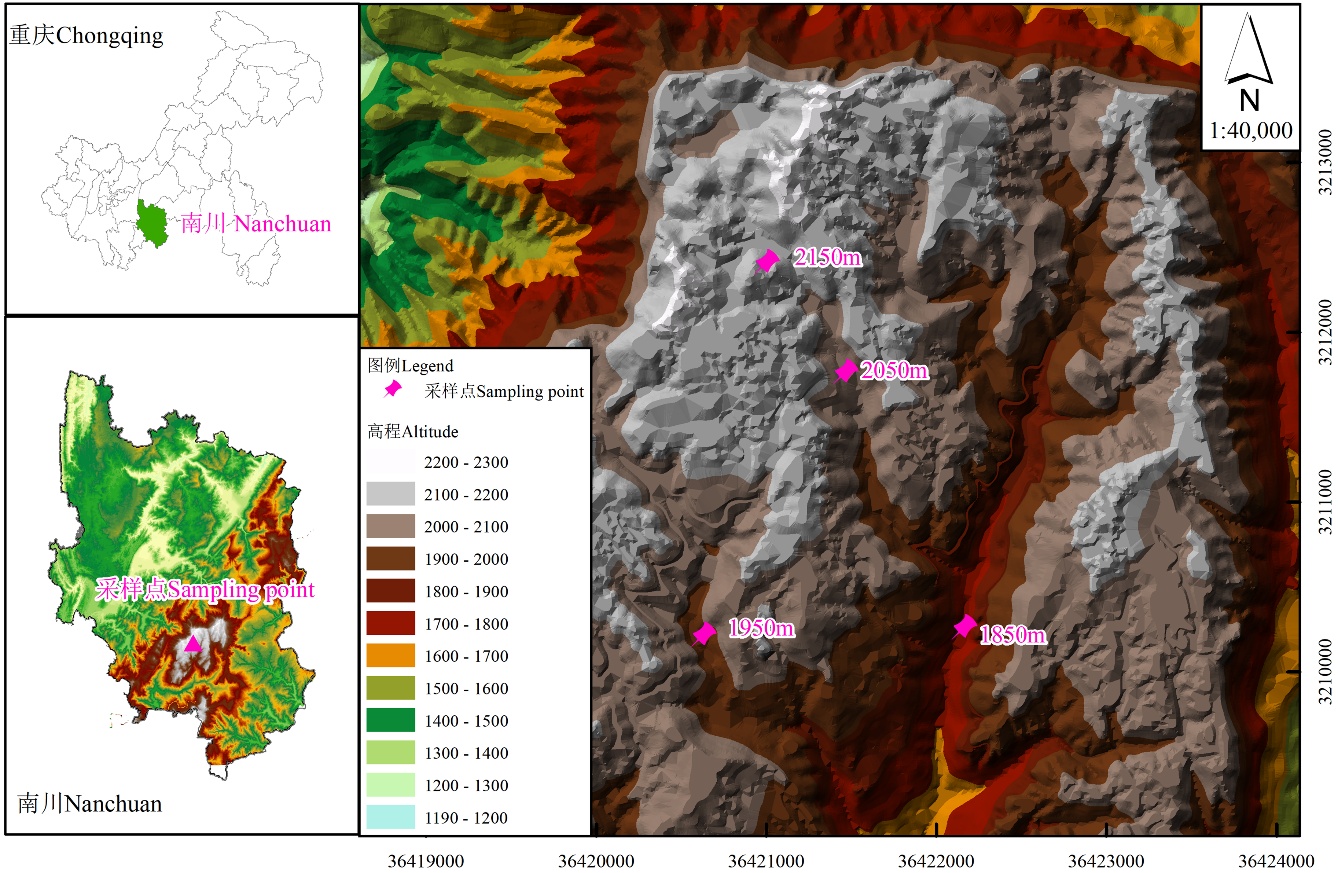
图1
金佛山方竹鲜笋采样点位置图"

表1
不同海拔试验样地基本情况"
| 项目 Item | 海拔 Altitude (m) | |||
|---|---|---|---|---|
| 1850 | 1950 | 2050 | 2150 | |
| 经度Longitude | 107º12′33″ | 107º11′07″ | 107º11′38″ | 107º11′21″ |
| 纬度Latitude | 29º00′49″ | 29º00′22″ | 29º01′12″ | 29º01′33″ |
| 坡度Slope (°) | 8 | 2 | 6 | 3 |
| 坡向Slope direction | 东南Southeast | 东北Northeast | 东East | 东北Northeast |
| 平均胸径 Mean diameter at breast height (cm) | 3.03 | 3.13 | 3.26 | 3.18 |
| 金佛山方竹占比Proportion of Chimonobambusa utilis (%) | 50 | 52 | 49.67 | 49.5 |
| 平均树高 Mean tree height (m) | 5.2 | 5.15 | 5.5 | 5.6 |
| 密度 Density (plant/hm2) | 29515 | 27414 | 27614 | 26113 |
| 主要阔叶树 Main broadleaf species | 毛花槭Acer erianthum、青麸杨Rhus potaninii、扁刺锥Castanopsis platyacantha、白辛树Pterostyrax psilophyllus、房县槭Acer sterculiaceum subsp. Franchetii、灯台树Cornus controversa、毛花槭Acer erianthum、盐麸木Rhus chinensis、水青冈Fagus longipetiolata、栓皮栎Quercus variabilis | 华西花楸Sorbus wilsoniana、微毛樱桃Prunus clarofolia、石灰花楸Sorbus folgneri、稠李Prunus padus、包果柯Lithocarpus cleistocarpus、金山杜鹃Rhododendron longipes var. chienianum、梾木Cornus macrophylla、扁刺锥Castanopsis platyacantha、中华木荷Schima sinensis | 梾木Cornus macrophylla、匙叶栎Quercus dolicholepis、阔柄杜鹃Rhododendron platypodum、湖北海棠Malus hupehensis、石灰花楸Sorbus folgneri、微毛樱桃Prunus clarofolia、四川花楸Sorbus setschwanensis、巴东荚蒾Viburnum henry | 金山杜鹃Rhododendron longipes var. chienianum、西南红山茶Camellia pitardii、巴东栎Quercus engleriana、包果柯Lithocarpus cleistocarpus、华西花楸Sorbus wilsoniana、五尖槭Acer maximowiczii、野八角Illicium simonsii |
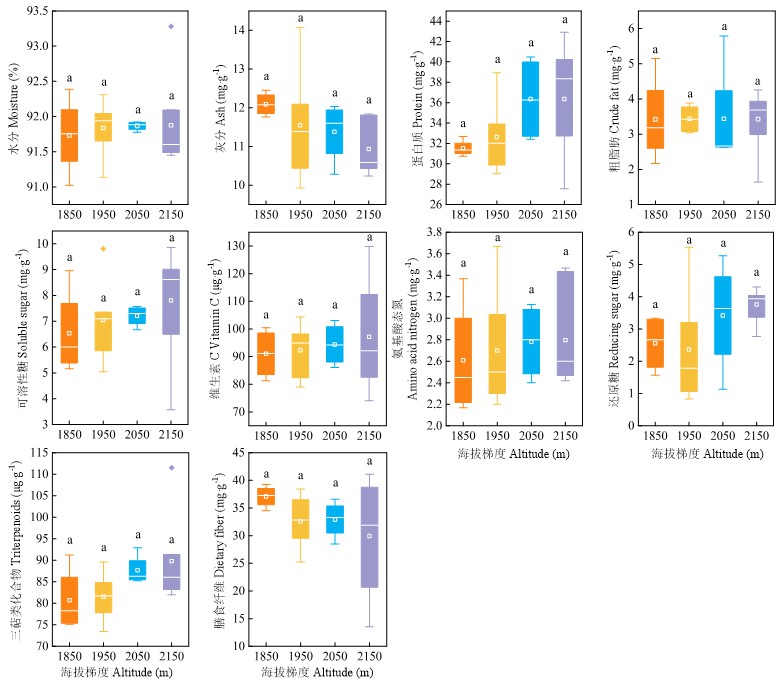
图2
不同海拔梯度下金佛山方竹鲜笋基础营养成分分异规律 不同小写字母表示不同海拔之间差异显著(P<0.05)。下同"

图3
不同海拔梯度下金佛山方竹鲜笋矿质元素分异规律"
表2
不同海拔梯度下金佛山方竹鲜笋氨基酸含量"
| 项目 Item | 海拔 Altitude (m) | |||
|---|---|---|---|---|
| 2150 | 2050 | 1950 | 1850 | |
| 天冬氨酸Aspartic acid (mg·g-1) | 4.87±0.63a | 4.62±0.83a | 4.53±1.07a | 3.98±0.78a |
| 谷氨酸Glutamic acid (mg·g-1) | 3.25±0.40a | 3.25±0.43a | 3.12±0.40a | 3.01±0.47a |
| 丝氨酸Serine (mg·g-1) | 1.48±0.10a | 1.46±0.06a | 1.50±0.04a | 1.34±0.11b |
| 甘氨酸Glycine (mg·g-1) | 0.78±0.08a | 0.74±0.08a | 0.74±0.05a | 0.71±0.08a |
| 苏氨酸*Threonine (mg·g-1) | 0.94±0.09a | 0.93±0.13a | 0.93±0.10a | 0.92±0.02a |
| 丙氨酸Alanine (mg·g-1) | 1.24±0.14ab | 1.18±0.22ab | 1.34±0.14a | 1.08±0.22b |
| 异亮氨酸*Isoleucine (mg·g-1) | 0.58±0.06a | 0.53±0.04a | 0.58±0.06a | 0.52±0.07a |
| 亮氨酸*Leucine (mg·g-1) | 1.19±0.11a | 1.10±0.10a | 1.21±0.04a | 1.09±0.13a |
| 缬氨酸*Valine (mg·g-1) | 1.15±0.24a | 1.12±0.08a | 1.15±0.25a | 1.06±0.29a |
| 甲硫氨酸*Methionine (mg·g-1) | 0.28±0.08a | 0.21±0.09a | 0.23±0.04a | 0.21±0.09a |
| 苯丙氨酸*Phenylalanine (mg·g-1) | 0.81±0.09a | 0.80±0.05a | 0.79±0.07a | 0.76±0.11a |
| 组氨酸Histidine (mg·g-1) | 0.60±0.08a | 0.57±0.05a | 0.60±0.13a | 0.60±0.07a |
| 精氨酸Arginine (mg·g-1) | 0.97±0.15a | 0.99±0.28a | 0.89±0.05a | 0.89±0.10a |
| 半胱氨酸Cysteine (mg·g-1) | 0.44±0.40a | 0.31±0.03a | 0.31±0.08a | 0.27±0.10a |
| 酪氨酸Tyrosine (mg·g-1) | 0.52±0.09a | 0.44±0.07ab | 0.46±0.07ab | 0.39±0.03b |
| 赖氨酸*Lysine (mg·g-1) | 0.12±0.02a | 0.11±0.01a | 0.12±0.01a | 0.12±0.01a |
| 总氨基酸Total amino acid (mg·g-1) | 19.21±1.91a | 18.36±1.13a | 18.50±0.94a | 16.93±1.65a |
| 必须氨基酸Essential amino acid (mg·g-1) | 5.07±0.41a | 4.80±0.17a | 5.01±0.43a | 4.67±0.95a |
| 必需氨基酸占总氨基酸百分比Proportion of essential amino acid (%) | 26.37±1.69a | 26.17±2.77a | 27.08±1.15a | 27.57±3.37a |
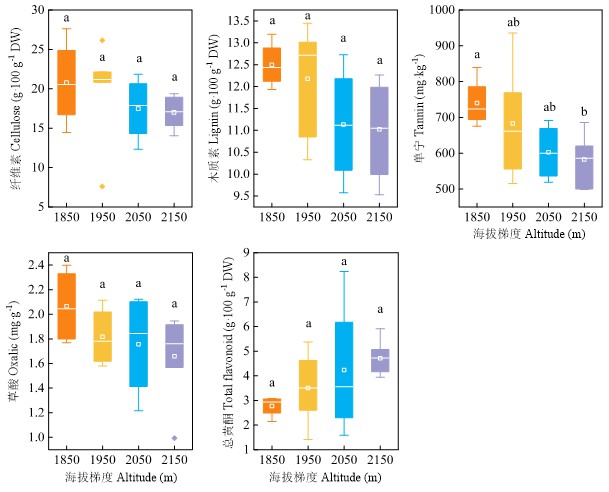
图4
不同海拔梯度下金佛山方竹鲜笋呈味物质分异规律"
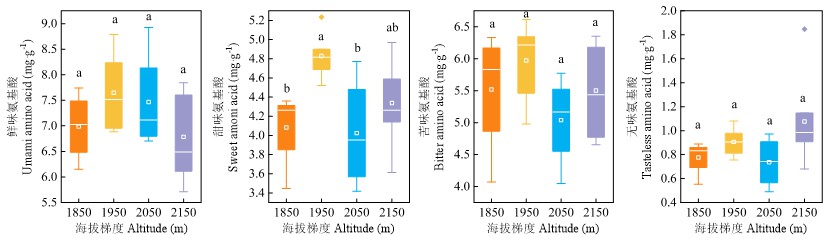
图5
不同海拔梯度下金佛山方竹鲜笋呈味氨基酸分异规律"
表3
不同海拔梯度下金佛山方竹鲜笋质构分异规律"
| 项目Item | 2150 m | 2050 m | 1950 m | 1850 m |
|---|---|---|---|---|
| 硬度Hardness (g) | 3 066.54±219.58a | 3 219.66±57.59a | 3 381.81±476.85a | 3 335.17±584.05a |
| 脆度Crispness (g) | 3 460.72±287.23a | 3 441.23±389.82a | 2 915.06±591.25a | 2 915.80±520.97a |
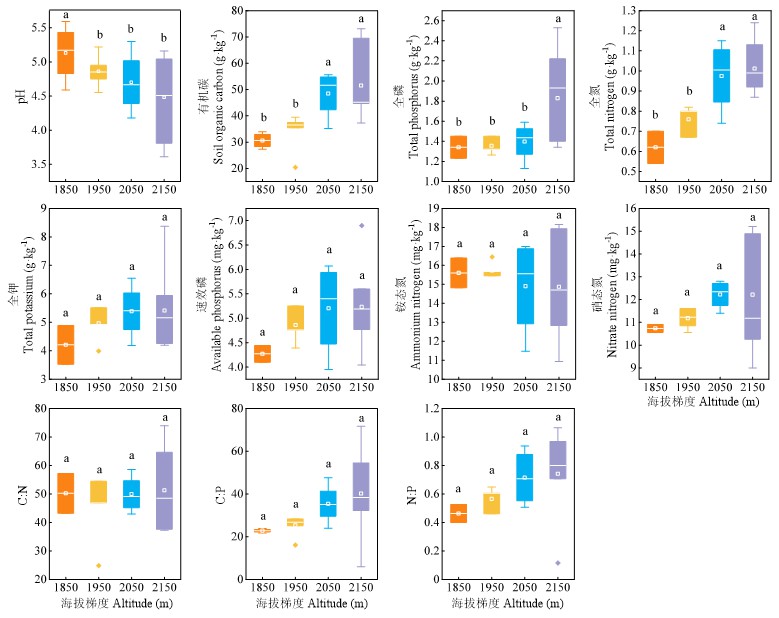
图6
不同海拔梯度下金佛山方竹林土壤养分分异规律"
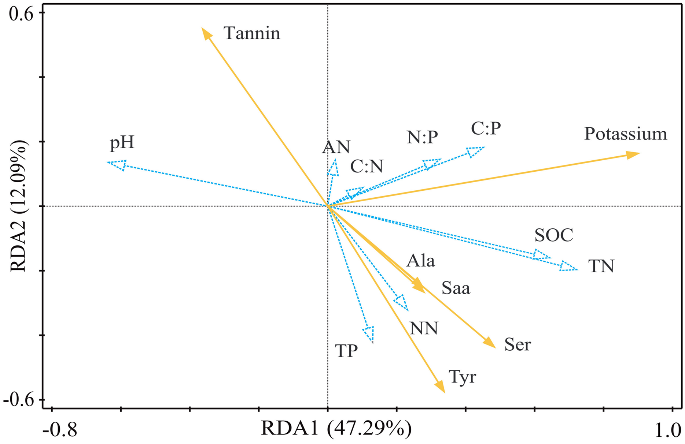
图7
金佛山方竹鲜笋品质与土壤因子的冗余分析 SOC:土壤有机碳;TP:全磷;TN:全氮;TK:全钾;AP:有效磷;AN:铵态氮;NN:硝态氮;C:N:碳氮比;C:P:碳磷比;N:P:氮磷比;Potassium:鲜笋钾含量;Ser:丝氨酸;Ala:丙氨酸;Tyr:酪氨酸;Saa:甜味氨基酸;Tannin:单宁。下同"
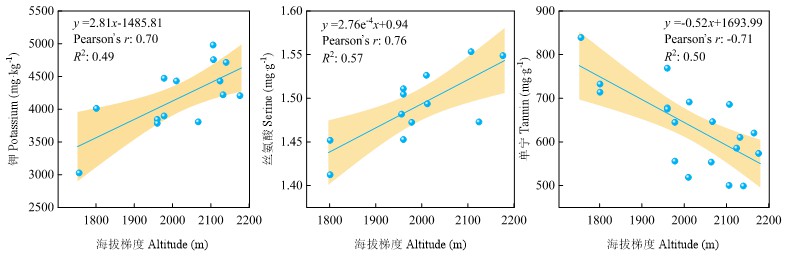
图8
金佛山方竹鲜笋品质对海拔梯度响应的线性模型"
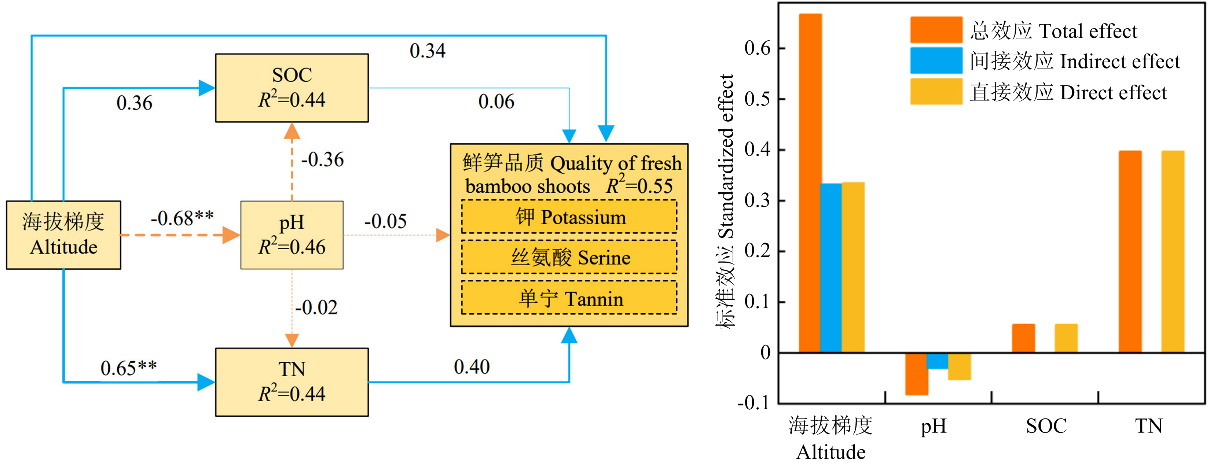
图9
金佛山方竹鲜笋品质与环境因子的最优结构方程模型 *:P<0.0。实线和虚线箭头分别表示因果关系的正向和负向影响,箭头上的数字表示标准化路径系数,R2表示模型解释的因变量的方差"
表4
模型自举法重采样检验结果"
| 指标 Index | 模型指标值 Model index value | 置信区间 Confidence interval | |
|---|---|---|---|
| 95% | 99% | ||
| SRMR | 0.087 | 0.126 | 0.158 |
| d_ULS | 0.247 | 0.446 | 0.698 |
| d_G | 0.158 | 0.430 | 0.850 |
| [1] |
|
| [2] |
徐森, 董亚文, 陈双林, 郭子武, 杨丽婷, 谢燕燕. 覆盖雷竹笋箨叶碳氮代谢特征及其与竹笋食味品质的关系[J]. 林业科学, 2022, 58(8): 109-116.
|
|
|
|
| [3] |
何大敏, 缪荣浩, 路纪芳, 付冬梅, 方维业, 孙亚茹, 展茂魁. 贵州八种竹笋营养成分含量分析及综合评价[J]. 食品与发酵工业, 2026, 52(6): 354-362.
|
|
|
|
| [4] |
|
| [5] |
陈中爱, 耿阳阳, 黄珊, 吕都, 唐健波, 王梅, 王德斌. 不同品种竹笋营养品质分析与综合评价[J]. 食品工业科技, 2023, 44(3): 262-268.
|
|
|
|
| [6] |
|
| [7] |
|
| [8] |
|
| [9] |
刘欣, 姜鹏飞, 傅宝尚, 杨晶琦, 祁立波, 尚珊. 竹笋膳食纤维的提取、生理功能特性及其在食品中的应用[J]. 食品与发酵工业, 2023, 49(3): 354-362.
|
|
|
|
| [10] |
张景润, 左珂怡, 凡莉莉, 郭子武, 林华, 胡瑞财, 陈双林. 苦竹笋营养和食味品质的区域分异及其环境驱动作用[J]. 生态学杂志, 2025, 44(3): 728-735.
|
|
|
|
| [11] |
李建伟, 覃万玲, 辉朝茂, 陈倩, 王雨濛, 朱书红, 赵秀婷, 刘蔚漪. 甜龙竹笋品质的地理变异及其与立地环境的关系[J]. 林业科学, 2024, 60(11): 75-83.
|
|
|
|
| [12] |
贾冬冬, 梁绍煜, 熊建文, 潘慧玲, 朱秀芬, 崔娜, 徐振国. 柳州市不同产区麻竹笋品质分析[J]. 广西林业科学, 2024, 53(1): 87-93.
|
|
|
|
| [13] |
李苑, 张令, 黎祖尧, 张艳华, 张雷, 孙娅东. 不同产地厚竹笋的营养成分及其对土壤养分的响应特征[J]. 经济林研究, 2017, 35(4): 147-154.
|
|
|
|
| [14] |
|
| [15] |
|
| [16] |
|
| [17] |
郭子武, 杨丽婷, 林华, 陈双林, 杨清平. 沙县苦竹笋外观、营养和食味品质变异的海拔效应[J]. 生态学杂志, 2019, 38(1): 83-88.
|
|
|
|
| [18] |
时俊帅, 陈双林, 郭子武, 高平珍. 3个海拔梯度对高节竹笋品质的影响[J]. 林业科学研究, 2018, 31(4): 113-117.
|
|
|
|
| [19] |
张雨峰, 代丽, 谢寅峰, 马迎莉, 汤文华, 袁婷婷. 不同海拔金佛山方竹出笋及幼竹生长特性[J]. 南京林业大学学报(自然科学版), 2019, 43(5): 199-203.
|
|
|
|
| [20] |
秦敏, 王晓芹, 卞丽丽, 伍虹雨, 姚文静, 林树燕. 金佛山方竹不同出土高度和部位竹笋营养品质分析[J]. 南京林业大学学报(自然科学版), 2024, 48(6): 79-90.
|
|
|
|
| [21] |
|
| [22] |
任春春, 贾玉龙, 娄义龙, 乔世玉, 许文静, 秦礼康. 贵州金佛山方竹笋营养及功能成分剖析[J]. 食品与发酵工业, 2021, 47(10): 214-221.
|
|
|
|
| [23] |
张仁固, 李明, 汪晓晴, 刘立才. 南川方竹笋特殊品质形成原因初探[J]. 世界竹藤通讯, 2010, 8(1): 30-33.
|
|
|
|
| [24] |
|
| [25] |
|
| [26] |
|
| [27] |
|
| [28] |
李杉杉. 凯氏定氮法测定蛋白质的方法分析[J]. 现代食品, 2018, 11(21): 140-142.
|
|
|
|
| [29] |
程月红, 鲍连艳, 王健, 冯炜, 李静, 于艳艳. 食品中脂肪测定方法对比研究[J]. 现代农业科技, 2018(16): 234, 240.
|
|
|
|
| [30] |
张述伟, 宗营杰, 方春燕, 黄赛华, 李静, 许建华, 王亦菲, 刘成洪. 蒽酮比色法快速测定大麦叶片中可溶性糖含量的优化[J]. 食品研究与开发, 2020, 41(7): 196-200.
|
|
|
|
| [31] |
张彩珍. 2, 6-二氯靛酚滴定法测定鲜榨桃汁中维生素C含量[J]. 食品安全导刊, 2021(24): 53, 55.
|
|
|
|
| [32] |
张海神, 钟圆圆, 林秋凤. 酸度计法测定蚝油中的氨基酸态氮的不确定度评价[J]. 广州化工, 2024, 52(10): 78-80.
|
|
|
|
| [33] |
余丽梅, 向平, 叶丽娟, 刘晶. 四种水果中还原糖含量的测定与分析[J]. 广东化工, 2021, 48(16): 243-244, 248.
|
|
|
|
| [34] |
徐晓萍, 戴尽璇, 朱莉. 紫外可见分光光度法测定灵芝孢子油中三萜类化合物含量[J]. 化工时刊, 2018, 32(10): 29-31, 42.
|
|
|
|
| [35] |
张文会, 顿珠次仁, 强小林. 酶法制备青稞麸膳食纤维的工艺优化[J]. 粮食加工, 2013, 38(5): 58-60.
|
|
Zhang W H, Dunzhurenci, Qiang X L. Optimization of enzymatic preparation of barley bran dietary fiber[J]. Grain Processing, 2013, 38(5): 58-60. (in Chinese)
|
|
| [36] |
刘仙金. 电感耦合等离子体质谱法(ICP-MS)测定坛紫菜中矿物质元素含量[J]. 福建农业科技, 2019, 50(9): 36-39.
|
|
|
|
| [37] |
莫润宏, 汤富彬, 丁明, 屈明华, 倪张林, 沈丹玉, 钟冬莲. 氨基酸分析仪法测定竹笋中游离氨基酸[J]. 化学通报, 2012, 75(12): 1126-1131.
|
|
|
|
| [38] |
徐欣然, 王明, 刘莉, 刘财汶, 胡又丹, 程晓彬, 赵钢, 严俊. 燕麦秸秆纤维素测定方法比较及响应面优化分析[J]. 饲料研究, 2020, 43(3): 68-73.
|
|
|
|
| [39] |
中华人民共和国农村农业部. NY/T3494-2019农业生物质原料纤维素、半纤维素、木质素测定[S]. 北京: 中国农业出版社, 2019.
|
|
Ministry of Agriculture and Rural Affairs of the People’s Republic of China. NY/T3494-2019 Agricultural biomass raw materials- Determination of cellulose, hemicellulose and lignin[S]. Beijing: China Agriculture Press, 2019. (in Chinese)
|
|
| [40] |
中华人民共和国农业部. NY/T1600-2008水果、蔬菜及其制品中单宁含量的测定[S]. 北京: 中国标准出版社, 2008.
|
|
Ministry of Agriculture of the People’s Republic of China. NY/T1600-2008 Determination of tannin content in fruits, vegetables and derived products[S]. Beijing: China Standards Press, 2008. (in Chinese)
|
|
| [41] |
中华人民共和国卫生部. GB/T12456-2008 食品中总酸的测定[S]. 北京: 中国标准出版社, 2008.
|
|
Ministry of Health of the People’s Republic of China. GB/T12456-2008 Determination of total acid in foods[S]. Beijing: China Standards Press, 2008. (in Chinese)
|
|
| [42] |
周亚琦, 董杰, 官凤英, 范少辉. 竹阔混交林研究进展与展望[J]. 林业资源管理, 2016(3): 145-150.
|
|
|
|
| [43] |
|
| [44] |
|
| [45] |
徐田, 廖永坚, 宁德鲁. 不同产地金佛山方竹竹笋营养成分分析[J]. 竹子学报, 2023, 42(1): 11-17.
|
|
|
|
| [46] |
杨金来, 高贵宾, 张甫生, 郑炯, 吴良如. 5种彩色笋壳的金佛山方竹笋品质分析与评价[J]. 食品科学, 2022, 43(6): 303-308.
|
|
|
|
| [47] |
余松夏, 龙昭航. 金佛山方竹笋的营养价值及储藏保鲜技术研究进展[J]. 食品安全导刊, 2021(26): 133-134, 136.
|
|
|
|
| [48] |
|
| [49] |
|
| [50] |
|
| [51] |
潘红丽, 李迈和, 蔡小虎, 吴杰, 杜忠, 刘兴良. 海拔梯度上的植物生长与生理生态特性[J]. 生态环境学报, 2009, 18(2): 722-730.
|
|
|
|
| [52] |
韩晓芳, 彭柯力, 吴海霞, 宋珊珊, 李亚辉, 朱晔荣, 白艳玲, 王勇. 丝氨酸对光呼吸基因节律的影响机制初探[J]. 植物生理学报, 2016, 52(9): 1397-1405.
|
|
|
|
| [53] |
|
| [54] |
|
| [55] |
何强, 姚开, 石碧. 植物单宁的营养学特性[J]. 林产化学与工业, 2001, 21(1): 80-85.
|
|
|
|
| [56] |
徐森, 杨丽婷, 陈双林, 郭子武, 谷瑞, 章超. 竹笋适口性形成及其主要影响因素研究综述[J]. 浙江农林大学学报, 2021, 38(2): 403-411.
|
|
|
|
| [57] |
叶佳敏, 张名位, 卢琦, 张瑞芬, 邓梅. 乳酸菌半固态发酵对沙田柚果粉苦味及活性成分的影响[J]. 中国农业科学, 2024, 57(13): 2662-2673. DOI: 10.3864/j.issn.0578-1752.2024.13.013.
|
|
|
|
| [58] |
王昕怡, 陈铭珏, 胡晨阳, 李博雅, 邓先俊. 竹笋食味品质评价指标及其提升技术研究进展[J]. 安徽农学通报, 2023, 29(4): 128-131.
|
|
|
|
| [59] |
高婧, 陈益存, 高暝, 赵耘霄, 汪阳东. 植物单宁合成调控及其对环境的响应机制[J]. 生物技术通报, 2025, 41(7): 49-59.
|
|
|
|
| [60] |
耿想, 姚曦, 尤俊昊, 荀航, 汤锋. 不同干燥方式对竹笋品质的影响[J]. 食品与发酵工业, 2022, 48(16): 144-149.
|
|
|
|
| [61] |
|
| [62] |
郑蓉. 产地绿竹笋品质及土壤养分的主成分与典型相关分析[J]. 浙江农林大学学报, 2012, 29(5): 710-714.
|
|
|
|
| [63] |
罗蔚生, 唐秋月, 蔡会德, 卢峰, 蒙检, 柳雄辉, 莫奇京. 广西大瑶山森林土壤养分随海拔梯度的变化[J]. 水土保持通报, 2025, 45(5): 91-102, 244.
|
|
|
|
| [64] |
赵建诚, 杨振亚, 王波, 倪惠菁. 鸡粪有机肥配施生物炭提高雷竹林土壤肥力和竹笋产量品质[J]. 植物营养与肥料学报, 2025, 31(3): 458-469.
|
|
|
|
| [65] |
肖淑媛, 任开格, 王娟, 沈健林, 喻舞阳, 陈宗顺, 安显鹏, 刘学军. 施肥对我国竹笋生产与竹林土壤环境的影响[J]. 农业现代化研究, 2022, 43(6): 1101-1109.
|
|
|
| [1] | 李永娟, 张悦彤, 王艺博, 赵长江, 宋洁, 陈雪丽, 姚钦. 生物炭施用对大豆轮连作系统土壤固氮微生物nifH基因丰度及群落组成的影响[J]. 中国农业科学, 2026, 59(6): 1272-1285. |
| [2] | 岳丽昕, 王清华, 王振宝, 尼玛琼吉, 刘泽洲, 孔素萍, 张立峰, 高莉敏. 基于广靶代谢组学分析藏葱和细香葱营养品质及黄酮类代谢产物差异[J]. 中国农业科学, 2026, 59(5): 1070-1086. |
| [3] | 张利东, 郭一聪, 黄洪宇, 聂静, 王兵, 李梦雨, 李加旺, 眭晓蕾, 李愚鹤. 基于感官评价结合营养品质特征与风味物质特性关联分析黄瓜果实品质[J]. 中国农业科学, 2026, 59(5): 1087-1100. |
| [4] | 董金龙, 赵莹, 余海兵, 吕建晔, 秦佳琦, 梁晨, 明博, 李少昆. 多模型解析玉米籽粒容重的营养品质贡献度与区域异质性[J]. 中国农业科学, 2026, 59(5): 985-995. |
| [5] | 林娇, 牟廷森, 陈俊, 李想, 袁思雨, 刘乐, 张振华, 夏银行. 湖南省典型红壤区不同土地利用方式农田土壤碳氮磷化学计量比特征[J]. 中国农业科学, 2026, 59(11): 2434-2446. |
| [6] | 季圣阳, 陆柏益, 李培武. 关于现代农产品品质学的若干思考[J]. 中国农业科学, 2025, 58(9): 1830-1844. |
| [7] | 罗一诺, 李艳霏, 李文虎, 张思琦, 牟文燕, 黄宁, 孙蕊卿, 丁玉兰, 佘文婷, 宋文斌, 李小涵, 石美, 王朝辉. 我国新育成小麦品种(系)籽粒不同部位铁含量及影响因素[J]. 中国农业科学, 2025, 58(3): 416-430. |
| [8] | 张丰, 徐隽峰, 高志源, 党海燕, 郭戎博, 佘文婷, 李文虎, 刘金山, 王朝辉. 基于长期定位试验的氮磷表观平衡优化小麦氮磷肥用量[J]. 中国农业科学, 2025, 58(22): 4688-4702. |
| [9] | 张斯佳, 杨杰, 赵帅, 李莉威, 王贵彦. 华北平原多样化作物与小麦-玉米轮作对土壤质量的影响[J]. 中国农业科学, 2025, 58(2): 238-251. |
| [10] | 任家辉, 孙娟娟, 郝莹璐, 王凤梧, 王靖宇, 张明伟, 李宝涵, 郑成忠, 何竹青, 王照兰. 内蒙古中部地区饲用燕麦品种筛选及青贮品质评价[J]. 中国农业科学, 2025, 58(19): 4026-4038. |
| [11] | 吴勇, 文雪, 王天舒, 黄炎炎, 孟熠黎, 姜红宇, 毕利东, 吴会军, 尧水红. 黑土区坡耕地地形因子和垄作方式对土壤养分和肥力指数的影响[J]. 中国农业科学, 2025, 58(18): 3676-3689. |
| [12] | 唐佳灵, 张玉林, 杨勇, 方正锋, 韩国全, 惠腾. 日粮中添加酱油残渣压榨油脂对猪肉品质的影响[J]. 中国农业科学, 2025, 58(15): 3118-3133. |
| [13] | 郭磊, 张斌斌, 沈志军, 严娟, 许建兰, 蔡志翔, 俞明亮, 王发林, 宋宏峰. 桃园绿肥连续还田后中微量元素释放特征及对土壤有效养分的影响[J]. 中国农业科学, 2025, 58(12): 2411-2426. |
| [14] | 罗玉红, 黄予姝, 珠娜, 李乐, 程延彬, 刘嘉慧, 张敬敏, 包雨凡, 徐诺, 闫玉春. 锡林郭勒盟典型草原区草地开垦及退耕造林对土壤粒径分布和养分的影响[J]. 中国农业科学, 2024, 57(24): 4919-4932. |
| [15] | 王小军, 王金兰, 琚泽亮, 梁国玲, 贾志锋, 刘文辉, 马祥, 马金秀, 李文. 环青海湖地区不同饲用燕麦品种生产性能和营养品质综合评价[J]. 中国农业科学, 2024, 57(19): 3730-3742. |
|
||
